Episode Transcript
[00:00:00] Speaker A: The absence of intentionality is a recipe for resentment.
[00:00:05] Speaker B: Hey there billionaire. Yep, I'm talking to you. If you expect to live another 31 years, you're already a billionaire. Not in money, but in the real measure of wealth, time.
That's because 31 years is roughly a billion seconds. But most of us waste time in ways we'd never waste money. The currency of time billionaires is micro moments, the 90 second to 15 minute gaps hidden between the structured parts of your day. This podcast is about reclaiming them with quick research backed ideas to help you feel more creative, productive and alive. Welcome to Time Billionaires. Let's make your next micro moment count.
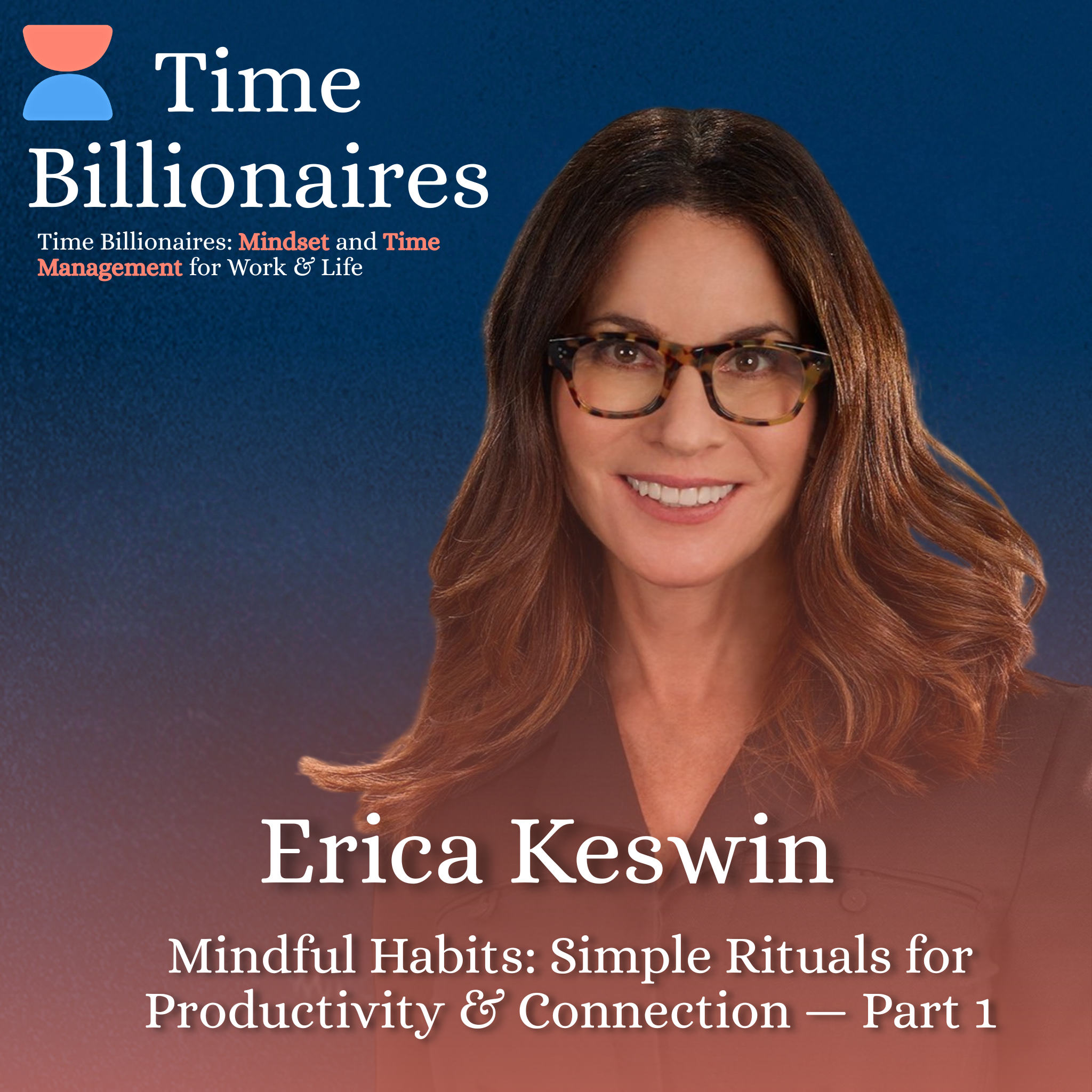
[00:00:49] Speaker C: Thanks for joining today's episode of the Time Billionaires Podcast. Our guest today is somebody I've been really excited to talk with for a long time. It's Erica Keswin, a workplace strategist, author and speaker who helps organizations build human centered cultures of connection. She's a three time best selling author and her work has been featured in Forbes, Fast Company, and the Harvard Business Review. Erica's research and insights help leaders create meaningful rituals that foster belonging, productivity and performance in an age of distraction and disconnection. Thanks for being here, Erica.
[00:01:19] Speaker A: Thank you so much for having me.
[00:01:21] Speaker C: I have loved the way that your books explore that rituals drive a sense of meaning, but they don't necessarily have to be these elaborate routines that take a bunch of time.
Can you help us understand simple rituals that can help teens feel more grounded and connected during busy work days?
[00:01:37] Speaker A: Sure. So I think it might be helpful to start with the working definition of a ritual that I used in the book.
So a ritual has three component parts. The first is that a ritual is something that has meaning and intention to you, to the person.
The second is that there's typically a regular cadence. It could happen once every day, once every week, once every month. For those watching on video, right now I'm wearing my Team USA hat. You know, the Olympics is something that happens every four years and for some people, you know, that's a ritual. But the third part of the definition is something that I didn't know before I started studying the science of rituals, which is that a ritual is something that goes beyond its practical purpose. So I'm sitting here in my home office as an example, and let's say that the lights go out and I light a candle because I can't see anything.
That's not a ritual. But if on Friday at 5 o' clock I light a ritual, I light a candle to signify for me the End of the work week and the beginning of the weekend, there's meaning and intention for me, there's a regular cadence every Friday at 5, but there's no quote unquote, real practical purpose. And so that's sort of my working definition. And one of my own rituals that I talk about in the book and in general is that, you know, my morning cup of coffee is a. Is a ritual that, you know, back in the day before I really thought about it, I would get my coffee and I would have my very analog Moleskine notebook and be cranking out my to do list. And then one day I was at Starbucks and it occurred to me that I didn't even taste the coffee and it was gone. So in that moment, I shifted from what was once a routine. I would go, go to Starbucks, overpay for my coffee and get it and sit down and drink it to a ritual whereby I would take a few deep breath, I would feel, hold the cup and feel the heat on my hands, which sort of centered me. And rituals are also very connected to our senses as well. And so, you know, sometimes I'll say to people when they try to think about rituals at work or rituals at home for themselves, for the personal rituals, I'll say, and maybe you can answer this question. I'll put you on the spot.
You know, what do you do in your life that makes you feel most like you? And oftentimes that could launch a thought process to bring about the beginning of a ritual.
[00:04:05] Speaker C: I love it. Yeah, I'll answer that question. But the difference between routines and rituals I think is really interesting because there has to be a cadence to your point. But we can do this mindlessly and not have a ritual or mindfully in the exact same activity to your coffee example becomes a ritual, the usefulness of it. So you said there's no functional practical purpose of lighting a candle as a ritual in Shabbat, for example. But if we were to say that anything you currently do. I currently do drink a cup of coffee most mornings. And I don't think of it as a ritual, but I think of it as having a purpose. This routine versus ritual purpose versus not mindfulness versus mindlessness, I think is really interesting of how we can just claim things that we're already doing and make
[00:04:52] Speaker A: that it's mindless to mindful.
And what I, when I was, you know, working with companies when I was writing the book and continue to do when companies say they want to create rituals, sometimes I'll say there might be things that you're already doing. And it's even just calling it a ritual and sort of elevating it to ritual status. Oh, this is a ritual. How do you know it's a ritual? You would really miss it if it went away. This would, it would feel crazy. You would think that somebody was selling the company.
[00:05:22] Speaker C: That's brilliant.
And to this Mindfulness, mindlessness. I can think of weekly team meetings as an example that happen.
Set cadence, set time, and the ones that I've been a part of that have a ritual like drop something you're grateful for, drop a win in at the beginning, feel distinctly different than the exact same activity that just jumps right into substance.
[00:05:45] Speaker A: Yeah. And I also will say to people, you know, not everybody, you know, approaches those kinds of rituals in the same way. So if somebody's listening to this and they say, okay, well I'm going to go back and have my team meeting and I'm going to have everybody drop in something that they're grateful for, that might work, or some people might not be into it. And you can sort of move on and say, all right, when do, when does our team feel most like our team? I wrote about a group at LinkedIn that had pre pandemic, a one minute dance party at 3 o' clock. And they literally everybody would rotate picking the song.
And I actually was just with the woman that told me the story for the book. I was out at LinkedIn on the west coast and we were chatting about it and after everybody went home for the pandemic and came back and when they came back and tried to reinstitute it, it just didn't feel the same and it felt forced.
And that's okay to then pivot and experiment and see what sticks. And. And I also believe that rituals can come from anywhere. Top down, bottom up, inside out. And so it's really just, you know, if you're listening to this and thinking, how can I bring this to my team, my organization, my family? I mean we always had Taco Tuesday when my kids were little. It's, you know, getting, getting feedback, getting input and iterating. But, but sharing the science. Because, you know, I came up with an equation in the book called the Three Ps. This is what rituals give us. They give us a sense of psych safety. Starts with P. Sounds like an S, but it's still a P.
It gives us a sense of purpose. And when you add those two together, you get increased performance.
And we can talk about what that means at work. What that means in our personal lives is that when we feel connected to others and we are connected to others, our oxytocin, which is our feel good hormone, goes up and our stress goes down. So whether you're connecting with others or connecting with yourself, there is a physiological response in our bodies.
And so they're really.
There's. There's a real ROI to thinking about how to incorporate rituals into our lives.
[00:07:56] Speaker C: Yeah, you mentioned that when companies reach out to you about wanting to start a set rituals, is that what they have in mind? Or why would people suddenly say, you know what, I need more rituals in my family, in my team, in my company?
[00:08:08] Speaker A: Yeah, I think people are just. They're feeling disconnected. They. They're feeling like there's a box check. I think the biggest thing over the last couple of years was, you know, we lost our, many of our rituals during the pandemic. We weren't commuting. I mean, there were all those funny memes back in 2020 where people were recreating their, you know, commute ritual or they missed their 20 minute. They didn't necessarily miss commuting, but they missed their podcast or they missed that time of, like, moving away from, you know, the kids, breakfast, throwing Cheerios all over the house, to centering themselves and going into the office. So they missed like something was missing. And now with. With the hybrid workplace, which is becoming somewhat of the norm, you know, whether you're four days in, one day out, what do you know, whatever that structure is, people are saying, well, I don't want to just have people.
We could be in the office five days a week and not connecting with anybody. So they're turning to rituals to say, what could be those touch points that I know. We have a lunch and learn on Tuesdays, and Tuesday is all about professional development. We have our all hands on Wednesdays. We do something with our ergs once a month. And so it's, it's these touch points to, to give people that sense of connection and community, which, you know, when you talk about mindless to mindful or mindless to intentional, you've got to be even more intentional in this, in this hybrid world. And I'll say one, one last thing in my. I give a lot of keynotes, and I have a slide in my keynote that, that people really.
Everyone's always taking pictures of it, so I'll share it with you, but it says the absence of intentionality is a recipe for resentment.
Wow.
Right?
[00:09:58] Speaker C: That's a bold word. Not apathy, resentment. Will you say more about why?
[00:10:05] Speaker A: Yeah. So let's Say, you know, I, you know, used to live or, you know, raise my kids in New York City. So in New York City, you have people commuting from Westchester, New Jersey, Connecticut, and everybody's, it's a commuting culture. So let's say you're the manager and you have your people commute in. Right now people are complaining about it a little bit more than they used to because things we had that, that break.
And let's say they commute in and they get there and half their team's not there and they're doing the exact same kind of work that they could be doing from home in their sweatpants.
They're resentful. Why, why did I bother? Why did I bother?
I come into my office and I commute an hour and a half from door to door and, and I'm on zoom all day. What am I doing? And so what I'm working with companies with now a lot is, you know, creating those, you could call it rituals, you can call it moments that matter so that people feel like the commute was worth it. Now, this is not all day every day, but you don't want to be in that situation where people come in and are like, what I could do?
What was the point of this? And they are resentful.
[00:11:15] Speaker B: Part two of this two part episode
[00:11:17] Speaker C: is coming to you next week.
[00:11:23] Speaker B: Thanks for spending this micro moment with me. If you found it valuable, share it with a fellow time billionaire and give us a rating to help others discover the power of micro moments. For more ways to reclaim your time, check out timebillionaires.org and follow me, Rebecca Shattuck on LinkedIn. See you next time.