Episode Transcript
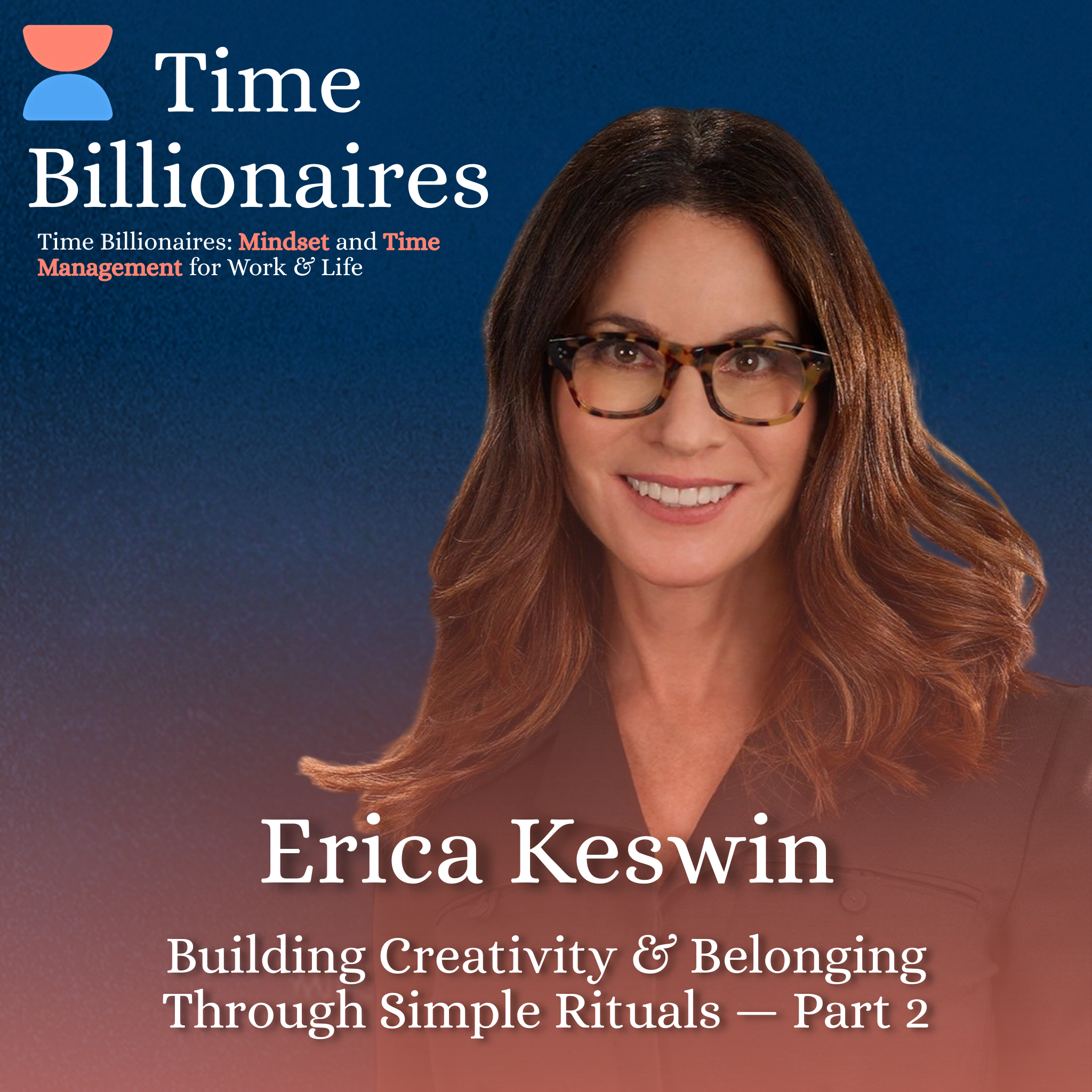
[00:00:00] Speaker A: We're at a time right now where there's so much uncertainty in the workplace and we have an erosion of trust. We are still in an epidemic of loneliness and isolation. Beginnings and endings are what I call prime rituals.
[00:00:12] Speaker B: Real Estate hey there billionaire.
[00:00:16] Speaker C: Yep, I'm talking to you. If you expect to live another 31 years, you're already a billionaire. Not in money, but in the real measure of wealth, time.
That's because 31 years is roughly a billion seconds. But most of us waste time in ways we'd never waste money. The currency of time billionaires is micro moments, the 90 second to 15 minute gaps hidden between the structured parts of your day. This podcast is about reclaiming them with quick research backed ideas to help you feel more creative, productive and alive. Welcome to Time Billionaires. Let's make your next micro moment count.
[00:00:58] Speaker B: This is a two part episode. If you want to check out the first part, listen to the previous episode of Time Billionaires. Yeah, I'm thinking of family dynamics too. There could be something important to me and not important to my husband, and until I ritualize it or establish the intention behind it, he could be resentfully going along with, okay, I can't put wood spoons in the dishwasher. I don't know why it matters. But if he hears the intention behind why that does matter to me. Anything to your point, right? Could be intentional or not. And I hadn't really thought of resentment as underlying that lack of intentionality.
It's clear, I mean to me from hearing this, reading your content too, that there's power behind rituals. But I think there could be people listening to this who are sold, who think rituals on their team sound great, but may not have a formal leadership title or feel like they have the ability to directly control or implement that. If someone's listening and wants to establish rituals for their team culture, but doesn't feel like a an explicit leader, what advice would you have for them?
[00:02:00] Speaker A: Yeah, so two things. One, to get a little bit of buy in, I always go with the business case. Here's the business case for rituals. Here's the business case for connection. When we feel more connected to others, employee engagement goes up, job satisfaction goes up, turnover goes down, health and wellness goes up, you know, which, which we still in an epidemic of loneliness and isolation. So there is a business case in terms of how to get started.
I what I would do is I would, you know, think first I would answer the question myself, which is when do I feel Most, you know, LinkedIn. Ish Allbirds. Ish. Microsoft ish. Like fill in the blank for your company. When do you feel most connected to your organization? And I would start asking everybody else kind of what, what they think and see what those answers are.
And again, there might be things that you do that you just have always done and you could elevate them to ritual status. You could think about, you know, if that's not the case. One of the things I also say are beginnings and endings are what I call prime rituals, real estate. So to your point earlier about meetings, you know, the beginning of a meeting, the end of a meeting, the beginning of a quarter onboarding is a really prime for opportunity, you know, opportunities for rituals. When you bring a new employee into the organization or a new employee joins your team, I would also say that, you know, as I said earlier, they can come from anywhere. So think of some things that stick and approach it through the lens of experimentation. There's always that one person or two people on the team that you get the eye roll. Like, are you, I can't believe we're freaking doing this. Like, what?
And sometimes those people will come along.
But that's why I also say to lead, lead with the data.
[00:03:53] Speaker B: Yeah. And the eye roll, people sometimes need it the most. You're reminding me of a classmate I had in business school who we did improv at the, whatever, the weekend orientation when you kick off. And he came from a very rigid, I'm the boss, I'm the CFO that listened to me. And he said months later that he thought about dropping out of the program after that. He's like, my leadership style. Why would people listen to me? Because I'm the boss. That's why people listen to me. And he needed it the most, but he was the most resistant to it because it seemed so outrageous to him. So I think to your point, the intentionality behind the transition and even leaning into why we're resisting something can be a great flag, right?
[00:04:35] Speaker A: And oh, do you think that we're, you know, wasting time? I read an article recently about the ROI of, of small talk. You know, that we need to be more intentional about building relationships today in this hybrid world with all this technology, with AI. You know, we're at a time right now where there's so much uncertainty in the workplace and we have an erosion of trust. And all of these things, I believe, increase the importance of leaning into more of the human side of work. And that's really what this is. And we don't have to force feed it. It's going to be different for Every organization.
But I do think after people take some time and connect with each other as humans, most, if I would say 99% of the people say that was worth it.
[00:05:26] Speaker B: Yeah. Even that shared language, to your point, calling it a ritual, you're reminding me of Spotify's team culture. I consulted for them and they Swedish company who just used the word fika want to fika. So it wasn't just, hey, do you want to get coffee and chat? It was let's marketing team do fika together. And just the intentionality behind that shared word that brings in that same connotation. Right. I know exactly what we're doing and it's the same feeling every time. I, I think to your point, transitions are powerful and they give us this opportunity to, I think, reflect on what is or isn't working.
You mentioned the pandemic. When I first started getting intentional about micro moments, the small gaps between the structured parts of our day was during the pandemic because to your point, the commute, which I didn't think I liked, had rituals in it of things that weren't just waking up, walking to my desk and not moving for 13 hours. And so I think that the power of any transition between meetings, onboarding, somebody does have this little built in reflection opportunity to say, what do we want more of what isn't working? That you can add every Friday if you want to just reflect and ask those questions. What do we want more of what isn't working?
[00:06:40] Speaker A: Yeah. You know, you reminded me my, my friend and fellow author. I don't know if you have ever met Lindsay Pollock. She's a, she's an author, she studies the multigenerational workforce. She's a rock star. But we both ended up in Connecticut during the pandemic. And she told me this story one day where she was in this home, like this little bit of a home office, and she would go in and one day it was. And she would open the blinds and sit down at her desk and get ready to work. And one day, you know, her husband, to be nice, went in and like opened the blinds for her and she was like, no, don't do it. That was her, like, it was sort of unconscious in the beginning, but that was her beginning of the day ritual where she would go in and be intentional and open the blinds. And that separated, you know, the home from the work when we were all living and working in, in one place.
[00:07:30] Speaker B: Yeah. To your question of what's something you already do that you can reclaim. Yeah. During the pandemic, I noticed I wanted more time outside. And so I finally said, every day, go outside.
And a friend of mine asked me a couple weeks in, what do you usually do when you're going outside? And I said, well, usually I'm just taking out the trash. And she went, no, that doesn't count. You have to do something different. But to me, it did count. It felt productive. It was enough to get me out of the habit of never physically leaving the house. And so it didn't have to sound grand to her, but to me, it was the first step to building a habit of actually then pausing for 60 seconds, taking five deep breaths. But I couldn't have built that if I had just gone from nothing.
[00:08:11] Speaker A: Yeah, and you would have. You would miss it if. If, well, one, the house might smell because of the garbage, but you were like, wait, what's missing? I didn't get up, I didn't go outside. And it almost starts to pull you versus, like a push. Which is why rituals are typically not forced. It's something that has this magnetic. It's magnetic that we, that we want to go toward it when it, when it really sticks.
[00:08:33] Speaker B: Yeah. And acknowledging where you are to that LinkedIn dance party example, it worked for where that team mentally, culturally was. And the same exact activity doesn't work if it's that push towards something that isn't natural.
[00:08:48] Speaker A: One of the things that came up in the book was, you know, one made me think of it because when. When does a ritual run its course at LinkedIn? I said, you know what, this just feels awkward now, like it's just not working for us. Okay, fine, move on. But when I was asking the question, you know, when do you feel most fill in the blank? There were some people at companies that all of a sudden got like a sort of a blank stare and were like, oh, almost like an oh, no moment. And I said, well, what are you thinking? And they said, well, it occurred to me that when I. All the things that we do that make us feel us and make us feel connected, we were all around going to happy hour and all around drinking. And there was this feeling that, you know what, that's not so inclusive. Or another person that said, wow, everything that we do is at 7 o' clock at night after work. And so another shift that I started seeing was that, you know, how do we. Rituals can be the most sticky when they're inclusive. They're the most sticky when they're also connected to our company values. So, I mean, I think everything works better when it's Connected to your values. Unless your values are wrong, which is a whole separate issue.
But that's another sort of thing to layer on to think about as you're talking to people and saying, when do you feel most connected to? Then look at it through the lines of your values and through the lens of. Does this really include everybody?
[00:10:13] Speaker B: Oh, it's a powerful mirror. Right. Because it can feel like if you actually run it through the filter of your values, it can. You may not like the answer at first blush of like, wait a sec, if my values are right and this feeling is that they can't coexist. So, yeah, I think that's a brilliant shortcut to our first mirror to ask and then probably not regretting whatever decision comes out of it, even if it is difficult to face initially.
Yeah.
When do you feel most alive? Is it that coffee in the morning?
[00:10:46] Speaker A: Yeah. I would say that really is that moment that.
Again, it's the pause almost.
Yes. I love that first cup of coffee. I'm not an all day coffee drinker, but it really is that first sip that I sadly, or not sadly think about before I go to bed. But it's that pausing moment of feeling the heat and just taking a deep breath and just being centered.
[00:11:13] Speaker B: Yeah, I love it. And it's.
[00:11:16] Speaker A: You know, I have other ones too. I've written about our. My family.
You know, if you were to say to my kids, when do you feel most? Keswin Ish. You know, when they were little, you know, Taco Tuesday was a big thing. We always had Taco Tuesday. Really? Because I don't cook and that was an easy thing to make.
We also sit and watch. We play a lot of board games and we watch a lot of sports. And that's what most people, you know, they can find us doing when. When we're all together. And those would be some of our family rituals that make us.
[00:11:43] Speaker B: That's beautiful. Yeah. There's the individual and then there's that collective group. For me, I'd say it's yoga. And when I first.
That was my immediate answer. I'm not good at yoga. I do it quite a bit, but I am not particularly flexible, etc. And so I think just that lens. I realized that my husband is better at this pose that I consider difficult the other day. So, yeah, I think there's something powerful just accepting that answer and not worrying about the result or how it looks.
[00:12:10] Speaker A: I love that.
[00:12:10] Speaker B: Amazing. Is there anything I didn't ask or give you a chance to express that you think is important for either people to apply or just understand about rituals.
[00:12:21] Speaker A: Let me think, you know, I would go back to this idea of sort of when you're looking at where to start, you know, maybe because it's the beginning of 2026. So I've been thinking a lot about beginnings, but. And you know, we think about resolutions and rituals and kind of all these things. Things.
But I do, I think beginnings and endings are an interesting place to start if from personal ritual perspective that how do you begin the day? How do you end the day?
In my, in my retention book, which is the most recent book I wrote, the first chapter is called Start as you mean to go on boarding. But this whole idea of how do you start as you mean to go on, what's important to you and how do you kick off that meeting, how do you start the next quarter?
So I think I think about beginnings a lot and maybe I'm thinking about it more just because it is the beginning of the year.
[00:13:14] Speaker B: Yeah. And to your point, the endings too, if we think about our whole time as being cyclical or powerful for the energy they take into the next beginning. I love that. Yeah, we end with shavasana, this corpse pose, where you basically just lay there. And I just sort of went along with it for years until one teacher explained that this is a. Appreciating the death of the practice, that the stillness of it is taking into the next beginning. And I, I love that if we think of the beginning as carrying the energy we want for the rest of it, but every ending, then sparking the next beginning for the day. The energy you sleep with or recharge.
[00:13:54] Speaker A: Yeah, I mean, I totally agree. And I, I talk about that in, in the retention book. Even with the. Let's be really intentional about how we onboard when we have people that we work with us, we're going to help them to develop up, down and sideways. And then if and when that person comes and says, I'm leaving, it's the refrain from the you're dead to me. Don't let the door hit you. And if you're really intentional about how you off board and stay connected. What we have seen and will continue to see is that work is much more of a virtuous cycle. And that's kind of what we're getting at with the yoga, that an ending is a new beginning. And if somebody leaves, they become a client, they become a customer, they might come back.
And so I think it's really important that intentionality is really through that whole cycle.
[00:14:40] Speaker B: Yeah, that's not what I thought you were going to say after off forwarding. I thought you were going to talk about the impact on the people left of what they see. All of that is powerful. Right. If you do hear now gossip, whisper, you're dead to me about a colleague who left. That doesn't spark the psychological safety that you talk about being so important and.
[00:14:59] Speaker C: Right.
[00:15:00] Speaker A: I mean, there's multiple impacts of off boarding with intention. It's the person that's leaving, let's let them leave on a good note. And you know, unless they did something really bad because who knows where that could lead. And then the people that do it even better are saying, okay, let's also make sure that the people that are there see how we treated that person and see what we're saying and doing. So yeah, it's both. And I do, I have a lot of, you know, just examples of off boarding rituals and alumni gatherings where people get together and to intentionally stay connected. There's a company in Chicago called JellyVision and the CEO had a get together.
She would call it the seven year itch get together. And it was for all these people that had been there for seven years. And anybody who left that were alumni would come back. And I feel like one year she said, I don't know, like half the people were alumni, that they were all staying connected because it was, you know, know, they didn't want to miss this ritual, that it was this funny party that, you know, the seven year itch, you're celebrating that what people might leave and get that seven year itch. It was just sort of a fun play on words, but it was her way and people really stayed connected.
[00:16:15] Speaker B: Yeah, that's powerful. And that example is driving home the point you made that anything can be a ritual if it's intentional. I didn't really think about alumni gatherings as rituals, which is silly because of course they are football games, of course those are rituals. We have all kinds of rituals and rules. But yeah, the intentionality behind it of how you want to show up for them is everything.
[00:16:38] Speaker A: Yeah, I've heard, I've never been. But supposedly, you know, at Goldman Sachs when you retire, they have these partner alumni gatherings every year and it's like a who's who. And like people don't miss it. You go and you show up and just strengthens and that look, some people will use. They will. I think it's McKinsey, one of the consulting firms that basically on someone's first day of work says, you are now part of our alumni. Like you're part of our family and you're going to be part of our alumni. You know, whenever you leave, you, you are now part of us. And that is today, in the beginning, and also when you leave and they remind people that, that alumni, that what comes next is really a critical part of the whole process and a huge benefit.
[00:17:30] Speaker B: It's empowering.
I never thought about working at McKinsey, but it's empowering to think about now. Suddenly you have this ownership over. I'm part of this entity forever. Which is not how a lot of us think of our jobs. It's forever. Our, our alumni communities for our schools, those are forever. Yeah. So the rituals of how you kick that off and then really what you're communicating to people about them belonging, I could just see that sparking a lot more accountability, but in a good way of like not a punitive, hold you accountable, but like I feel accountable for the success of this firm because I. Forever part of it.
Yeah.
[00:18:07] Speaker A: And I think companies that do that well and elevate that and talk about that, it could be, you know, a competitive advantage in terms of attracting and retaining top people.
It could be a part of, you know, combating this, this moment of such severe loneliness and isolation and people not feeling part of something.
[00:18:29] Speaker B: Yeah.
And combating those big things. This is less work. Right. Instituting a ritual is less work than wondering what to make for dinner every Tuesday. Wondering how to on or off board everybody. You've essentially front loaded a better decision that you don't have to revisit every interval that comes up. Yeah, I love that. It's less work and better results.
[00:18:51] Speaker A: Yeah, we, we moved to Florida recently and we started having dinner people over for dinner on Fridays and you know, as a ritual. And I, like I said, I'm not going to give them Taco Tuesday. I'm going to try to up level it a little bit, but there's really only one thing that I cook other than that. And so I, you know, we started having people over and I made the same thing every Friday and it was just, it was easier for me and something that I could do. But it just, it added to this whole idea of, of this, of it being a ritual, that we're going to have similar foods, that we're going to have cocktails in one room, then we go have dinner and then we go have dessert another room. And it just, I don't know, it just flows and it's easy and to your point, you just almost takes on a life of its own.
[00:19:43] Speaker B: I love it. You're inspiring me in so many ways. I have a almost five month old and not seeing our friends is a big.
Just the. The barrier of it of I have decide what to cook and how we're going to set up and clean etc just that if we could say okay fine, every other Sunday we're going to do something easy and let's just make that a ritual. Even how I wake her up from naps I can think of as a ritual. I really like that. This is awesome.
[00:20:06] Speaker A: Well you know what, it's funny. I'm going to follow up and I'll send you this recipe but a friend of mine that I've done a lot of work with she her thing like she has this brunch like her when she has people over she doesn't do dinner, she does brunch. And. And she has this one thing that she makes and it's you put all the stuff in one day. It's like foolproof and it's amazing and that's her thing and it just takes the stress off because she knows what pan it's going in. So I'm going to send that. So I think it's good and I think said to trying to do it every week sometimes feels over overwhelming but you know it's important and you front load the work and people start to look forward to it because they know it's going to be you know, your ritual.
[00:20:43] Speaker B: I love it.
[00:20:43] Speaker A: Yeah.
[00:20:44] Speaker B: Even just the first Sunday of every month, something that you know you can come back.
I love it. Yeah. Oliver Berkman talks about scruffy hospitality how just embracing that it can be chaotic and still meaningful. Oh, I love this. Please do send that resume and you
[00:20:58] Speaker A: can look, you can say the first Sunday every month or you could say again like one Sunday a month like because it may. You might have to be flexible. Like I think that you know when we're creating rituals there's this reminder that it doesn't have to be so rigid that oh no, it has to be the first Sunday. So again think about that. Especially with a five month old you're going to do it your way. And it goes back to the very first question. When do you feel most like you? And then when your 5 month old is older, is it a, is it a boy or a girl?
[00:21:28] Speaker B: A girl.
[00:21:29] Speaker A: A girl. So you know, when does she feel most like your family? And it might be we have people over on you know, on Sundays and I get to bring my friends, I mean who knows.
But you know, approach it with intention.
But also give yourself grace and flexibility.
[00:21:46] Speaker B: Now, with flexibility, it's brilliant. There's so much I found surprising from this that I thought I understood the intent and the application of the word ritual. But the way you define it is different. Is there something that you found surprising in your research or you wish you knew when you started doing it that, you know, now?
[00:22:05] Speaker A: I. I guess I saw the magic in the rituals that, yeah, it was something that you did, and, yeah, you know, you feel connected.
But I loved seeing that, you know, when something really became a ritual and stuck.
Just, you know, the mad. Like it even feels cheesy to use that word.
And I do use it in the book because that's what.
What I saw that there was this magic, there was a shift in the room when something really was a ritual.
And so I would tell people to take the, you know, listen, take what pieces of this resonate and.
And give it a.
[00:22:59] Speaker C: Thanks for spending this micro moment with me. If you found it valuable, share it with a fellow time billionaire and give
[00:23:04] Speaker B: us a rating to help others discover
[00:23:06] Speaker C: the power of micro moments. For more ways to reclaim your time, check out timebillionaires.org and follow me. Rebecca Shattucks on LinkedIn. See you next time.