Episode Transcript
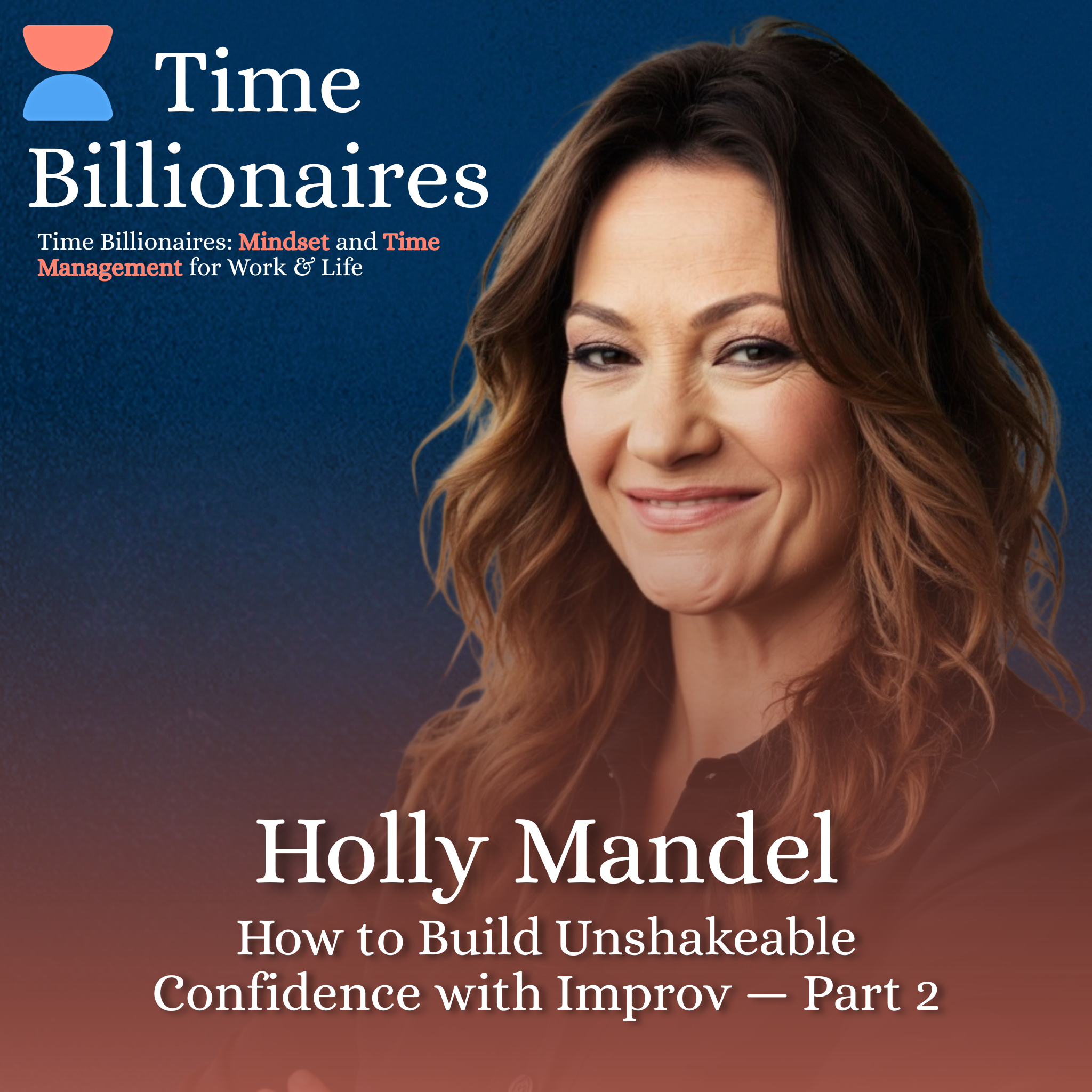
[00:00:00] Speaker A: A lot of people who take improv, maybe you as well, have gone like this is kind of a spiritual practice. The pushing up against something you don't like, doing that alone becomes easier to push up against anything you don't like. The beauty of improv, it's experiential. You can't theorize your way out of going. If you can play it, you can be it.
[00:00:23] Speaker B: Hey there, billionaire. Yep, I'm talking to you. If you expect to live another 31 years, you're already a billionaire. Not in money, but in the real measure of wealth, time. That's because 31 years is roughly a billion seconds. But most of us waste time in ways we'd never waste money. The currency of time billionaires is micro moments. The 90 second to 15 minute gaps hidden between the structured parts of your day. This podcast is about reclaiming them with quick research backed ideas to help you feel more creative, productive and alive. Welcome to Time Billionaires. Let's make your next micro moment count.
[00:01:07] Speaker C: This is a two part episode. If you want to check out the first part, listen to the previous episode of Time Billionaires. Yeah, you, yes, anded me at the start of that answer, which I think is great. I've seen the same thing. And I think to your point, we need to practice this because how we do anything in a large part is how our brain has been practicing how to do other things. And I, I've noticed this shift too, of I stopped doing improv three weeks before my baby's due date, haven't gone back because I'm afraid of getting sick indoors, et cetera. And I do notice the difference in my stress response because I think the practice of a low stakes, low consequence, failure to be celebrated rejection is likely. If I think I set something up that's funny, that doesn't land. There's. There's no problem with that, right? Doing a show that goes great or goes poorly, there's no consequence really beyond that room at that time. But it's so easy to set up of, oh no, we're out of diaper cream. How did I not think? It's just that the practicing of that I think is so important and the practicing, being uncomfortable is so important for life.
[00:02:15] Speaker A: Yes. Oh, I love that. Yeah, Comfort zones.
I say this in my classes because it was an aha for me. Comfort zones are stretchable.
So the things, they're elastic, the things that trigger, I think they call it hyper and hypo.
You know, this is where we're comfortable and then we get uncomfortable and we Go.
Or we get uncomfortable and we freeze. These tend to be.
This is stretchable.
And so the thing that used to trigger us, if it's still in here, it doesn't, it's not going to trigger. And then you stretch it more and it doesn't trigger. And so again, it's like, oh, the circumstances don't have to change.
How I react to the circumstances is what I can. And I mean, that's like a philosophical, metaphysical conversation. And that's why a lot of people who take improv, maybe you as well, have gone like, this is kind of a spiritual practice without any of the extra stuff that you don't need.
It is, it's. It's learning how to live in a way where, where you're in charge of how you want to show up and react.
There's many ways to do that. I find this is a really fast way to just go, I'm going to be a team player. I'm going to listen, I'm going to come in with ideas, but I'm going to make sure you feel heard and valued. I'm going to see where this path takes us. And then I'm sure if you're a brain surgeon, you're like, well, that does. I'm not going to, yes. End, you know, instincts that I have while I'm got someone's brain open. But I think a lot of times there's a lot more freedom, a lot more things happening in the present that we could really say yes and to and find things would happen a lot smoother.
[00:04:02] Speaker C: Yeah, you're right.
And the comfort zone itself is stretchable, but how you respond to discomfort is in itself a practice worth doing. Right.
Yeah. I used to get scared before practices with a couple of other beginners, and now I don't throw up before shows. That was progress. Right. But the practice of being afraid of something, not wanting to do it, not finding it fun, dreading it all day, preferring to make excuses to stay later at work so I wouldn't have to go. That in it of itself is worth practicing getting over because it means you're more willing then to take charge and go toward things that are uncomfortable. I think the practice of running away from things that are uncomfortable is the most dangerous part.
[00:04:48] Speaker A: Agreed. Agreed. And I think that itself is a thing that you learn. Like you're saying. I just want to highlight it because I think it's really important is the pushing up against something you don't like, doing that alone becomes easier to push up against anything you don't Like, I know you just said that, but it's true that that itself is worth something. And it can be just an improv class. It doesn't have to be scaling a mountain. It's the same reaction that you're having. Like, I don't want to do that. I'll do it anyway. That practice is fantastic.
[00:05:23] Speaker C: Oh, you're so right. Yeah. And seeing that train of thought through that, the consequences of it, occasionally I'll tell people, oh, yeah, I do improv. And I often will get, oh, I could never do that. Why not? Oh, I'd be so embarrassed.
Why? It's like, you're not embarrassed? Like, sure. I. What's the worst that could happen? You look stupid in front of a couple dozen people.
Okay, and then what? And that just is this painful discomfort of, no, I don't want to look stupid in front of a couple dozen people I'll never see again. And just following that line through of what will happen.
[00:05:54] Speaker A: Yeah.
[00:05:54] Speaker C: So many things are not that consequential.
[00:05:57] Speaker A: I remember there's a. There's a liberation. I know you have experienced it. I have experienced it so many times. But there was something. There was a guy that I had a crush on that I worked with while I was taking class at the Groundlings, and we would do shows every weekend, and he was gonna come see me in a show. And I remember being backstage and those stakes of, I don't wanna look stupid in front of this guy that I like, had not been in my head for a long time. And I remember I had to prioritize what was more important to me.
Doing what I thought was good and kind of being cute and doing great in an improv or actually just doing improv and saying, eff it, and seeing what happens. And I just. My instincts were like, you just can't care or you're gonna have a horrible time. So I remember I went on stage and I didn't care.
I didn't care what was gonna happen. I cared that we did well, but I wasn't attached to it being good or bad. I wasn't even thinking in those terms, like you're saying.
But it was the liberation. On the other side of that, there was a liberation of, like, I just know it's going to be okay. And even if it isn't, it's still going to be okay. The only thing that's not okay is if I try so hard and I care. That feels so terrible. That is so unfree.
I'm watching myself do improv. Kill me now. And So I think to your point, for anyone who's had this conversation with themselves, oh, I don't want to look silly. Feel how unfree that is and how stifled and suffocated that is. And then, no, you can go to this place and practice just being in the space of is it good or bad? I don't know, but I'm having fun. That's. That's actually what matters.
[00:07:47] Speaker C: It is, yeah. And following that line even further. Right. The five whys. Oh, I don't want to look silly in front of these people. Why not?
Because then they'll judge me and think I'm stupid. Why does that matter to you?
Have you given them a position of power or authority to decide your worth that you don't willingly want to? Just following whatever that fear line is through, I think to your point, is really empowering and productive through anything. Yes, that scares us. Yeah.
[00:08:14] Speaker A: And it'll probably reveal a lot of things that were programmed for. I mean, just to go back to the female thing, you know, we.
We are rewarded when we give power out away.
You know, we're nice and we fit in and we. Oh my God, that's such a great point. And you know, people love that version of.
So your questions of the why but then why but then why is fantastic. Because there is something to be learned about where is that fear coming from? And do you want to look it straight in the eye and take it on?
[00:08:51] Speaker C: Yeah. I find it interesting how situational this is for a lot of even experienced actors. Like, a few months after I started my very first improv class, I was just like on this binge of signing up for every class I could. And there was something that I thought was an improv workshop at the theater. I do improv at. That was this two day weekend immersive that I thought was improv. Turned out to be a clowning workshop where legit experienced actors go in clown. And I should have known something was up because the executive director emailed me a few days before asking if I was still planning on taking the workshop, which I thought meant like, oh, maybe it's canceled. So I was like, yeah, if it's still on, I'm definitely taking it. And I show up and they're all the main stage players who use phrase is like, I wasn't cast last night because they get paid to act. And I'm just sitting there like, oh, no. I have made a horrible, horrible, horrible mistake signing up for this clowning workshop where paid actors are coming from all over the freaking country. And actually also Canada to learn with this esteemed teacher. And I was like, oh, boy, okay, well, I'm here. I gave up a kayak weekend with my husband and friends.
I'm here, I'm doing it. And over the course of that weekend, actors I really respect, who I still really respect, who are like 8,000 times the performer I'll ever be, were revealing really interesting things about how they were really comfortable initiating a scene on stage. But if they were to be in Costco, they wouldn't be comfortable making eye contact and smiling at somebody because they felt like they didn't have the permission. They felt like in a theater, they had the implicit permission of the other players of the audience to go initiate, to be bold, to start something, but they didn't feel like they had the permission of the lady in Costco to look at her, sort of. And so just all of these stories we tell ourselves about the situations we do or don't have authority in, like just flipping it of, how would you feel if you were in Costco and somebody smiled at you? Probably pretty good, right? Why do you think she feels different? And just all of these layers of stories of giving away power, I think really come out when you just start asking, why do you feel more comfortable doing that in a theater than in Costco?
[00:11:00] Speaker A: Yep, yep, that's fantastic. And it's such a nice complement to the contemplative.
Contemplative version of that, which is to ask yourself the question. And then the beauty of improv, it's experiential. You can't theorize your way out of going, gosh, I guess I give my power away.
I hope I don't do that anymore.
The beauty of improv is, hey, like you said, it's a low stakes place to practice. Not practice, not doing that. Practice this other version of yourself. Viola Spolin, to anybody who hasn't heard her name, she is the mother of improv. She's the first person who made games to have certain outcomes. She was brilliant, total genius. And this was in the 20s in Chicago. And you can do a deep dive on her if you want to. She's fascinating. But hers was a real social experiment. And what she. One of her theories was she was working with a lot of people who felt very disenfranchised, a very poor part of Chicago, a lot of immigrant community there.
And her goal was like, you belong here. You're just as important as everyone else.
But they were like, you can tell me that, but I don't feel a part of this. Community. She's like, we're going to play these games and you're going to play somebody who's really important and you're going to play somebody with confidence and you're going to play the boss. You're not going to just be the employee. And her theory was, if you can play it, you can be it.
And so people were practicing being different versions of themselves. And then you kind of obviously go to the point of like, well, why do you go back?
Why not keep that and add that to how you are? And that's such a magical thing that, you know, you can change over time slowly and not notice. Or you can say, okay, starting today, I want to add this quality to who I am.
[00:12:58] Speaker C: Yeah, you're right. And you can choose it. You can bring that man. I totally forgotten about that. The same clowning workshop weekend. What changed from my total insecurity, want to disappear and sneak out and make an excuse, was one of the warmup exercises was to do planks. And it turned out that that was the one thing that I was better at than anyone in the room. Like I could do a five minute plank, et cetera.
I do them in my micro moments, right? So I do planks and push ups throughout the day. So I have practice with them. And that flipped for me, feeling great at something. I just kept that. And I think that that was a lesson to me. Just remember the last time I felt totally great at something, the last time I felt like I was better at something that everyone else in this room bring that because that's the confidence that for me personally, feeling like an imposter, I needed. And you can choose that. You can choose the last time you felt so confident, so in control, so in command, so in belonging that you just bring that energy with you. I heard Maya Angelou give a recording of her of a graduation speech she gave. And she talked about bringing everyone who loves you to these pivotal moments. And she said, you're going into job interview, right? Come on, auntie. Come on, grandpa. Right? If they all believe in you and they're with you, why not? And we can choose that.
[00:14:09] Speaker A: To your point, it's fantastic. And I, and I, I know I'm sort of harping on the female thing, but it's, it's front of mind. And we're both women. So what I find when I work with a lot of women, very accomplished women, we have a very hard time holding our accomplishments.
It often feels braggadocious, it feels arrogant. We don't want to be like, that was great. That feels really sometimes icky and hard.
But the thing is, a lot of them, most of them are facts. They're just facts. You were the best at doing a plank and you owned that, which was fantastic because it fueled how you kept going and showed up. And I think to what you're saying, that could be another thing that someone practices is own your accomplishments because they're facts and you won't be this. I feel it like a leaky boat. If we keep leaking out our accomplishments, it almost always feels like we're starting over.
[00:15:09] Speaker C: Who, me?
[00:15:10] Speaker A: I couldn't possibly. Oh, it's going to go wrong again. And after a while it's like, is that helping? That's not useful. Like, know that the last eight times you hit a home run.
So you have to own that. Otherwise you're going to show up very differently.
[00:15:25] Speaker C: Oh, it's so true. Right? And how you feel about saying it is how the people around you will feel about it. If you're saying it from a place of arrogance or superiority, that's how it's perceived. But if you say it from a place of insecurity, like, oh, I don't know, like, yeah, I led this really high growth team and it was okay, I guess. I don't know, it's not a big deal. That feels weird to listen to. But yeah, I led marketing for the fastest growing education company in US history. I'm really excited to be here. Now that's fine. Own that the way you feel about it. If you're saying it for a constructive reason, great. But if you feel awkward about it, and that goes any direction, right? Bringing up to your boss, if you feel awkward bringing up a raise, they're going to feel awkward about it. But if you say, hey, I've been here. This, this is my impact. I'd love to talk about a raise or the next step. Great. Now you've had a productive, pragmatic, non emotional conversation.
[00:16:13] Speaker A: I love this. And I feel like the combination of you and, and what we and I have been talking about, I feel like we've given somebody a really great thing they can do because like, let's say it is a raise.
Your thing. Of the five whys, why do you feel weird? But why? But why? I bet you'll hit on something pretty deep.
Oh, I was always told blank or something. Right. But then you can apply improv and practice.
Put on the qualities of somebody who doesn't feel that way. Practice being somebody. Do it in the mirror, do it with a friend, record yourself, but pretend for A second, you're not you. You're somebody who feels great getting a raise, and over time, that will merge and you'll access the part of you that actually does feel that way. It's not cheating. It's not pretend. It's just you're. Yes. Handing a different part of yourself.
[00:17:02] Speaker C: Yeah, you are. Right. Yeah. And one of the best parts of an improv scene, there's different ways I've heard described. An endowment, a gift, a stonemate. You can endow your scene partner with being this really loud, obnoxious Jerry who does this, or you can give yourself the gift of being somebody who's excited to have this conversation, who isn't worried about the outcome, who's just present. You can gift yourself whatever trait you want to bring, and there's nothing stopping you.
Yeah.
So you've given people a lot. If someone just has just five minutes, though, is there something you want to bring this all together with and say today? How do you use these five spare minutes to show up as the version of yourself you want to be as.
[00:17:49] Speaker A: The version of yourself? That's good. Okay.
I would write down one adjective.
One person, one image, something that you can connect to that gives you the feeling of what that quality is you would like to. Yes. And into who your person is. So is it Oprah? Is it Amy Poehler? Is it just the quality of being kind of badass? Whatever it is to you? Like, I would write that down and every day, look at it for five minutes and just access that feeling in yourself. You don't have to do anything more than that. Just identify where that is in you.
And I have a feeling it will grow, because they say what you put your attention on grows.
So don't put the attention on. It's not there. Put the attention on. Where do I find the Oprah within? The Oprah within.
And I was like, I could pretend to be Oprah for five minutes.
No one has to see me. But I can find it. And then I bet it'll grow.
[00:18:49] Speaker C: Yeah. Yes. And it's even better, I think, if you can put a physical picture of that person on your desk to remind you. I had one of my grandma for a long time. I still have it. She's not on my desk right now. And she really did not hesitate to stand up for what she believed in. She grew up on the south side of Chicago and got arrested during the 50s, during the civil rights movement for beating. Hitting a cop who was beating a teenager and wouldn't tell them her name. So she was Held for a long time. Right. And so she saw something she thought was wrong. She was not afraid to go to jail, deal with any consequences. And so I thought if she's willing at 23, to go to jail and stand up for what she thinks is right and put herself in physical harm with police brutality, she would be fine. Having a bold conversation here. And there's right, there's shadows of any positive trait. So it's easy for us, I think, to focus on, oh, she was really larger than life and she always got what she wanted because she pushed through it. And so there's negative ripples of that in a family. But for me to remember, hey, I'm working on being more assertive. Who was assertive and standing up for what they believed in. Grandma Norma put that picture physically on your desk. Because then I just sort of channeled her while I was working on it. I found to be really empowering.
[00:20:06] Speaker A: I love that. And I love that you use the word channel because, you know, this gets into the woo woo stuff, but I'm all for it. I mean, you know, you can't prove what makes us who we are and you can't prove what it takes to change.
Everyone tries.
I do think it's very simple. I think it's very simple to see something that you want more of. There's a reason why there's a resonance there. There's a reason why they impact you.
And I think it's meant to open up that dimension of your personality. Otherwise why would you be attracted to it?
So I think there's something really powerful about what you're saying and maybe somebody who's not dipped into that pool before, you know, give yourself permission to, you know, make it a great 2026 thing to do as we're coming to the end of this year, you know, who do you want to be at the end of 2026 and really borrow those qualities? But you can use improv of just. It's just a simple yes. And you don't have to make it complicated.
[00:21:07] Speaker C: Yeah, you don't. I think not making it complicated feels too simple. But it's the only thing that actually works. I know people who have like 17 New Year's resolutions for their. All of their different categories. But what do you want to bring into this year? What don't you want to bring into this year? Those can just be two single words that you can focus on. I do want to bring this energy. I don't want to bring this trait. Fantastic. That's easy to apply every day.
[00:21:34] Speaker A: Yes, yes, exactly. And you'll get really. You'll get some great traction and probably by March, you'll need two new words because you'll have done it.
[00:21:42] Speaker C: It's great. As opposed to abandoning New Year's resolutions by March, which usually happens because they're too complicated or ambitious. Yep.
[00:21:49] Speaker A: Yes, exactly.
[00:21:50] Speaker C: Yeah. Oh, thanks, Holly. Is there anything else you want people to follow up with or follow you from?
[00:21:55] Speaker A: Oh, gosh, thank you.
No, everything's pretty much on LinkedIn. You can always reach out. I'm happy to just, you know, discuss anything for people. Personally, I coach. We have people who coach.
My mission is to allow everyone to see how important. Yes. And is and how much it can unlock in you as an individual or a company, and especially women, is something I'm very passionate about. If you can't tell.
So, yeah, reach out, don't hesitate.
[00:22:25] Speaker C: And I can personally confirm Holly's very responsive. I pinged you cold on LinkedIn and we had a lovely chat, and here we are.
[00:22:37] Speaker B: Thanks for spending this micro moment with me. If you found it valuable, share it with a fellow time billionaire and give us a rating to help others discover the power of micro moments. For more ways to reclaim your time, check out timebillionaires.org and follow me. Rebecca Shattucks on LinkedIn. See you next time.
[00:22:54] Speaker A: Time.