Episode Transcript
[00:00:00] Speaker A: Why do we have these emotions as humans? Like biologically, we probably have them for a reason, evolutionarily. And so what are these emotions trying to tell us? If you go through life without having regrets, then you're missing one of the core human emotions.
[00:00:19] Speaker B: Hey there, billionaire. Yep, I'm talking to you. If you expect to live another 31 years, you're already a billionaire. Not in money, but in the real
[00:00:28] Speaker C: measure of wealth, time.
[00:00:31] Speaker B: That's because 31 years is roughly a billion seconds. But most of us waste time in ways we'd never waste money. The currency of time billionaires is micro moments, the 90 second to 15 minute gaps hidden between the structured parts of your day. This podcast is about reclaiming them with quick research backed ideas to help you feel more creative, productive and alive. Welcome to Time Billionaires. Let's make your next micro moment count.
Thanks for joining today's episode of the Time Billionaires Podcast.
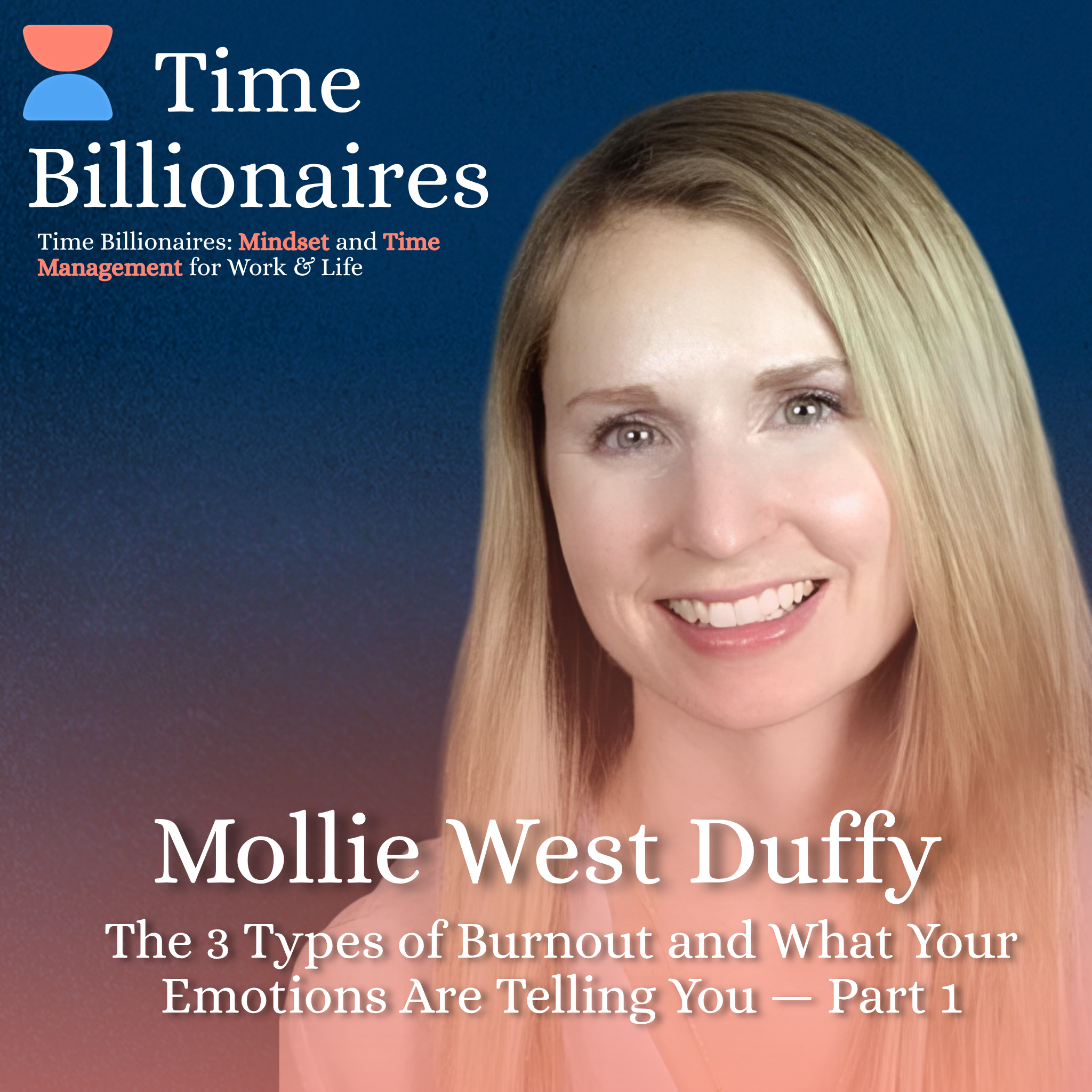
[00:01:08] Speaker C: Our guest today is Molly West Duffy, the co author of Big Feelings and no Hard Feelings, two books that unpack how we navigate emotions in our work and everyday lives. She spent her career helping organizations think more intentionally about leadership, culture and the human side of work, including as an organizational design lead at IDEO and currently as the head of learning and development at Lattice. Her work has been featured in the Harvard Business Review, Bass Co. And Entrepreneur magazine. Thanks for being here, Molly.
[00:01:37] Speaker A: Thanks for having me.
[00:01:38] Speaker C: Happy you're here. You've shared publicly, including in your books, ways that you've navigated really hard chapters and emotions that I really resonated with and was surprised to hear from. Your books are actually a lot more common than we realize because people tend to feel isolated during them and then not share, myself included. So if somebody is in the middle of what you describe as a big feeling, whether that's uncertainty, comparison, burnout, anger, despair, or regret, what's one small shift they can make to interrupt that pattern and respond differently?
[00:02:14] Speaker A: We wrote the book Big Feelings because both me and my co author, Liz Foslian had experienced a lot of big feelings and had a lot of times spent wishing that we didn't have those big feelings. It's like, what is the purpose of having these?
And so that was really what we did when writing the book was uncover why do we have these emotions as humans? Like biologically, we probably have them for a reason evolutionarily. And so what are these emotions trying to tell us?
And each of these are different. I don't have like a one size fits all answer for each of these. But. But the overarching Thing is, is what is that trying to tell us? So, for example, anger is letting us know that we care deeply about something, and a boundary has been crossed with that thing. And so it's actually like, behind the madness, there is a caring deeply about something which can be helpful to then figure out what to do with that emotion in a, in a productive and healthy way.
Same thing for comparison is likely telling us that something about what our current life is not working for us because we're wanting something else. And so then how could we change something in our life to, to make that different?
And despair is, is probably the most difficult one. And despair, I think, exists in, in some ways that, you know, we, we all want to try to get out of despair, but I do think that it helps us feel connected to other people going through despair and coming out of it. It helps us just be more complete humans who understand, you know, the full range of emotions.
So that is one small shift. And, and to be clear, we're, we're not saying, oh, you know, you're going to be so glad that you experienced this. And, you know, there's always a light side like none of that. These are really difficult emotions.
And at the same time, it can be helpful to try to figure out what, what they're trying to tell you.
[00:04:24] Speaker C: Regret was a big one for me, reading your book, Big feelings, because I spent a lot of time and energy sort of admonishing myself for feeling regret as if it was some kind of personal failure, either of planning then or of gratitude now. But you wrote that it's actually impossible to live a life without regret, which alone made me feel kind of less of a failure, which was really validating. And so you talk about how the goal isn't to eliminate regret, but to actually understand it. So if someone is feeling regret, how do you recommend that they process that in a way that's actually useful?
[00:05:00] Speaker A: Yes. So to go back to what you said, so I think if, if you go through life without having regrets, then you just are not, you're, you're missing one of the core human emotions. And again, evolutionarily, why would we have regret? Well, to tell us that we might want to do things differently in the future than we did in the past.
And so that's helpful, right? Like, that's helpful to know, okay, I'll, I'll make a different decision. But where we don't want to get stuck is just like belaboring over the regret and, and, and not being able to move past it. And so sometimes when we don't want to feel regret. We try to shove it under the rug, and we're like, I don't want to feel that right now. But then actually, that's preventing us from learning from it and just moving forward.
One of the ways that we can move forward through an emotion is to process it and then get something from it. And so saying, oh, you know, I. I regretted moving to that place or taking that job.
Okay, well, that doesn't have to be a forever thing. Let yourself feel that regret, and then what choices can you make differently moving forward? Now I'm making it sound like a lot more, you know, straightforward and easy. It's not easy. Um, but it is a. As you said, it is a big mindset shift to think about it as the way that you're going to feel regret. And that's okay.
[00:06:22] Speaker C: Yeah, it's okay. And you'll learn from it. And if you don't, that's the failure, not feeling it. So I think that's huge.
Burnout is another one of the big feelings you talk about, and it's a really hot topic. It's come up on the podcast, and actually a former podcast guest who's a licensed psychotherapist and a cancer survivor said that burnout is the most socially acceptable way to talk about big emotions in the workplace or mental health in the workplace, without fear of being isolated, which I think is an interesting idea, that there's all these big emotions that can get grouped as burnout. She said, sometimes they are, sometimes they aren't, and what we can learn from them is huge. Is there something specifically about burnout that either you wish people understood or you think is helpful for people going through it?
[00:07:10] Speaker A: Yes, I absolutely agree with your previous guest. And clinically, when you look at the research around burnout, there are three different types of burnout. So there's feeling overwhelmed, which is what we typically think about when we say, oh, I'm feeling burned out. It's because you have too much to do. But there's also two other types. So one is feeling disengaged, and we saw that a lot during the pandemic, when everyone's working totally remotely and like, oh, I'm. I don't feel connected to my colleagues. I don't feel connected to the work I'm doing anymore.
And then the last one is feeling ineffective. So this is. I'm working really hard, but nothing is changing. I'm trying to get things done. I'm not able to get things done.
And so the reason I bring those up is that those last two are not commonly what we think about as burnout, but they can indeed be a part of burnout. And all of these have different remedies. So one thing that can be helpful if you're feeling overwhelmed is to take time off. But actually taking time off is not going to make you feel either more engaged or more effective. And so if you're feeling disengaged or ineffective, then we have to look at some other things that could be helpful.
So that's why we talk about in the book is really around. Like, once you get clear on the type of burnout you're experiencing, then the solution is easier to follow. But I totally agree. So I teach manager development workshops. And as part of teaching prioritization, I also teach a few minutes on burnout.
And it's something where it's interesting because I think I could spend a whole hour talking to managers about burnout, but it feels more acceptable if I have put it in under prioritization and delegation. We're talking about how to prioritize better, how to delegate, delegate better. And we also don't want you as managers to burn out. We don't want your team members to burn out. And so I talk about it there, and I see managers sort of like, perk up because we've gone from talking about, you know, pretty, like, tactical things into something that is much more emotionally based.
And, you know, I always say, I know we don't talk about this a lot openly, but it is really important to talk about. And, and you can see managers being like, I, you know, I am burned out, or like, I need. I also need help. Like, I'm, you know, I'm really listening.
And so I would even edit the, what you just said, as you talked about in the previous episode, to say, like, I'm not even sure that burnout is totally socially acceptable. It might be the most socially acceptable thing, but it's still not totally socially acceptable to talk about, especially in economic times like we have now, because it's like, well, we should feel lucky that we have a job. And everyone feels so behind on learning AI. So there's a real fear mentality around that. And like, I don't have time to learn how to use AI, but I need to go learn how to use AI.
And so I, I feel like in the past couple years, we've even seen a little bit of a reversal. Like it was more acceptable to talk about burnout 2020, kind of through 2022, and the economy was doing well. And, and since Then I don't see people talking about it as much. But yes, I, I still agree that it is a more acceptable thing to talk about at work than something like anxiety, depression, loneliness, some of those things that absolutely can be a part of a burnout.
[00:10:46] Speaker C: That's so interesting. The idea that the fluctuation could be cyclical, not even linear of it was more socially acceptable and now it's not.
Is a really interesting point. And the importance of sharing came across in your book and then your answer there too, because you've talked about this perception of ineffectiveness is often self perceived and your book pointed out that it could be in your own eyes that you feel less effective even if other people don't think you are. And there's sort of this weird paradox of if someone seems highly effective, it looks like they're doing well and thriving and even giving a compliment or the praise. I know Lattice has a great praise tool to bring that to the forefront and make it more part of the culture. But even giving someone praise, you seem so effective, you're really on it. You're accomplishing so many things. Can kind of be this expectation then set of if they don't feel like they are, well then I have to rise to this bar. But if you don't know how you're perceived, it can be helpful to say, hey, I don't feel as effective or I'm feeling like I'm heading towards burnout right when you need it most. Could be when other people's perceptions, they might have thought it wasn't necessary to share. Like I'm thinking of somebody who seemed so effective, so calm to me under a lot of conflicting demands, who felt very ineffective and I had no idea. I was very shocked to hear that because it seemed like things were going so well. But until that comes out, nobody knows that the other person needs to hear.
[00:12:15] Speaker A: Yes, it is very hard to see from the outside when someone is feeling ineffective and even when someone is burning out. And it's really hard for us to see, even for ourselves.
If it's hard for us to see for ourselves, then it's going to be pretty impossible for someone else to see.
One former mentor manager of mine, when I was trying to make a decision about whether to take on a new consulting project when I was consultant and it was going to mean a lot of travel and I was like, I'm not sure if I want to do that right now. And this person said to me, molly, no one is going to draw your lines for you. You have to draw your own lines. And it's like we wish that a boss or a partner or a friend would be like, seems like you're taking on a lot. Like, you should really, you know, take a break, take a step back. But they're not going to do that because that's not how our society works, unfortunately. And also, you're the only one who can see all the ways in which you are stretched. Work and home and family, et cetera. So I think we talk a lot about this in the book of, of recognizing your own early warning signs for burnout. And those are things like you find everyone irritating.
Basic tasks start to feel overwhelming, like doing the laundry, going to the grocery store.
You feel like you need to take a vacation to recover.
So like, we, we want you to use vacation to like, have fun. But then when you're like, oh, I just need to spend the first few days of my week off, like, recovering from work, that, that is a big sign.
So anyways, identifying these early warning signs so that you can take action on them can be helpful. But again, a manager may or may not pick up on that. Colleagues may or may not pick up on that.
Um, and then to the ineffectiveness point you made, people can feel ineffective for a bunch of different reasons. So some people might feel ineffective because as you said, they, they are actually effective, but they have such high standards for themselves and a little bit of perfectionism going on where it's like, well, I'm, I'm never going to do 100% at this. And so that's being ineffective in my mind.
Other people can feel ineffective when they're working on something and they're hitting barriers that are not, that are beyond their own control. This is how I feel ineffective, which is I'm working in a cross functional project and things are not progressing at the pace in which I would like them to. Or like there's decisions being made that I disagree with, that I think are gonna be detrimental to the end goal.
That makes me feel really ineffective and can be really frustrating to me and, and can even lurch lead to burnout because it's like, hey, I'm trying so hard, but I don't feel like we're getting to our goals. So that's, that's totally different reason and again, would have a different resolution which would be to like, you know, talk to my cross functional partners and have some alignment conversations.
So back to your point. I think that's another reason why it's hard to see if other folks are feeling ineffective is because it can be for very different reasons.
[00:15:21] Speaker C: Absolutely. And this disconnect between how we see people, how we feel that basic tasks becoming overwhelming is a big one for me. But ironically starts this spiral of basic tasks feel overwhelming. So I feel inadequate. And instead of answering a question like, why is this so hard for me? It becomes a self condemnation. Why is this so hard for me? Other people can do this easily.
And it usually is this disproportionate response to something minor. For me, most recently, for whatever reason, it was thawing the right amount and right time of frozen breast milk. I just couldn't get it right. I felt like I was wasting some. And it drove me insane to the point I was like, tyler, you just need to do this. I can't do this. And his take was, you've done a lot more complicated things, you've done a lot harder things. Why is this hard for you?
Just answering that kindly, why is this hard for you? Okay, there's whatever is okay. And I think that's the basic task becoming overwhelming.
Especially for anyone who feels like their brain works differently than the norm or expectations at different times.
I know executive dysfunction, perceived or actual, can be a big early sign that somebody may be struggling with depression or anxiety, even underlying neurodiversions too, that may or may not have been diagnosed. And so that trigger, why is this so hard for me?
Actually trying to answer it has been helpful of why am I so tired right now? Can be a, come on, get it together. You're not doing all that much. But actually diagnosing that can be the unlock in a way that being self critical never is.
[00:17:01] Speaker A: Totally. It's like you're recognizing that there's an issue here. And I do this for myself too. Like, okay, yeah, why? I mean, I can think of a million things of like, why am I not able to do this thing that other people are able to do? I've had on the floor in my office, I've been trying to put together a photo book and I have had photos strewn across the floor for like months. And every time I come in I'm like, I should probably finish that. And it's like, why are other people able to do this and not me? And yeah, I mean, it goes to like, probably unrealistic expectations for what I'm trying to accomplish and maybe a deeper sense of identity. Like I'm somebody who, you know, does that for my family and. And so that I'm putting a lot of pressure on myself for being that identity and answering some of those questions instead of like, berating myself every time I see the photos. And, and for me it absolutely is a sign of like I just have too much going on. It's the overwhel. It's like I don't have the mental bandwidth and, and long enough free blocks of time to sit down and do it. So like I might have 10 minutes but I'm like I can't do that in 10 minutes and I never have the time. And, and things are always prioritized above that.
So I tried to take a week what I've been trying. So I'm a parent of two young kids now and I've been trying to take more like full weeks off to just do like a staycation because it's very difficult to travel with young children and expensive. And so I'm like instead, why don't I take the time for myself without needing to travel anywhere.
And my intention in these times is to like do some of these things like the photo book that I never have time to during the week or on the weekends.
And it's funny because this last time when I did it, I was sick the whole week. And this has happened to me before where I, I've been like, okay, I'm going to take off time to have a staycation. And then I get sick.
And I do think it's like my body's way of saying, I mean well number one, I, I have two kids who are just always sick so they're, they're always germs in my house but I don't always get get sick from them. So why, why do I get sick certain times and not others?
And it's that burnout thing of like even in my week off I was like, well I need to be productive and do these other projects and my body being like, no you don't, you need to rest. And then I was able to. So like I did fully slow down. I was sick. So I was like, okay, I'm gonna spent four of the five days just resting and being sick. And then the last day I made some progress on the photo book.
[00:19:49] Speaker B: Part two of this two part episode is coming to you next.
Thanks for spending this micro moment with me. If you found it valuable, share it with a fellow time billionaire and give us a rating to help others discover the power of micro moments. For more ways to reclaim your time, check out timebillionaires.org and follow me. Rebecca Shadducks on LinkedIn. See you next time.