Episode Transcript
[00:00:00] Speaker A: Not surprisingly, I burned out within a year. I found myself constantly on slack after hours, waking up, getting notified of messages, feeling like I needed to respond right away. Other people are deciding how you're going to be spending your time because you're constantly getting interrupted. You feel like you're doing stuff, but you're actually not and it actually burns you out. Unless you work in an ER. Candidly, there is nothing that cannot wait 30 days minutes. They are designed to hook you in and you have to outsmart them.
[00:00:32] Speaker B: Hey there billionaire. Yep, I'm talking to you. If you expect to live another 31 years, you're already a billionaire. Not in money, but in the real
[00:00:41] Speaker C: measure of wealth, time.
[00:00:44] Speaker B: That's because 31 years is roughly a billion seconds. But most of us waste time in ways we'd never waste money. The currency of time billionaires is micro moments. The 90 second to 15 minute gaps hidden between the structured parts of your day. This podcast is about reclaiming them with quick research backed ideas to help you feel more creative, productive and alive. Welcome to Time Billionaires. Let's make your next micro moment count.
[00:01:18] Speaker C: This is a two part episode. If you want to check out the first part, listen to the previous episode of Time Billionaires.
[00:01:24] Speaker A: It's truly liberated a lot of people. And I, I, like I said, I'm grateful for that part of the culture at that company that I worked way back when.
[00:01:32] Speaker C: It's so empowering and even just adopting part of that into my brain has been really helpful. But I've also worked at a company where the culture was the diametric opposite. And what stands out to me is that in that culture it was very much one of fear and optimizing for appearances. Does this reflect someone smart enough to work here? Ironically, it was hedged under high performance of like, we have high standards, high expectations, and the worst question you could get was did you think this was ready to show? To me, that went, you think this is a good, this is a good enough reflection of what you thought was worth my time. But really it made us focus on optimizing the alignment of every pixel. And I found myself even after I left and clicking through in Google Slides, looking at the position to see if there was a 0.1 difference in how these two box. That's not the point. Right? It doesn't matter. And I and all of my hundreds of colleagues invested an inordinate amount of time in appearances when we didn't have this really vulnerability of saying let's make sure we're at least on the right track because that keeps us focused on the bigger picture. But when things get petty or small quickly, we start nitpicking the minutiae. We've actually lost the focus on the impact. And I don't think a company can grow to the size and success and scale that envision was with this micro optimization focus.
[00:02:57] Speaker A: Well, it's, you know, kind of getting back to project management. It's, it's, it's about phases and the early phases of a project.
That's where, you know, bad version is great. Of course there is a time and a place where it's sort of like, you know, through multiple versions and getting feedback on those versions and iterating, you get to it, you, you do arrive at a point where it's like, all right, I think this is ready to show to the CEO or to XYZ executive, where maybe the expectation is it actually needs to be pretty dialed in. But you've gone through the hardest part, which is to getting something down early on, and you've shared it with people that you know are trusted and safe to be able to give you feedback and understand that iteration is how great ideas are born. Like, ideas aren't born in a silo. You have to get feedback from others. So, yeah, but yeah, totally. I've spent time at different companies, like obsessing over like presentations and there is something about like having things looking polished, of course. But yeah, it's a balance.
[00:04:13] Speaker C: Yeah, it is a balance. The time and place of what are we optimizing for, who's the audience and yeah, like the wisdom that comes with figuring out where your energy is best spent.
I love that.
Are there small changes that you've made around your focus or where you put your time that have had a big impact on how you feel or how productive you are?
[00:04:38] Speaker A: Yeah, I would say, I would say, yes, there is one. And I want to share, I think what had to happen before I was able to do this. I was working at a startup, running their marketing team, reporting to the CEO and like, it was a very reactive job. It was in my, at that time, I felt an always on 247 job and I felt that I needed to be on all the time. And so I found myself constantly on slack after hours, waking up, getting notified of messages, feeling like I needed to respond right away. And not surprisingly, I burned out within a year.
And I took a few weeks in between that job and my next job to assess.
Oh my God. What part of this was the job, the culture? What part of it was me and my Habits and behaviors, which I have way more control over.
And a lot of times, you know, when you make these career changes or, you know, start a new job or change a new job, like, it's important to sort of assess what part is you and what part isn't you.
Turns out managing notifications and your relationship with a messaging tool like Slack. And if you're out there listening to this and you don't use Slack, maybe it's your email, maybe it's your, the pings on your text messages, not setting boundaries with that technology, that was on me, that wasn't the job. And so the thing that has absolutely, I think, changed my life and made my work so much more productive and satisfying is turning off all of my Slack notifications.
Even when I'm on my screen working, the toolbar is hidden.
And essentially I decide when I'm going to go look at messages.
And the reason why that is such a game changer is because when you don't decide when you're going to go in and respond to all these messages, other people are deciding how you're going to be spending your time because you're constantly getting interrupted. And so it puts you in this reactive state where you're doing a bunch of stuff like responding to everyone else's needs, but you're actually not doing your job and you're not focusing on the projects you need to be working on. And so it is such a slippery slope because you feel like you're doing stuff, but you're actually not.
And it actually burns you out. And it feels incredibly unsatisfying to go a day and just service everyone else's needs except for what is actually and put yourself last. And so the, the habit is hiding all of the notifications and using a timer to focus on a task, whether it's a writing task, maybe need to review a document. It's basically like I'm going to spend 40 minutes or 30 minutes on whatever this task is, maybe it's a meeting, maybe whatever it is, and I'm going to fully focus on it. And then I'm going to take 5 and 10 minutes, 10, 15 minutes, however many time it takes to then go in myself into Slack, check all the messages, or if you use email, go through your messages and respond all at once. And so it's not only more efficient to work that way, but it protects your focus time so that you're actually doing the job that you were hired to do with the brain that you were hired for, because the reactive brain, not great for Creativity, focused brain, great for creativity. So I really think managing your relationship with notifications is so important. They are designed to hook you in and you have to outsmart them. And so that is something that has fundamentally changed the way that I work. It has made me love my job, it's made me feel not burned out and it's made me feel more in control of getting, you know, the focused, fun, larger picture projects done while also being able to show up for teammates who have questions and also address their needs. But it's like in more of a focused way.
So that was a really long winded way of answering that question.
But I just think it's so important.
[00:09:08] Speaker C: I think it's so important. It's so common and so relatable too.
Even feeling like we have an alternative to being this always on as a choice, I find the more secure I feel in a role in my ability to do it well, the less reactive I feel. Which is why I think for people who might be earlier in their careers or facing imposter syndrome or newly promoted into a role they haven't done before, it can be this like negative flywheel of I feel insecure. So I feel like I have to control what I can control, which is looking like I'm responsive and always on, especially if I'm working remotely proving that I'm here so I can show I'm committed to the old get in the first, leave last. Now it's like, let me just show that I'm always here, I'm always responsive. So there's nothing anyone could wonder that I can't answer. But those are worse responses. And the same thing. If we're checking messages between meetings, if we have four minutes between one zoom meeting ending and another starting, that could be a single context shift from that meeting to the next one. Or it could be infinite of then checking all of the messages we have from all of the different people with all of the different context shifts, not having time to reply thoughtfully to any of them. So even if you thought, oh, I just want to see if something's on fire, whatever you're going to respond in those 4, 7, 10 minutes won't be as thoughtful as if you were to just pause and batch them together to your point. And it creates this loop of sending half baked messages that may not fully convey your thoughts or answer the question so you get another message back and now we have a confusion spiral versus just calmly pausing to say this is what I really mean to convey with the admin task that I have, which for Me is in the afternoons because I tend not to be as focused or creative between like 2 and 4. So I like to batch those because I don't need deep work time and then step away confidently that nothing's on fire, I can recharge. And that becomes a positive feedback loop.
[00:11:12] Speaker A: Yeah.
[00:11:13] Speaker C: Of fulfilling that. But it's so common. And I remember saying to somebody who was relatively early in her career, your job is not to respond quickly. And she really couldn't fathom that because. What? No, I'm in a customer facing role, I have to be responsive, et cetera, et cetera. But really your job was to deliver results for the business. And if you're doing something that's compromising your ability to deliver, especially in the AI, unique results for the business, then you're not doing your job. And ultimately you're training people to interact with you like that. Right. If you're constantly able to drop anything on a moment's notice to create a one pager for a conference that day, well, you're telling people that you're not really working on anything that important because it couldn't be interrupted. And that becomes true. That becomes true. If you're constantly fielding these reactive requests that weren't a priority a week ago and now you're burnt out from your ability to do things that were a priority a week ago, well, then it becomes true that you're not actually working on anything that important.
[00:12:12] Speaker A: Yeah. Unless you work in an error, candidly, there is nothing that cannot wait 30 minutes. Like, I'm not even talking about an hour here, people. I'm saying 30 minute blocks.
There's nothing. I mean again, like I said, if you work in an er, if it is truly life and death, and I've been watching some ER related shows lately, it's like, yeah, you have to literally change tasks all the time and respond to new needs. But like most of us don't. And most customers that you have, even if you're in a customer facing role, if they send you an email and you respond 30 minutes later, 45 minutes later, that's still pretty responsive.
And so I think just, I don't know how along the way we told ourselves that responding within seconds is like realistic and like the goal or goal.
[00:13:10] Speaker C: Right.
Yeah.
[00:13:12] Speaker A: No, it's not. And so again, anyone that I see on my team that is responding, responding to me, it's actually a flag that they might not be carving out enough focus time to do the work. The harder, higher level thinking work that, that I've hired them to do.
And so like I get it, like sometimes you need a break from that focus work. And you're like, I'm going to spend an hour, hour maybe on slack going through stuff. And so maybe you are in that, that mode and you can be super, super responsive. But again, it's about you telling yourself, setting that boundary, saying, okay, I'm going to go into slack for 20 minutes and then I'm not going to go into slack, I'm going to spend 30 minutes on, on this other task. So it's really about just setting boundaries and yeah. And I promise you if you do this, you will get so much more work done and you will enjoy your life so much more.
[00:14:06] Speaker C: Find you more effective. One of the, the best accidental phrases that I happened into was I have confidence in your ability to figure this out.
[00:14:15] Speaker A: And I love that all the time.
[00:14:17] Speaker C: Really. Whenever I'm asked a question that I don't think I should have to answer right, if there's an internal wiki or a Google search or a low consequence to getting it wrong, it's actually training your team, your partner, your friends, your kids that it's okay if they answer this question differently than you would. And that's fine. And just I have confidence in your ability to figure this out or whatever variation feels in line with your personality, lets people know you don't have to do everything exactly the way I do it. And I think some of these micro corrections optimizations, especially in marketing, I realized that I was sort of line editing in my first marketing leadership role. That was basically just my opinion. And when I stopped and I said, let's just test this other version, I actually thought I was doing something. I thought I was like, great setting this up for my team member to feel empowered. And her version performed better than mine. And I could not believe it. And that was such a, like a visceral feeling of I've been line editing and eroding her confidence to publish things without me for what my opinion. So just letting it be. It's okay if it's not exactly how I would have done this or even with my husband in dishes and laundry of I was feeling like it was disproportionately falling out on me and getting frustrated. And he was like, there's so many rules, like you can't put this spoon in the dishwasher, but this one has to go in the dishwasher. And that sweater doesn't go in the dryer, but that sweater can't go in the, like whatever. There are rules and the Consequences of a spoon getting replaced or a sweater getting shrunk were smaller than the consequences of me being sole laundry doer. Whatever. I have confidence in your ability to figure this out. And so if we stay focused to your point on what we're actually optimizing for, then that's what matters. And it's not being the fastest to respond, no matter how in control it makes us feel to have that. And I don't know if you notice that. I noticed when I'm on vacation for the first time in my people management career, how many emails were like four deep when I came back?
Question, follow up, never mind, figured it out.
[00:16:21] Speaker A: Okay, so they can resolve themselves in 30 minutes. In Slack thread. With other people, things can actually resolve themselves. And it's like, oh, look at that. You didn't even have to jump in, right?
[00:16:32] Speaker C: You didn't need to signal, oh, hey, I'm working through a problem. So manager, you think I'm productive? You could have just figured it out without sending me an email at all. And I don't need to question the method of getting the results.
[00:16:45] Speaker A: Yeah, yeah, yeah.
Oh, yeah.
[00:16:50] Speaker C: So let's say someone just has two minutes today between some of their meetings and they're feeling overwhelmed or burnt out or frustrated. What's something you recommend people do with just a couple of minutes,
[00:17:02] Speaker A: two minutes, burned out or frustrated?
Well, I would say you would probably need to, instead of do something, maybe undo something.
And this is something that a friend shared with me somewhat recently that I actually have to hold in my mind's eye quite a bit as a kind of fellow achiever oriented, addicted to doing personality.
It's taking a minute or two to undo or to recover.
And what that looks like for you depends on what you're recovering from. So you said, you know, somebody's stressed out and overwhelmed, maybe in between meetings. Okay, well, chances are if you've been on a meeting and you're a virtual worker, knowledge worker, you've been sitting in the same position.
If you're overwhelmed, chances are you've been not only sitting in the same position, but you're probably holding tension somewhere.
So undoing that for one minute might look like laying on the floor and just breathing.
And I can hear some of your audience, like, eye rolling. Oh, great, don't make me meditate. I know it's like apparently the thing people, but if you can't do that, then, okay, well, I've been sitting, I'm tense, I can do one minute of jumping jacks, get some blood flow. Because if you're feeling overwhelmed in your brain, you need to get back in your body. And so jumping jacks could be a physical recovery snack that you take. Laying down on the floor could be one.
Your two minute recovery snack could be a creative recovery. Maybe you were on a really analytical call and you're overwhelmed with like these, the reporting you have to do on something. You know, go do two minutes of a puzzle or like sketch, sketch, draw something for two minutes and bad version, draw something. Don't judge yourself while you're doing it.
You know, take a creative recovery snack.
If you are, you know, feeling overwhelmed, take an emotional or social one minute recovery snap. Go pet your dog. Your dog is always happy to be interrupted. Your partner might not want to hug in the middle of the day while they're on their zoom meeting, but your dog would love to be pet. Like, think of one minute's worth of something you can do to undo the physical or mental state of mind you were just in. And the undoing for high achievers, like, is so hard because for some reason, once again, we've sort of framed recovery as like unproductive. But you actually have to recover to be productive. Your brain and your body need recovery moments to show up 12 out of 10 on the next call. So reframe your mind around the 1 minute recovery snack and, and, and decide like what you need to to do. Creative recovery, physical recovery, breathing recovery, and, you know, do it.
[00:20:07] Speaker C: Yeah, I love these.
I find that sometimes when we do have just two minutes, it can be hard to decide what to do and do it because by the time we've decided the two minutes, the two minutes is gone. Yeah.
[00:20:18] Speaker A: So pick something, pick one thing, have it in your pocket, ready to go.
[00:20:22] Speaker C: Every Friday, like, I like to do what went well, what didn't. What do I want more of next week? And if what I want more of is creativity, then I just have three little exercises I keep on a literal notepad, a white Amazon Basics notepad, and drawing overlapping triangles for when I want more creativity. As basic as that sounds, just straight up isosceles triangles over and over and over for 60 seconds and they overlap in different corners. And I just think it looks interesting and it takes no effort whatsoever. But it is that snack of recovery. And if you've decided this week you want more creativity, whatever it is to your point, you can just have a couple of those. One or three that you'll say, all right, every time I have a break now between meetings, I'll just do this. And it doesn't have to Take any effort to prep or prepare.
[00:21:11] Speaker A: And if you're listening out there and you're like, oh, come on, just tell me what to do. I'll tell you.
Lay down on the floor and close your eyes. Set a timer for one minute. Don't even worry about breathing. Just lay on the ground and close your eyes for one minute. So if you need to be told, like, the one thing to do, I would say do that.
And then once you get used to doing that, get your list of, like, four other options. But if you just need to be like, tell me what it is. Just. I think in most situations, that's going to help you get back to feeling grounded and back in your. Your body again. If you're feeling overwhelmed.
[00:21:46] Speaker C: No, I. I know you're right. And it makes a minute feel longer. I'm like, really? This is still a minute of. I've been here for a while. I thought, no, that was 22 seconds. Okay, good to know. Yeah. It's why we end most yoga practices with Shavasana is just corpse pose laying on the ground. Right. It's to recognize the power of a transition, that the death of a practice holds the opportunity to transition.
And that's exactly what you're doing. You're recognizing the transition between the meeting that just died and the one that's about to start.
[00:22:16] Speaker A: Yes, yes, yes, exactly.
[00:22:18] Speaker C: There's power in it. That's great.
[00:22:20] Speaker A: You can do anything for one minute.
[00:22:22] Speaker C: Yep.
[00:22:22] Speaker A: One minute. We're not asking too much here. And I'm telling this to myself too, because I have to. It's hard for me. I go through the same thing where it's like, all right, I want to jump on this thing. It's like, oh, whoa. No, actually, I need you to take a pause. So it's. It's hard. It's practice, especially for. For doer doers addicted to doing people.
[00:22:40] Speaker C: Yeah. It's hard to actually feel like it'll work too. Right. You can do a one minute wall, sit a one minute plank, or. I was sick this past week and my doctor was like, lots of fluids. I'm like, that sounds so simple. It's so stupid. Okay. I do feel much better when I actually drink fluids. So the fact that something simple and not more can be the solution is hard for us to learn.
[00:23:00] Speaker A: Totally, totally. There's something freeing in that actually, if you lean into it. But. Yeah, yeah, totally agree.
[00:23:06] Speaker C: Freeing in what?
[00:23:09] Speaker A: Freeing in that you just like, sometimes the simplest solution is the best solution. It doesn't have to be this whole orchestrated thing. Like, oh, God, I actually don't have to manage this minute with four things. I can actually just lay down on the ground and just trust that that's going to be fine. I think there's something really freeing in that.
[00:23:28] Speaker C: I totally agree. Yeah. And to your point, you could do that in your office or outside. And now you've gotten nature and relaxation in just a minute.
[00:23:38] Speaker A: Yeah. Yep, yep, exactly.
[00:23:41] Speaker C: So that's great. Is there anything I didn't ask that you wanted to share?
[00:23:47] Speaker A: Gosh, I guess I would just sort of maybe end by saying that it.
Yeah, it's really hard, like I said, to frame the recovery moments as productive, but I would say the sooner you do, the more likely you are to start doing them and benefiting from them, regardless of what you do. If you're trying to save time, if you're trying to focus, sometimes these things that don't feel productive are actually the most productive thing that. That you could do. And if it's hard to get started with a habit, you know, you can write things down, use a counter just to get you kind of unstuck. But over time, like, I think as you sort of feel results from these little, little micro moments of recovery or these. These practices, you'll kind of naturally want to do them. So I would say, like, when you start any new habit, it's going to be hard. Everything in your brain's going to resist it.
So just find a way to get through that first few weeks and. And then, like, see what happens and don't put a lot of pressure on yourself, I would say, too.
[00:25:06] Speaker C: Yeah, that last part can be hard, not putting the pressure on it. It's true. And then when other people start noticing things that you didn't realize were a shift from what happened before, that's when I think a lot of the compounding benefits just become all the more natural and powerful.
[00:25:21] Speaker A: Yeah, for sure.
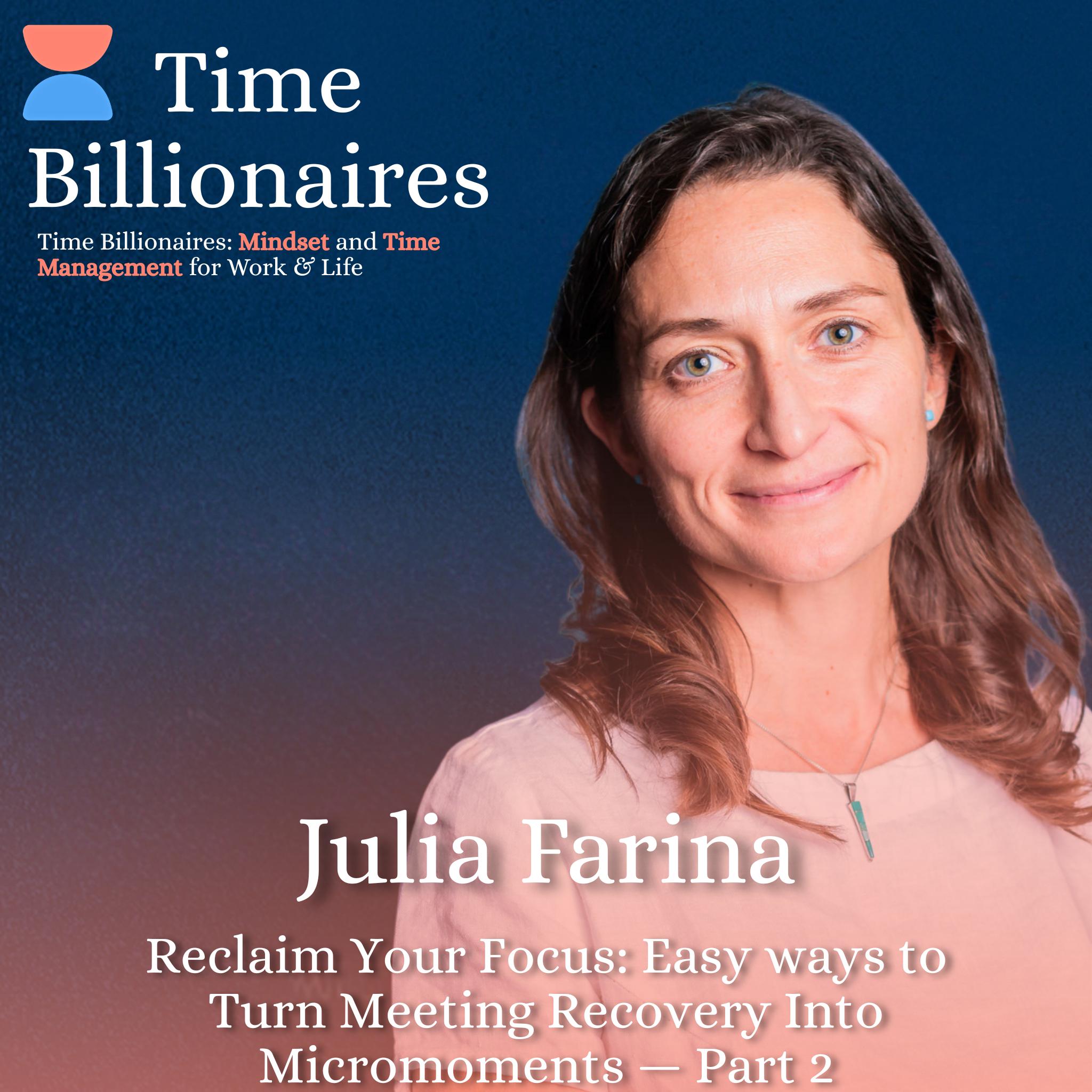
[00:25:23] Speaker C: Well, thank you, Julia. This was fantastic. I've loved your insight and I know other people will too.
[00:25:29] Speaker A: Thank you so much. Thank you so much for having me. This is really fun.
[00:25:31] Speaker C: Thanks for being here.
[00:25:35] Speaker B: Thanks for spending this micro moment with me. If you found it valuable, share it with a fellow time billionaire and give us a rating to help others discover the power of micro moments. For more ways to reclaim your time, check out timebillionaires.org and follow me. Rebecca Shadix on LinkedIn. See you next time.