Episode Transcript
[00:00:00] Speaker A: Between meetings, I would go outside and I would just literally walk around my yard, my backyard for five minutes and do nothing. It's those cumulative moments throughout the day to process things. We're so from one thing to the next that no one is really taking the time to like step back and be like, what's the underlying issue here? These things that I thought were making me happy actually were not making me happy. What actually should I be spending my time on to make me happy?
[00:00:30] Speaker B: Hey there billionaire. Yep, I'm talking to you. If you expect to live another 31 years, you're already a billionaire. Not in money, but in the real measure of wealth, time. That's because 31 years is roughly a billion seconds. But most of us waste time in ways we'd never waste money. The currency of time billionaires is micro moments. The 90 second to 15 minute gaps hidden between the structured parts of your day. This podcast is about reclaiming that with quick research backed ideas to help you feel more creative, productive and alive.
Welcome to Time Billionaires. Let's make your next micro moment count.
This is a two part episode. If you want to check out the first part, listen to the previous episode of Time Billionaires.
[00:01:21] Speaker A: And it's that burnout thing of like, even in my week off I was like, well I need to be productive and do these other projects. And my body being like, no you don't, you need to rest. And then I was able to. So like I did fully slow down. I was sick. So it's like, okay, I'm going to spent four of the five days just resting and being sick. And then the last day I made some progress on the photo book.
[00:01:42] Speaker B: Yeah, you're hitting on one of the core tenants behind the idea of Time billionaires, which is that we talk a lot about time management, but really energy management is what makes life feel rewarding and fulfilling and tasks that don't have to take that much time. If you don't have the energy because your brain is going somewhere more important, it's easy to feel like this is a 30 minute task. Why have I been procrastinating for three months? But it really is the energy management and the energy giving process of throughout the day. There's all kinds of demands in our time. All the context shifting doesn't lead to any output. It just makes us more and more trained. And scrolling social media drains our brain the same way that knowledge work does. So it may feel like a break, but to your brain it isn't. And that's really the idea of using These micro moments, five minutes between a meeting more productively than context shifting from a meeting to scanning emails, you don't have time to respond to, to going into another meeting. That could have been one context shift, but now it can be infinite. So if someone does have just five minutes, for example, and they can't take a full staycation, what's something you think that they should do in that five minute gap?
[00:03:01] Speaker A: So I'm a big believer in just like having downtime for your brain. So I was much better about this during the actual pandemic than I am now because I think unfortunately we have just gotten used to being on our screens all day and, and you know, I work fully remote and I've back to back meetings, etc. But what I did during the pandemic was I would, between meetings I would go outside and I would just literally walk around my yard, my backyard for five minutes and do nothing. I, you know, left my phone inside and it was more just at that time like I, I'm, I was so tired of being on screen.
But like I said, we've now gotten uncomfortably used to that. But, and just like think and, and, and that sort of downtime, I think it helps you process the meeting that you just had. And like, you know, if there's any takeaways, I might go back in and write something down. Like I need to do.
It's those cumulative moments throughout the day to process things. And I find when I don't have that, then at the end of the day I lie down in bed and that's when my brain starts to process all of the things that happen. And that's difficult because then I'm up and I'm like, I need to be sleeping because I know my kids are going to be up very early, but it's like we can't, the human brain seems to need to do that. And so it's not a question of if, it's just a when. And so for able to do that during the day, I do think it makes us be able to sleep better at night, which is healthier for all of us. So go walk around your yard between meetings.
[00:04:46] Speaker B: I love it. Yeah. If you don't close that loop, it just keeps percolating completely unproductively in a way that feels like you're solving this imminent threat, but you're not. I like that a lot of people struggle with the oh, but my next meeting is in five minutes. If I don't check my phone, how do I know? So I love that you could also set a timer for five minutes on your watch wherever else.
[00:05:08] Speaker A: And I like watch.
[00:05:10] Speaker B: Yeah, yeah. On your phone. Even if it has to be in your pocket without looking at it. I like the task though of a single word to summarize that last meeting for you because a lot of our listeners struggle with doing nothing if they're just walking in circles. So your task is. Can be to go into your backyard, walk in circles for five minutes and think of one single word that summarizes that last meeting you had. And usually the first word that comes to mind that can be a 22nd task that closes the entire loop because you can end up with. I found pages of notes that doesn't actually give the direction of does this still need attention? Because if something feels tense or complete or not mine to follow up on, it's just good to have that singular summary to close the loop.
[00:05:54] Speaker A: Totally. I love that. Yeah, that's.
And even if it's just like, well, that was kind of chaotic. Like that didn't like feel like a good meeting. Like even just recognizing that like there may not be anything you can do about it, but just like, okay, like how did that feel?
Or it's like what was the.
Like sometimes in those that walking around my yard, I'll be like, oh, I actually did like, you know, maybe at the end of the meeting you have a, you know, who's going to do what? Like let's, let's have the action items. But then when I'm walking I'll be like, oh, actually that's what I should do. Like that's my next step. I'll. I'll think about that quite often.
[00:06:35] Speaker B: Yeah, I love that. And even if chaotic is your word, then maybe that tees up. Do we need all these people in this recurring meeting or not? If that's the word that comes to you, maybe it sparks. We change this recurring meeting. Who knows where that'll go of just the closing that open loop.
[00:06:52] Speaker A: Yeah.
[00:06:53] Speaker B: Yeah.
[00:06:53] Speaker A: And I do think there's like even a business. I mean there's a personal case for this for your own mental well being and sleep as I mentioned. But I also think there's a business case for this because I think this is what's missing in a lot of organizations is we just, we're missing that shower idea time that like disconnected time.
And so often I'll have these sort of thoughts during the day. Like I just mentioned, I'm working on a cross functional project. I've been feeling ineffective on it and I'll have an Idea like, oh, we need to, like, you know, do this next step. Like, I'll have it, and then I'll go back to folks and they'll be like, oh, that's a really good idea. And I'm not saying that I come up with all the good ideas, but I'm just saying it's like, we're so from one thing to the next that no one is really taking the time to, like, step back and be like, what's the underlying issue here?
So if you can do that in your workplace, it will be very valuable to others.
[00:07:57] Speaker B: So valuable. And it's this energizing hack that I think is deceptive because it can feel really motivating. I can relate to that feeling. I imagine a lot of people watching or listening can too, but it doesn't take that much time. So it sort of feels like you're cheating because that was a big unlock that came out of a lot less effort. And that's fantastic for everybody. It's good for you for your sense of effectiveness. It's good for the business, like you mentioned. And you're right. If we don't have that, we could miss something major from it. Yeah, yeah.
The whole point behind the concept of time billionaires is just to help people live more intentional lives through work, through their personal lives, et cetera.
And a billion seconds is 31 years. So if you expect to live 31 more years, you are a time billionaire, which is awesome. But we waste time in ways we would never waste money on, things that we know don't make us happy or don't improve our lives.
To that end, what's something that you want to be true 31 years from now?
[00:08:59] Speaker A: So 31 years from now, I will hopefully be retired and I personally in retirement.
And it's weird to think about what you want from retirement when you still have a lot of years to get to retirement. But I have thought a lot about it because, I mean, my parents are retired and I have friends in my life who are retired. And it's a really hard transition to make. And I don't think I've figured it out. But I do think that there's two things that I would like to be true. One is I would like to have slow mornings.
So for me, that is such a nice thing that I don't currently have because I start work at 9am and then on the weekends, I have my two young kids.
And that helps me ease into the day, but also just become mentally grounded and not feel like when my days start In a rush, then the whole day is in a rush.
So, so that's, that would be a goal. And the other thing that I would like is to have some kind of structure and intentionality to my day in 31 years.
And ideally that would be like through volunteering or some other way of staying mentally engaged.
Because I think counterintuitively, like, you know, we long for having endless stretches of free time, but from what I've seen of people in retirement, that can actually be really hard. Um, and so that's something that I'd like to try to build forward to at that point.
[00:10:38] Speaker B: Yeah, so many thoughts there.
Cassie Holmes at UCLA's Research shows that if we have more than five unstructured leisure hours a day, we're actually less happy than people who have between two and five hours. That tends to be the sweet spot.
Yeah. And so I think the research supports that. My anecdotal experience of my grandma didn't fully retire until she was 84.
And I think it was partially from seeing how unfulfilled my grandfather, her husband, became when he retired earlier.
But the slow mornings, the rushing. Yeah. A couple of things reminding me of Cal Newport's slow productivity and how these unlocks can come from. He opens the book with this story of somebody who was working on an article for three months, basically lying on his picnic table, looking up and then wrote it in a weekend because it came to him that way. But yeah, the research shows that rushing causes anxiety. And so if, especially for kids. So if there's something that sounds additive to your life, like, yeah, I could go to this playgroup music session with my daughter. But then if we're rushing, it's negative for all of us.
[00:11:42] Speaker A: It's not really interesting.
[00:11:45] Speaker B: Yeah. And for us on pst, I don't know about you, but I often feel like I can wake up behind that. Even if it's 6am and I'm checking email, all of the east coast people, and let's not mention anyone in Europe, we are behind already. So it's easy to feel like we're perpetually in this reactive catch up that we can just never get out of.
[00:12:04] Speaker A: It's so true. I think the time zones make a difference. I mean, even just like when you get, you know, I get the New York Times newsletter in my email and it's like, well, it arrives at 4am so it's like, well, okay, the day has already started.
I gotta catch up.
Yeah. And I could probably do a better job of trying to be more intentional with not having the energy of rushing. Even if, you know, I have things to do in the morning. Morning.
[00:12:32] Speaker B: Is there anything I didn't ask that you want to express you think is important?
[00:12:38] Speaker A: One thing I'll share, going back to talking about the difficult emotions. So in moments of depression and despair specifically, but it can be with other difficult emotions as well.
Sometimes it feels like time slows down or life slows down a little bit just because we're in a lot of anguish and we would like things to be better now, please.
And for me, I was dealing with a lot of chronic pain, and so I just was like, I want to be better.
And life just felt like it was slowing down and I couldn't do a lot of the things that I normally did. I had to say no to some projects. And we talk about this in the book, that going through a moment like that really does help you restructure how you spend your time. Same with going through very extreme burnout, where you have to, like, take time off from work or stop doing what you're doing.
And again, to the purpose of, why are we having these emotions? It's like, it provides you this moment, not a moment. I mean, a long period of time to reset and then coming out of it to restructure your life a little bit differently. And I, after I went through a period of burnout after our first book came out, I had said no to a lot of things because I just had. I was like, I can't do anything other than what I need to do, which is work and, like, make myself food, and that's about it.
And then when I started adding things back in, I was much more intentional about, why am I doing this? How am I going to feel? You know, the classic, if I say yes to this, would I want to do it tomorrow? Not like, you know, oh, I'll want to do it in two months from now. Some of that making sure that I had much more downtime before and after big travel and big, like, just events that caused me a lot of anxiety. And then after going through despair and depression, the same thing where it's like, okay, these things that I thought were making me happy actually were not making me happy. And so what actually should I be spending my time on to make me happy? So, for example, it's like, I need to invest more in the community where I live and have friends that are close by, rather than, like, I'm gonna be traveling a lot and on airplanes and seeing friends in other places, because that doesn't affect my day to day Happiness as much so I think there's something in that, again, of like, I'm so sorry you're going through this and I wish that you weren't. And also it will help you uncover some layers about how you want to spend your time.
[00:15:32] Speaker B: Yeah, there's power in any of these transitions, really. And if we can think of periods of despair as transitional periods, even though to your point, it does not feel like that at the time, it feels like you're never end or there's some personal failure attributing or causing this issue.
Same thing for me. I attribute the origin of the time billionaires to chronic pain, to a car accident where in the recovery I couldn't figure out why. There's nothing medically wrong with me. My scans looked good, but I was having chronic pain. And in the three years between that and the diagnosis, it really did feel like, what's wrong? Why can't I just get it together?
But the intentionality then with the time that I did feel good is where this idea of micro moments came from. I didn't know if I would have the energy to socialize, so I would have moments of connection that could be between meetings or homework assignments, whatever it was.
There's really power to just deciding what's the priority.
And there's pros and cons to anything. We also, we made a Covid move and I found myself really yearning for a lot of the conveniences of being in LA that I didn't have that really were preventing me from putting down roots and taking advantage of where we were. Because I was like, oh, it would be so nice if we had direct flights anywhere like we used to, et cetera, et cetera. So I think you're right. Just really appreciating that periods of despair, as awful as they feel, are temporary. Everyone has them. They're not a personal shortcoming. And there's power and opportunity because our brains are actually primed to be more creative in those transitionary periods and remember things more intensely.
So there really is power to that. Yeah.
You remind me of Hal Hirschfeld, also at ucla. I have a UCLA bias because I went there.
He talks about the yes damn principle. Exactly what you said.
For your future self. It's easy to commit to things that your future self will have to live with because we discount the similarness between us and them. In FMRI scans, he actually found that people look at their future selves as if they're different people. Like, not like they're actually ourselves. And so he recommended exactly what you hit on which was, if you're going to make a commitment, imagine you have to do it tomorrow because you're not going to have more time, fewer problems, fewer demands three months from now.
So that yes, I committed to it. Damn, I wish I hadn't. And that really helped me decide, will I want to do this tomorrow or next week? The answer is no, I probably won't in three months either.
[00:18:03] Speaker A: That's a great one. Yeah. The other one that I like, I think I just saw it on LinkedIn is like, things are either a hell yes or a no.
Like, it can't just be like, yeah, that sounds all right. I'll do it. Like, no. If you're not, like, really excited about it, it should be a no.
[00:18:19] Speaker B: Because I struggle with this one because there's so many good things that have come from me. Of a meh. I guess I'll go.
I don't really feel like it, but I have the tickets and then I have an incredible time at To Kill a Mockingbird on Broadway, which I was kind of meh about. But I like the principle of if you're not really into it, don't just sort of give away your free time because you don't know what else to put it to. There's an opportunity cost. So, yeah, I like the principle and sometimes I've been met and really been glad I went.
[00:18:46] Speaker A: Yeah.
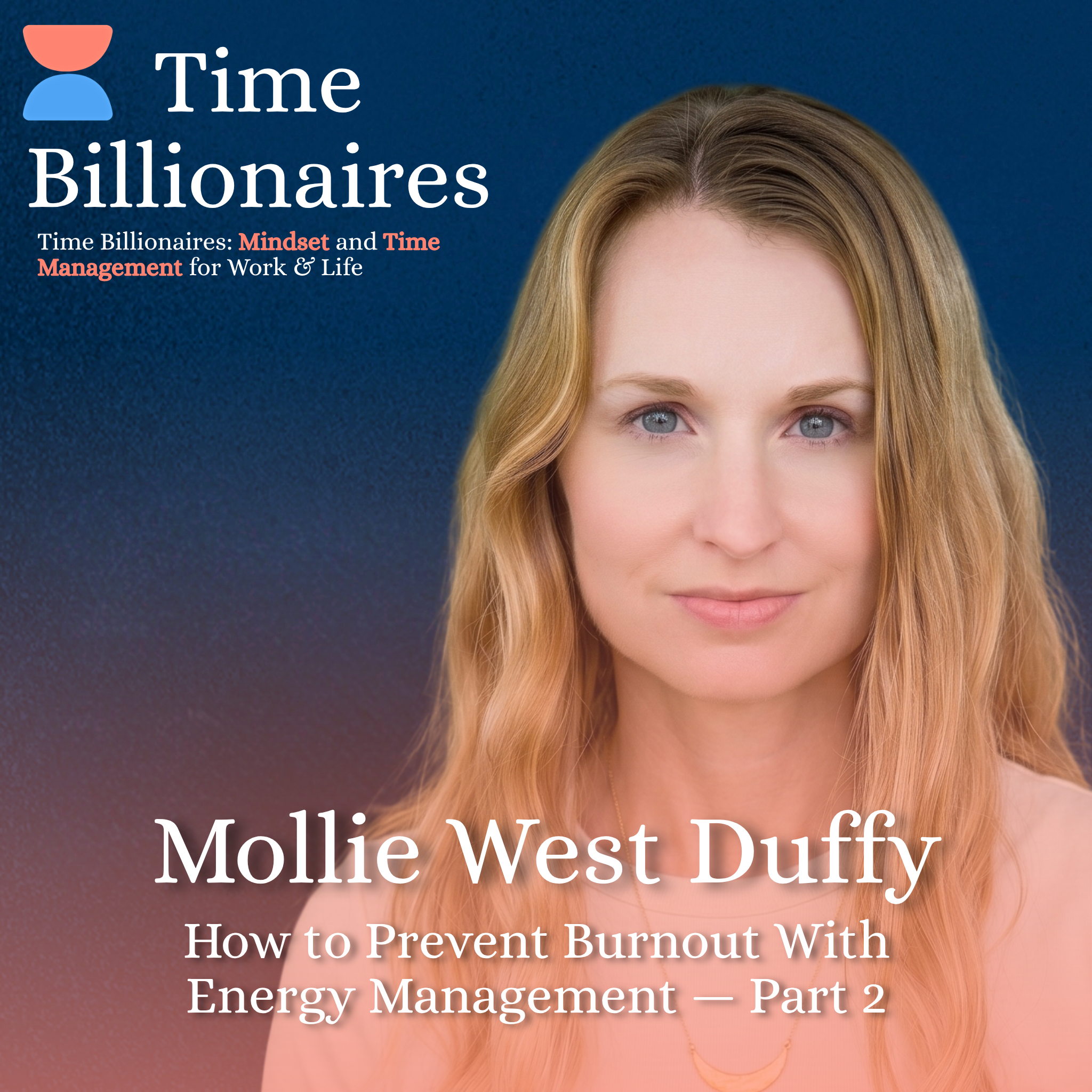
[00:18:47] Speaker B: Yeah. Well, thanks for this, Molly. This was fantastic. We will link to your website and your LinkedIn. Anything else, anywhere else you want people to find you.
That's great.
[00:18:57] Speaker A: Thank you so much. I really enjoyed our conversation.
[00:19:00] Speaker B: How should I. Thanks for this.
Thanks for spending this micro moment with me. If you found it valuable, share it with a fellow time billionaire and give us a rating to help others discover the power of micro moments. For more ways to reclaim your time, check out timebillionaires. Org and follow me Rebecca Shadducks on LinkedIn. See you next time.