Episode Transcript
[00:00:00] Speaker A: The lack of activity throughout the day is more harmful than smoking. I don't actually believe most people truly have a problem with time management is that their priorities are mismanaged. Every time you do that, you're stealing from your future and you're stealing from your time bank account. You can make more money, but you can't make more time.
[00:00:17] Speaker B: Hey there billionaire. Yep, I'm talking to you. If you expect to live another 31 years, you're already a billionaire. Not in money, but in the real measure of wealth, time. That's because 31 years is roughly a billion seconds. But most of us waste time in ways we'd never waste money. The currency of time billionaires is micro moments. The 90 second to 15 minute gaps hidden between the structured parts of your day. This podcast is about reclaiming them with quick, research backed ideas to help you feel more creative, productive and alive. Welcome to Time Billionaires. Let's make your next micro moment count.
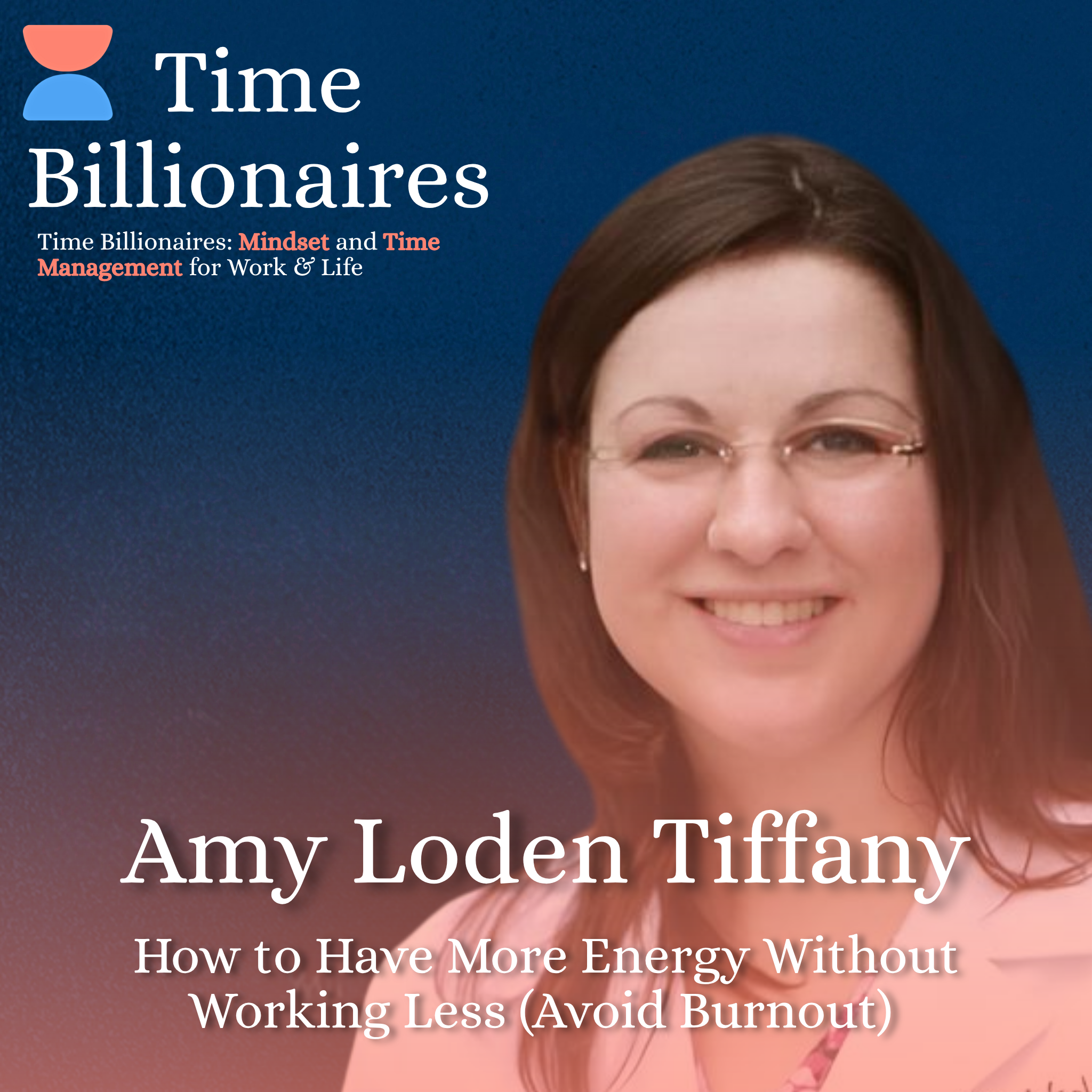
[00:01:03] Speaker C: Thanks for joining this episode of the Time Billionaires Podcast. Our guest today is Dr. Amy Loden Tiffany, a physician, entrepreneur, TEDx speaker, author and parent who helps high performers build sustainable success without sacrificing their health. Her work blends evidence based medicine with modern leadership to help people reclaim time, focus and vitality in demanding careers.
Thanks for being here.
[00:01:27] Speaker A: Oh, thanks for having me. This is one of my favorite topics.
[00:01:30] Speaker C: That's awesome because it's perfect for this audience and right before we hit record, you and I were talking about just bringing a lot of the sort of generic mindfulness advice and making it more actionable and more relevant. So for you personally, when you think about what gets your yes, what gets your no, what gets your attention, how do you very tactically go about that?
[00:01:51] Speaker A: So this has been a process for me over several years and one of the things that I love about your show is that it is very practical. And so to add back to the audience the same gifts you've given me historically, what for me makes the most sense is to spend an hour scheduled on my calendar as an appointment where I pre plan the coming week and I call it my calendar management time. And during that hour I look and say what aligns with my values, what doesn't, and what has to be done this week that is something I need to do versus something I forward to someone, someone else. And having that protected time on my calendar just to manage that time is actually what allows me to then capitalize on prioritizing because I don't actually believe most people truly have a problem with time management. Is that Their priorities are mismanaged. And when you understand your priorities, then you can plug that back into your time in a way that gives you all those minutes back.
[00:02:44] Speaker C: It's so true. Yeah. The effective forwarding or delegating is something I've personally really struggled with in big and small ways. Sometimes it's easy to feel like something is too small. By the time I ask somebody else to do it, it's too big. How do you think about doing that effectively?
[00:03:02] Speaker A: So every time I find myself spiraling in that same description you gave, I realize that I'm actually wasting time, that I'm sabotaging myself. And I have to sometimes out loud tell myself, stop it. You're sabotaging your efforts. Now, you understand that this is the long game we're playing. And to play the long game, you start with the small steps. So, for example, this morning, one of my nurse practitioners and I are editing part of our process in a service we provide patients. And I was like, I'll just record a video of me doing it. And then I was like, no, no. I just need to give her permission in our system so that she can go in and she can watch a video of someone else who's already been recording this do it. But she needs the role permission to do it. So if I trust her enough to have her do it anyway, then let's go. Go ahead and accelerate that process.
A different employee this week, I was like, I can go in and update all the credit card information on a new bank account we have, or I can give her my credit card, forward her the emails with the account information, and say, go.
So for me, it's trusting my gut to know that I have put good people, people that are worthy of the job that I've hired them to do, and then enabling them to do it and trusting that they're going to do it well. And that has been probably the most practical thing I can recommend. But you have to stop your mind in the spiral. You have to get ahead of it, because otherwise our. Our natural tendency is, I'll do it myself. It's easier if I do it. It's faster if I do it. I've done this a thousand times. It's no big deal. But every time you do that, you're stealing from your future and you're stealing from your Time bank account.
[00:04:33] Speaker C: It's so true. Yeah. And it's easy to feel like that Time Bank Account is infinite when it's not. This is something I've felt much more since my daughter was born. And especially in the early days, a Nap could be 20 minutes, it could be two hours. I didn't know. And so it was easy to say, oh, I can just unload the dishwasher, it's fine.
But where I really had to then say, if I only have 20 minutes, what am I actually wanting to get done? But then taking that now that I do have more predictability and control over the schedule, if somebody else can do it, somebody else should do it. And what felt like holding right. High standards before, I realize now for many people, micromanagement or under management can look different by each person.
So what felt like the right degree of setting high standards of how I wanted work to be done, was in retrospect, macro management. And it actually undermined what people were focusing on. Instead of focusing on playing to win, being on the offensive, doing the best job they could, and moving on, they knew I was going to go line by line and ask questions about things that probably didn't need it, or line edit, God forbid. Right. And I would do that. And that felt like the right degree of setting expectations and holding standards. But for most people, it wasn't. It actually made them do worse, work slower, and feel less autonomous over what they would bring up. And it's just easy to get caught into that spiral of, oh, I don't want to under manage either. I don't want to just ship something over to them and say, figure it out. And so just that balance of knowing who you're working with, I think is a really good point.
[00:06:02] Speaker A: Absolutely.
And sometimes it's setting those high expectations and who you hire and trusting yourself enough to know that you did a good job hiring them and, and to let them do their job.
[00:06:14] Speaker C: Yeah. Your medical work and research is really interesting, and it covers a holistic approach to things that I didn't even realize were a factor. Your TED Talk, for example, you talk about how pregnancy both reveals underlying lifelong health complications from the mother, but also can cause lifelong health complications for the baby from complications during pregnancy, which even as a parent, I didn't realize. Will you say more about that?
[00:06:40] Speaker A: Absolutely. One of the reasons I did the talk is I don't believe that outside of medicine, most people even understand that pregnancy is a huge gift when it goes wrong. And I say that knowing there's a lot of trauma experienced by people, when it went wrong, it went wrong for me. If I'd been born in a different time, in a different country, my, my children and I would have died. And so I say that with a ton of grace. And compassion. But we need to, as healthcare practitioners, be looking at pregnancy as what did it show us that was unmasked? In other words, the pregnancy didn't cause a problem, it revealed a problem that was already there. And how do we use the details from that person's health revealed by the pregnancy to then predict where her trajectory is going?
Furthermore, the children born from those pregnancies that were impacted by things like gestational diabetes or high blood pressure in pregnancy, help syndrome or preeclampsia, preterm birth, those children have different health outcomes because they were subjected to the environment of that pregnancy in which the problem was unmasked. What do I mean by that? My, for example, my children were all subjected to an environment in which I had gestational diabetes. So long term, they will all have a higher risk for diabetes as adults simply because I had gestational diabetes.
And what I realized is that most people don't know this. And so my aim was to, to get the message out, not just to people who've had pregnancies, but to everyone else, to be spreading the word. So if you're at your hairdresser and she knows that you had a complicated pregnancy, she can say, hey, did you know you need something long term? Your hairdresser could save your life, right? Or if you're at your bank account and you're setting up a new account for your now 13 year old kid and you happen to make an offhand comment about, gee, I hope you know, I don't get diabetes, I had gestational diabetes. People have the craziest health conversations in the most obscure places.
So the banker can then be like, oh, you know what, we can set up this account. But by the way, you should get that checked out when we start caring for our neighbor, because everyone knows it becomes a better situation of our community, we all know to wear our seatbelt, right? And so how did we get there? Most people in the 50s, when I, my parents were growing up in the 50s, they didn't wear seat belts.
So within 75 years we've transformed that seatbelts are the expected standard for safety. We can do the same thing if everyone knows that pregnancy is an unmasking of a mom's health rather than pregnancy happened, bad thing occurred, pregnancy over, bad thing gone. Which is how most of us think very simplistically and it's absolutely bonkers to me. So people need to be able to advocate for themselves and they can't do that when they don't know there's a problem.
[00:09:24] Speaker C: Yeah.
This undersharing versus oversharing came up on a conversation with another podcast guest, Dr. Emily Prinsloo, who teaches at Rice University.
And she talked about really how people underestimate how a little bit of disclosure about things they've experienced is immensely beneficial and can have snowball effects. So we often think, oh, I don't want to overshare, make someone uncomfortable, bring up something that isn't relevant to them. So let's just keep it sort of bland. Service level. How are you? Fine, how are you? Yeah, baby's good. But if we just share a little bit. Exactly. And people actually are really more receptive to this than we often think, and they benefit in ways we can't predict. So sharing one thing you've learned or experienced or are grateful for.
[00:10:08] Speaker A: Right?
[00:10:08] Speaker C: Versus Absolutely. You don't necessarily have to know how it'll affect somebody or where it'll be translated.
[00:10:14] Speaker A: Correct. Correct. Even if am.
You know, the classic example is all the dudes, they're like, why do I care about pregnancy? Right. Well, maybe it was your sister, mother, friend. There are everybody knows someone who's been pregnant. And so if you can just spread the word, hey, go check out the TED Talk, go talk to a doctor about this. You know, that is really important. And right now, unfortunately, most nurses, healthcare professionals, physicians, don't even know this is a problem because only in the past decade this has been started to widely disseminate. And in the medical community, it takes almost 17 years from the time science shows us something before it hits the bedside. So we're still in that first 17 year gap. And most people within the healthcare professions don't even know to be looking for this.
[00:11:00] Speaker C: Right. And the consequences of things early on, to your point, I heard this phrase, typically the earlier you experience something, the more it'll affect you. But if we don't remember these early phases of our life and we'll never have a clear counterfactual of what health would it have been if I didn't have XYZ exposure? It's something I come across a lot now, feeling the balance of what's important to wait and worry about and what isn't is this sort of fallacy. Well, we all did blank and we were fine. We all were exposed to X, y, Z of BPAs or flame retardants, and we were fine. But how common is hypertension and things that we'll never know.
Maybe you get Ms. Later on and don't know why this early exposure is so important. And so being a little more Mindful about things that can have consequences later on, I think can only be beneficial.
[00:11:53] Speaker A: And it can even be as simple for your own health. Right. Maybe you're not the one who got pregnant. Maybe you don't know someone who's pregnant. But you can ask your mom, I, you know, assuming she's alive, but you can ask her, did you have pregnancy problems with me? Right. This impacts my health. If my mother had high blood pressure, high glucose in her pregnancy with me. So knowing that about your health history, also very helpful.
[00:12:13] Speaker C: Yeah. The compounding benefits or impacts are something that really drove the mission behind Time billionaires is that we don't necessarily know how being a little more mindful, a little more present, a little more connected, moving more can have compounding benefits down the line. But it is all stacked and compounded. And so it matters to build this connection, to get more movement, feel more agency over your time. If somebody only has, let's say, five minutes in, right today, what's something you recommend that they do between tasks?
[00:12:47] Speaker A: One of the things that most people don't realize is the lack of activity. And I'm not even talking like exertional activity, just mentioned movement. The lack of activity throughout the day is more harmful than not smoking.
Think about that for a second. We always know we should. More harmful than smoking smoke, right?
[00:13:06] Speaker C: It's.
[00:13:06] Speaker A: Yes. So the lack of activity during your day is worse for you than you're not smoking.
[00:13:12] Speaker C: Than smoking. And not smoking is good for you.
[00:13:15] Speaker A: Not smoking.
[00:13:15] Speaker C: Smoking. Yeah.
[00:13:16] Speaker A: Not smoking is good for you. Yeah, but it's the, the, the. It's a double negative. So not smoking is b. Is good for you. Right.
But not moving is worse for your health than the protective benefit of not smoking.
[00:13:31] Speaker C: I see.
[00:13:33] Speaker A: And that double negative shocks people when you stop and think about it because you're like, I'm not a smoker. I'm pretty good in my diet sometimes. Right. But to your question, movement is the thing. So if you can do nothing else, even if you can't go get sloppy sweaty at a gym session, five minutes between meetings, stand up and do air squats.
Movement does not have to be crazy standing up, moving your thighs, your thighs are great big muscles in your body. And so if you are doing air squats in your office, even if you have to kick off the stilettos to do it, right, take off your office jacket and just do air squats for five minutes. Number one, most people can't do that because your thighs aren't strong enough. So you have to work up to it. You start at a minute, but just that is enough to make a meaningful impact.
[00:14:18] Speaker C: Yeah, it's great advice. A few years ago, I tore a ligament in my leg putting on my shoe. And this was after a particularly sedentary work grind session. And it took me months to recover. And I realized the time I then spent in physical therapy and doctor's offices, I found the time right. I hadn't found the time to move at all. Had I done three minutes of planks throughout the day, five minutes of air squats, a waltz it, that probably wouldn't have happened. And so when there was an emergency, suddenly I had hours a week to go to the doctor. But lo and behold, I couldn't have found minutes a day before that happened.
[00:14:53] Speaker A: Correct? Correct. It forced you to reprioritize.
[00:14:56] Speaker C: Exactly.
And we have the time right if we actually think of a week as being 168 hours. If you sleep for 50 and work for 55, you still have dozens of hours left over.
But it doesn't feel that way because they're fragmented. If we just reclaim a few of them at a time, we get the value right back.
[00:15:19] Speaker A: I think to build on what you just said, it's really important to understand that you don't get time back. You can make more money, but you can't make more time. Many people have pointed that out and you only have the time you have right now. And so if you're not intentional about how you're going to use that, you're choosing to be unintentional and there's an opportunity cost that you're not addressing. It's trade offs to everything. So my encouragement would be make the time to plan what you will do and prioritize it according to your best values so that you can have the life and the impact that you want to have.
[00:15:54] Speaker C: Yeah, it's good advice. The choice there, I think is so important, it's really easy to feel like you've given it away. If we're not choosing to be intentional, as you said, we're choosing to be unintentional. But it doesn't always feel that way. It often feels like we have no, no choice because we have to take our kids to school, we have to attend these work trips, but there's a choice in how we show up, even on the plane to those work trips, for example. And if the time is gone, it doesn't mean you can't control how you spend some of it.
[00:16:21] Speaker A: Yeah, that's right. And I choose to say I get to take my kids to school. Right. I get to go on the work trips because it's much more empowering and it allows me to then turn around. Say I get to choose how to spend my time just like I get to choose how to spend my money. Because there is always a choice.
[00:16:37] Speaker C: There is. And it's all filtered, whether we realize it or not, through lots of cultural learnings about what is worthwhile, time, what is productive, what's a good use of time. And for whatever society we grew up in.
It's just all filtered through that lens. I found that hard of when I started writing my book. I had have a very corporate productivity capitalistic mindset, for lack of a better word, because this is the society I grew up in. Spending months or weeks or even hours on a Google Doc by myself without knowing if it was promising was really, really hard for me in a way that no job ever has been. Because of that feedback validation loop of I know I was working on something worthwhile in a corporate job because I couldn't spend weeks doing something not worthwhile. It just never would happen. But having to build then that lens of what is worthwhile, it's up to us. And it's all really culturally imbued.
[00:17:32] Speaker A: Absolutely. And defining, even for yourself, what does success look like when we live in a corporate world, they give us the metrics. And when you're doing a book. I found this writing my book too. You have to say, what does success look like for day two today on this poorly defined, complex project?
[00:17:49] Speaker C: Yep. And then defining what feels like a win from the day and what's the priority for tomorrow? This are all things we can choose.
[00:18:01] Speaker B: Thanks for spending this micro moment with me. If you found it valuable, share it with a fellow time billionaire and give us a rating to help others discover the power of micro moments. For more ways to reclaim your time, check out timebillionaires.org and follow me. Rebecca Shattucks on LinkedIn. See you next time.
[00:18:20] Speaker A: Sam.