Episode Transcript
[00:00:00] Speaker A: Full calendar, empty life. The reason that most people are unfulfilled is because they're chasing somebody else's definition of success.
No man ever steps in the same river twice, for it's not the same river and he's not the same man. We should be deciding when we work, how much we work, what goes onto our calendar, what commitments to keep, and what we say yes to and what we say no to.
[00:00:24] Speaker B: Hey there, billionaire. Yep, I'm talking to you. If you expect to live another 31 years, you're already a billionaire. Not in money, but in the real measure of wealth, time. That's because 31 years is roughly a billion seconds. But most of us waste time in ways we'd never waste money. The currency of time billionaires is micro moments. The 90 second to 15 minute gaps hidden between the structured parts of your day. This podcast is about reclaiming them with quick research backed ideas to help you feel more creative, productive and alive. Welcome to Time Billionaires. Let's make your next micro moment count.
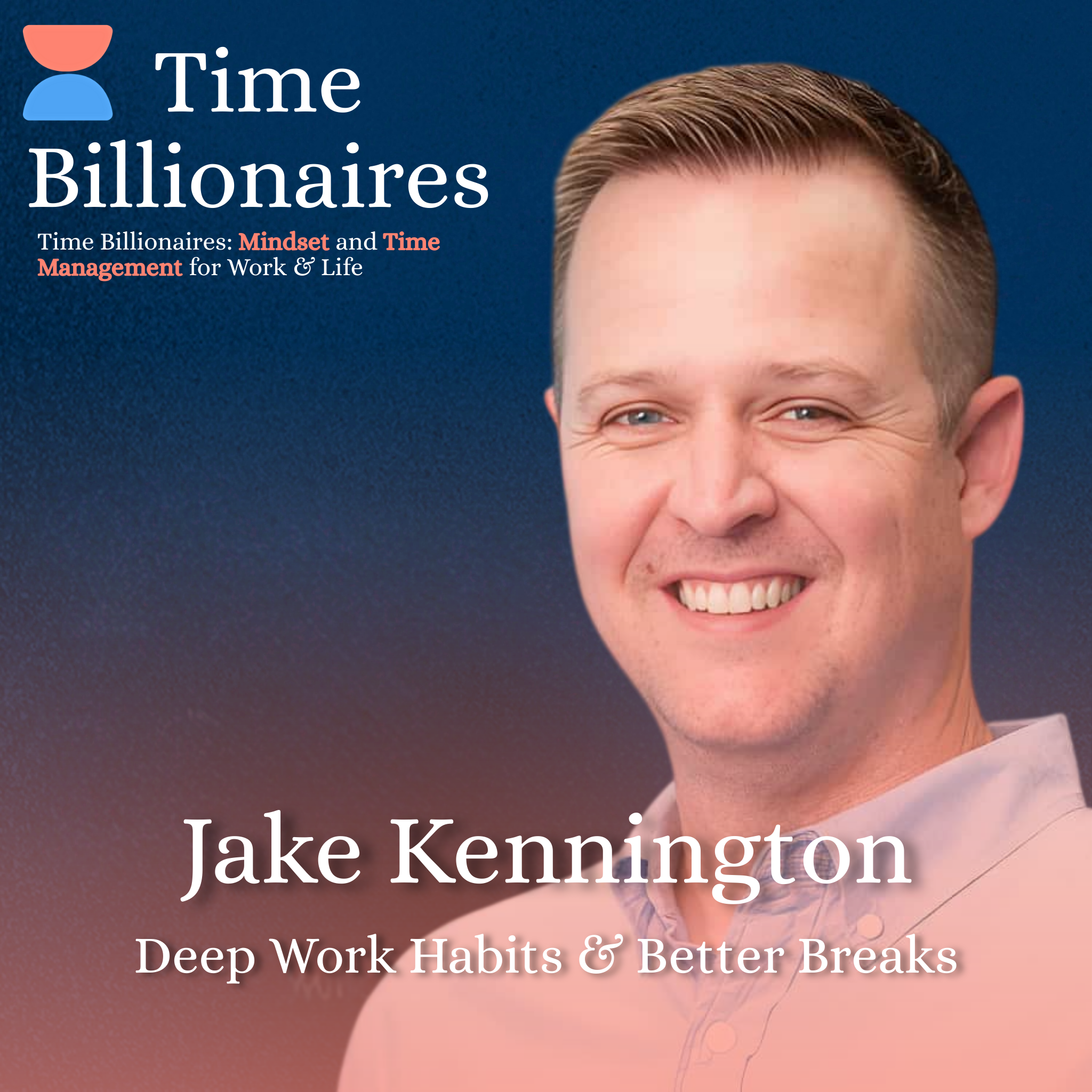
Thanks for joining today's episode of Time Billionaires podcast. Our guest is Jake Kennington. And Jake, go ahead and introduce yourself.
[00:01:17] Speaker A: Yeah, thanks for having me on the show, Rebecca. My name is Jake Kennington. I'm a licensed structural engineer. Before we hit record here, we were talking about how we're both parents. I'm a father and a husband. I've got four little kids, ages 2 through 11.
And just a few years ago I started a company called Actively Human.
It's a coaching business where I help mid career professionals design the life that they want to live right here and right now in whatever phase of life that they're in. So yeah, lots of different hats that I wear with the business and my career as an engineer and also a father, but keeps us busy. So I'm happy to be here.
[00:01:57] Speaker B: We're happy to have you. You've talked about having advice for people who feel like their calendar runs their life. What is that advice?
[00:02:05] Speaker A: Wonderful. I have a mentor that I've hired in the past, a coach for myself. His name is Richie Norton. And I'll use one of his typical sayings that he says, full calendar, empty life.
And I think we've all been guilty of that. We look at our calendar and we go, oh my gosh, there's so much going on and I'm over committed in particular to things that, you know, don't bring joy and fulfillment to me. And so it's an interesting idea that our calendar kind of runs our life when done properly, that that's a good thing. If it's full of things that, that are what we want, then then that's great. But I firmly believe that it's our job to set boundaries.
Whether that's personal or professional.
We should be deciding when we work, how much we work, what goes on to our calendar, what commitments to keep, and what we say yes to and what we say no to.
Easier said than done. A lot of times I'm not arguing that any of your listeners go to their boss and say, hey, look, I'm only going to work one day a week and it's going to be these hours. Sometimes we've got to run teams, right? And we have to do what's best for the team as well. But ultimately it's up to us to set those boundaries. And I'll share a real quick story that ties into that. Just. I think it was early 2024.
I was at my alma mater at BYU.
This is 10 years after I graduated. But I went with a friend who was in a business class. And Dwyane Wade, three time NBA champion, was there speaking at this business class. He was friends with the teacher and he came in and they just talked to business for, for an hour.
And in that hour he talked about the NBA. He talked about a lot of different things, but the thing that stuck out the most to me was his experience on the men's Olympic basketball team. And if you can imagine that there's, there's a lot of elite players on that team, those guys practically never lose.
And he said that he learned when he was on that team that it wasn't the coach's job, it wasn't the other players jobs to figure out how he could best help the team. He said it was his job to figure out how he could best help that team. Not the coaches, not the other players, but his.
And I think that's true of us as well. A lot of times we look to our boss or our career or coworkers or other people to kind of tell us what to do and how to spend our time.
And ultimately we do have to be on these teams within a work environment or church or family or whatever it is. We're all on teams. It's our job to figure out how we can best help those teams. And one of those ways is by setting boundaries with our time.
[00:04:54] Speaker B: Yeah, I find that every boss I've had is actually appreciated when I say, hey, here's who I am and how I work best. These are the constraints on my time. These are the time blocks that I'm usually most productive. So yes, I can make a 9am meeting, but I'd rather not because I'd rather be working on focus work during those blocks and then time boxing meeting, meetings in the afternoon. And they appreciate that because they want their results.
The more authoritative seeming someone is, oftentimes they just really want to get the results. And so if you can tell them, here's how I get the best results, they'll respect and appreciate that. And you reminded me of research by Cassie Holmes out of UCLA too. And she found that if we have less than two hours at leisure time on average in a day or more than five hours, we're equally unhappy. And so packing the right things into those time is really valuable. And making sure it's aligned to how you feel, you're having that unique impact.
And so these calendar management and this schedule, sometimes a lot of this free time is just in five minute blocks between structured parts of meetings, days, pickups, et cetera. So if you have just five minutes between tasks or a school pickup, for example, what's something you like to do with that time?
[00:06:08] Speaker A: What a great question.
Are you familiar with something called the Pomodoro technique? Have you heard of that before?
[00:06:14] Speaker B: Yep, it's great. And I found that when my daughter was on 27 minute naps, she was my Pomodoro timer.
[00:06:19] Speaker A: Yeah, that's fantastic. You mentioned to me you have a three month old at home. And so the 27 minutes, I understand that. Like I said, I've got four kids. So kids, timelines are very short. Right. We love the Bluey episodes, a show on tv and they're seven minutes long. And so about the attention span that they have. Right.
But your question about what do I do with, with five minutes in between tasks?
I bring up the Pomodoro technique because I heard of this first from a guy named Jerry Seinfeld, pretty popular comedian. He uses this technique when he writes his comedy. So he'll sit down for 25 minutes, he turns on a timer, he, he does his deep work of writing and thinking and editing and getting his comedy on the page. And then once the timer goes off, he stands up, he walks around. And the rule is during the 25 minutes, work on what you're supposed to be working on.
And in the five minute break, don't work on it. So it really doesn't matter what you do in those five minutes. I would just add that whenever I'm doing deep, focused work, I kind of use a method similar to Pomodoro. I'M not always putting a timer on per se, although I do that sometimes. But I will take these kind of intermittent breaks throughout the day every 30 minutes or so, 45 minutes. And my rule is just get out of my seat. So walk around, get a drink, use the restroom, go outside is a big one for me. Five minutes is short, but it's not time to be focused on whatever I was focused on before. It's to let the kind of the mental dust settle. Right. And then what you find is when you come back to the work to go kind of a second round or third or fourth round, that you're much more focused.
And so I think we can learn something from our children. Right. That maybe we shouldn't be spending an 8 hour workday cramming 8 hours of work in that we need those breaks every so often.
[00:08:16] Speaker B: Yeah. And it makes the work better. I love that you referenced that. I actually have a posted on my monitor that just says stand up because just that physical distance and makes then whatever I spend those five minutes on, not the same motion. There's some interesting research that to be most effective, the more different the break is from what you were doing, the better. So ideally this break is not scrolling emails, it's not even scrolling social media because that's similar probably to what you were doing at your desk. If it's just standing outside and getting sunshine on your face, that's actually enough to rewire and reset. So yes, the, the act of standing up, even if you have no idea what you're doing, is still better than staying where you were with a break, scrolling on your phone.
[00:09:00] Speaker A: Sure, absolutely. I agree with that a hundred percent.
[00:09:03] Speaker B: Yeah. You've had interesting thoughts too about why a lot of people are unfulfilled in their lives and their careers. I'm hoping you could share why you think that often is and what you recommend people do about that.
[00:09:15] Speaker A: Yeah, this is a loaded question.
There's probably a million right answers.
But what I found is that the reason in my own personal journey and the people that I work with in my coaching business, the reason that most people are unfulfilled is because they're chasing somebody else's definition of success.
So. And it's really easy to do that. I, I've done that. I continue to do that sometimes. We've all done that. There's kind of this mass trance that we have in society. We call it the status quo. Right. Where we kind of just do what other people do and, and oftentimes that's a good thing because A lot of people are doing good things, and we also want to do those things. But when we simply follow the leader and do what everybody else is doing, that might not fit our definition of success. And so a large part of my coaching for the first several weeks when I work with somebody, we get really clear on what the individual's definition of success is in that phase of life for them. And in fact, what's interesting about that, I have this on my. My screen, on my phone here. A quote by a guy that lived many, many years ago, I think over 2000 years ago. His name was Heraclitus, and he said this. He said, no man ever steps in the same river twice, for it's not the same river, and he's not the same man.
And so when I started my engineering career almost 15 years ago now, I wasn't married at the time. I didn't have any kids. I lived in a different state.
There's been a lot of big life changes that have happened, not only externally with my situation and circumstances, but also me as a person.
And so that quote about the river and the man is, the river is life. It's always changing. It's always moving. It's very fluid.
But the person as well, we as individuals are also changing. And so our definition of success could and should change as we progress through life. So for you, Rebecca, as a new mom, like, there's probably a lot of things that you would rank as higher priorities now that you're a mom, as opposed to not being a mom before. Maybe that's time with your little one. Maybe that's time with your husband. Maybe that's just. Whatever it may be, those priorities are now shifting and moving around. What happens is, oftentimes we become unfulfilled because we don't take account of those new priorities, that new version of us and the new phase of life. And we keep doing what we did before, and so we have to constantly reassess and redefine what success means for us.
[00:11:58] Speaker B: So true.
Yeah, a couple things came up for me with that.
The quote reminded me, the saying that there's no such thing as siblings being born into the same family, because by definition, the family changes with the introduction of each new sibling. So your oldest was not born into the same family as the youngest. Obviously, you and your wife were in a different situation, but they also had three more siblings or not. So there's no such thing. Right. As a static family dynamic or a static person, hopefully. And that's a good thing. But when we cling to goals from past versions of ourselves. It can feel misaligned. And then I think that can be pretty disconcerting when we don't know why something that we've worked hard for isn't bringing us the joy that we expected.
Possibly because the person who set the goal isn't the one reaping the rewards. Right now you've changed, which is ideally a good thing, but. And part of that growth is I heard this other saying that you don't opt into status quo intentionally, but you can opt out of it. So we were all born into a society to a set of values, to a family structure that had a set of expectations that we never opted into. And we just absorbed those messages for years, unintentionally. We can decide that those are the messages that actually do make us happy. But it actually takes more effort to then opt out and decide something that you taught was modeled to you isn't aligned with who you are. And that can change. And thinking that it's static, thinking that there's something wrong with you because there's dissonance between what you want and what your parents wanted for you, I think to your point is a recipe for unhappiness for everybody. And yes, those pro social behaviors are good. We need them. We need to be aligned with our communities.
But we want to intentionally opt into the version that works for our definition of success and our values at that time.
[00:13:53] Speaker A: Yeah, I love that the word you keep using is being intentional. Right. And so like you said, we kind of grow up like the, the fish in the water. It's. It. It doesn't know it's in the water because it's always been in the water. And at some point we, we kind of wake up, so to speak. And we realize, man, I, I could be a lot more intentional with my life and how I choose to set up my calendar and spend my time and what my priorities are. And. And that all comes back to this definition of success. And then you use the word alignment. And so in with actively human and the people I coach, we use a framework called redac R E D A C, which stands for redefine. So redefine success like we just spoke about. And then realign, which is, okay, we have a definition, but how do we apply that into our life? Like how do we show up and implement this? So how do we realign our lives to what matters most and then reconnect is the last one. And I'll just share this real briefly.
I was looking through.
I'm a Big journaler. At least in the last couple of years, it's really helped me kind of slow down and be intentional, like we're talking about with what I'm doing in my own life. And I've gone through my journal recently and I wrote down a bunch of stats of my own life, just some numbers that I find fascinating. I've lived in 25 houses and I turned 40 in February. So I'm not, I don't feel like I'm that old. But in my 40 years on this earth, less than 40 years, I've lived in 25 homes. I've lived in 14 different cities.
I've had 40 or more roommates. And that's not including like my own family, siblings, my kids, that, that's people outside of my family. I've lived in two countries and I've had 22 jobs.
Wow. And the reason I say all that is because I've been around a lot of different people in a lot of different circumstances.
Oftentimes we kind of get in this bubble of we just go, go to work, come home, and we live in like in a two mile radius of wherever we live. That's our environment.
But I've been to quite a few places on the earth and met quite a few people. And the two thing, my two takeaways about people. What I've learned about people is one, they want to be engaged in the work they do.
Sometimes we become disengaged as employees or even if we own our own business. But we want to be engaged, we want to be challenged, we want to be doing meaning and deep work. We all want that. And my second takeaway, the second thing I've learned about people is that we want to be connected to others.
We need relationships to thrive.
And so again, in the redact framework, that last part is reconnecting with not only yourself, but your loved ones, your family, your friends, and nurturing those deep relationships. Because I think those are crucial.
[00:16:38] Speaker B: They absolutely are. Yep. All the research shows that's what makes us happiest at the end of the day. Thanks for sharing, Jake. Really appreciate it.
Thanks for spending this micro moment with me. If you found it valuable, share it with a fellow time billionaire and give us a rating to help others discover the power of micro moments. For more ways to reclaim your time, check out timebillionaires.org and follow me. Rebecca Shadducks on LinkedIn. See you next time.