Episode Transcript
[00:00:00] Speaker A: I work with so many people who are in a place of, you know, severe anxiety or severe depression. And a constant that I really hear from them is I just feel like I don't have control over anything. And so when you teach someone to use their breath, suddenly you have control over one thing. And I was in the exact same situation. I felt like I had control over nothing.
[00:00:28] Speaker B: Hey there, billionaire. Yep, I'm talking to you. If you expect to live another 31 years, you're already a billionaire. Not in money, but in the real measure of wealth, time. That's because 31 years is roughly a billion seconds. But most of us waste time in ways we'd never waste money. The currency of time billionaires is micro moments. The 90 second to 15 minute gaps hidden between the structured parts of your day. This podcast is about reclaiming them with quick, research backed ideas to help you feel more creative, productive, and alive. Welcome to Time Billionaires. Let's make your next micro moment count.
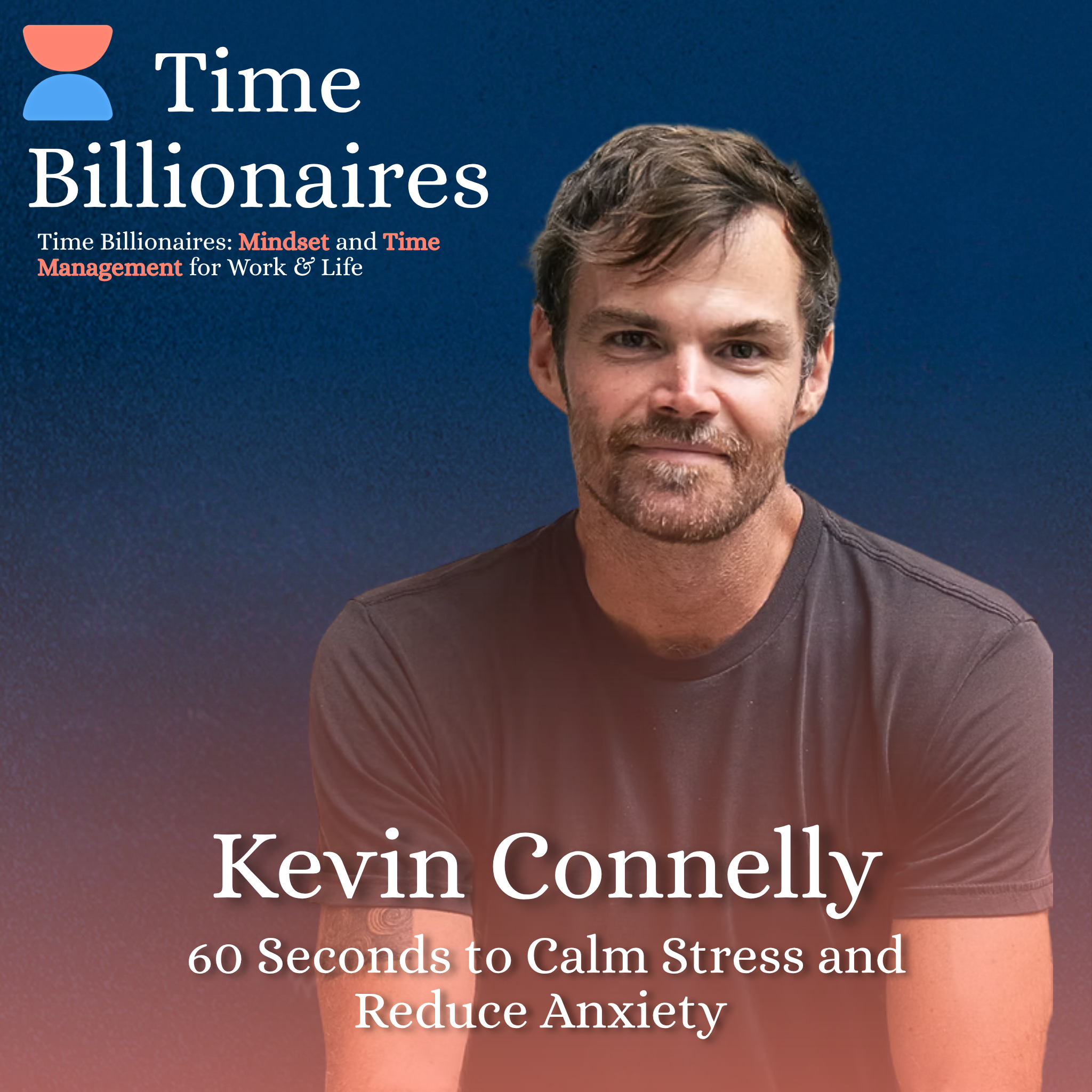
Welcome to today's episode of the Time Billionaires podcast. Our guest today is Kevin Connolly, an author and researcher who teaches breathwork and functional breathing techniques to athletes, therapists, first responders, and addiction professionals. His work combines physiology, neuroscience, and history to teach his clients the most natural and powerful methods for managing stress, releasing anxiety, and gaining stronger emotional control. Thanks for being here, Kevin.
[00:01:38] Speaker A: Thanks so much for having me, Rebecca.
[00:01:40] Speaker B: Pleasure is mine. I would love to start with how you got into this work.
[00:01:46] Speaker A: So I was working in human trafficking prevention back this was back in 2020 and just, you know, really due to the nature of that work, I started to become very depressed. I started to become really overwhelmed and kind of had a. Developed a dark side of like, oh my God, the world is terrible.
And found myself in an extreme depression. And I then was led to addiction to kind of try to manage my depression.
And I didn't want to kind of take the traditional therapy and meds route. I'm not anti therapy, but I just wanted to try and heal differently. That's when I found breath work and I wanted to kind of just dive in. So I joined an online instructor course and within 10 days, my, my depression was gone. My anxiety was, you know, now I had a tool for managing it. My insomnia was gone. I was sleeping through the night for the first time in years.
And that was kind of the, the changing point in my life.
[00:02:54] Speaker B: Yeah, the idea that that could happen in just 10 days is hard to believe even as someone who practices breath work regularly. For people who are skeptical, that breathing is actually something that they need to practice or learn how to do or can have the impact that you've just described. What would you say to them?
[00:03:12] Speaker A: I didn't believe in it. I just thought, you know what, maybe I'll try this. So I was going in completely skeptical.
And, you know, since then I've really tried to reverse engineer everything that happened to me.
And I really feel and believe that so much of it was physiology.
And the way that I had been treating my body and the way that I had been breathing really affects the way that your body responds to stress, that your body responds to anxiety, and that your body processes emotions.
So once you actually learn how to use your body in a healthy way, you start to see that it's not just about sports, it's not just about being physically healthier. It's about learning how to use the, the parts of your body that you were given to help you do things like get over different difficult emotions, to get all over difficult ailments and work through mental health issues.
[00:04:18] Speaker B: Yeah, absolutely. And it's in our control, which I think is powerful because when we're in these cycles of despair, it's easy to feel like our breath is just naturally fast and happening to us. But the idea that you could just stop and control it if you're feeling out of control of your time, of your energy, of your day, of your career, that is really the smallest dose of control you can take is how you're breathing. And the fact that the benefits compound into this positive, virtuous feedback loop as opposed to the spiral we find ourselves in and often feel like we can't control, I think is really powerful. And something I've never talked about on the show before and was so excited to make the connection was that I also did human trafficking research and work to a lesser capacity than you. I wasn't as hands on. I was on the policy research side in 2014 and I, I do know that it can be really despair inducing when we see these horrible sides of humanity and people who will abuse children for profit, it's really devastating to, to witness and be part of and see.
So the idea then that you could take control and pull yourself out of it in just 10 days, I find really powerful, but also not entirely.
I mean, I, I'm surprised It was just 10 days, but I've seen the benefits in smaller doses. So like, let's go even smaller. Let's say somebody listening has just two minutes between meetings. What's a breathing practice that could help them reset?
[00:05:42] Speaker A: So back in the early 1900s. They were doing some research around some cedar trees, and they were injecting these mushrooms with poison. And they found that when they injected too much poison, the mushrooms would die. When they didn't inject any poison, they would stay the same. But when they injected a small amount of poison, they actually became stronger and bigger.
Hence they formed this idea of hormesis, which is when you apply a small amount of stress to any living organism, it. It becomes stronger and healthier.
So sauna, ice baths, fasting, even public speaking are all forms of hormesis. So for a lot of people that I teach, what we can do in between meetings sometimes, and this is just to help your body become adaptable and familiar with stress.
And so how you can do it is you can take six breaths in through the nose, and you want to do it with me really quickly? Okay.
[00:06:51] Speaker B: Yeah, let's do it.
[00:06:51] Speaker A: So in through the nose, out through the nose. Okay. So breathing in, letting go.
In, out, in, out.
Three more.
Last one. You're going to breathe all the way in, you're going to let it go.
And then you're going to hold and you're going to relax your chin, relax your jaw, relax your face, relax your shoulders.
And you're going to inhale in 3, 2, 1. Breathe in and then let go.
Now, this is an exercise for, again, increasing your adaptability.
It's not something that you want to do in between meetings where you're super stressed for that. You always want to just work on slowing your breath down. So breathing in for six seconds, out for six seconds. All through the nose? No, in and out through the mouth. Everything through the nose. So sometimes I teach all different types of exercises, but if you want to think it very simply, if you want to activate your body, in and out through the mouth. If you want to calm your body. In and out through the nose.
[00:08:21] Speaker B: Yeah. And the speed of that, I think, is great. There's a lot I want to pull on. The idea that we can grow after traumatic situations is something I learned about fairly recently. We've all heard of post traumatic stress disorder, but post traumatic growth is very well documented, too. So that response to the stimulus, it's very much within our control, as Viktor Frankl and others have reminded us. But how we deal with that discomfort, I think, is the beauty of the practice you're describing. Holding and breathing for six counts, in and out, wasn't easy for me when I first started trying to do it. And I found myself just wanting not to. Just saying, this isn't comfortable. I don't want to do it. I would rather go outside, do something pleasant.
But how we practice this micro discomfort is really just a training strength rep exercise. If I can do something a little uncomfortable for 30 seconds or a minute, then how do I respond to bigger discomfort? And what does that mean for leaning into growth opportunities going forward? So I think that this response practice is really powerful for the immediate benefits of breathing. If you want to practice your long term adaptability, as you said, we'll go in and out six breaths more quickly. If we want to de stress between meetings, we'll take six counts up, six count out. So we'll slow down. But these are just response practices of how we respond to discomfort. What we do when our body is telling us something isn't natural and a lot of the things that we need to lean into are scary. Big changes, a move to a city or taking a job that doesn't feel obvious, that's a happier, more fulfilling life if we lean into it and if we are perpetually running away from the discomfort, that's a less satisfying life over time. So I love the idea that in two minutes you can actually work on that. And I believe it to be true. How we practice to your example, hold plunges does not come naturally to me. My body screams to get out. But if I say no, I committed to 60 seconds in here, I can do it. And that's just a practice of what do I do the next time I'm uncomfortable and my first reaction is to run, can I lean in instead?
[00:10:21] Speaker A: I love that. Yeah. And you know, I work with so many people who are in a place of, you know, severe anxiety or severe depression. And a constant that I really hear from them is I just feel like I don't have control over anything.
And so when you teach someone to use their breath, suddenly you have control over one thing. And I was in the exact same situation. I felt like I had control over over nothing.
And giving yourself control over something in your own body sounds really small.
But when you're in a situation like that, when you're, you know, suicidal, when the anxiety is so strong you can't even get out of bed, feeling like suddenly you do have control over something in your body can really change everything.
But as you learn to slow your breath down so much more.
I mean, I've been collecting and analyzing research for years now and seeing the chain reaction of what happens in your brain and your nervous system, in your endocrine system and your lymphatic system, it literally is affecting all of those Systems at once just by slowing the rate of your breathing two times.
So for most people, they breathe about two seconds in and out. If we can just work on doubling that, we have this massive not just control, but impact on the way that our body is feeling. And when you said you, you couldn't breathe in for six, I was the exact same way when I first started. So I just started with three. I started with what I could do and then I would slowly start adding time until I was getting up to, you know, eight or nine seconds. And that accomplishment just felt, you know, so incredible to me.
[00:12:18] Speaker B: Yeah, I bet it did. For me. It only took three days to go from I can't make it to six seconds to I actually can do eight. And that's powerful. I'm aware of research too that shows that agency over how we spend our time is a fundamental human need too. And a lot of the high performers I talk to and I imagine you work with feel like there isn't control over our schedule. We have to do X, Y, Z. So I think this practice of reminding ourselves that we do have control over things that we may not realize it start with our breath can then be other micro moments control over our time. It's a compounding agency builder. And so that self efficacy and agency can really start that small. But we all need to feel like we have agency over our lives and our times. Even toddlers. Lot of toddler meltdowns is from this sense of total lack of agency or control. It's a wired fundamental biological human need that we can't violate. And reminding ourselves that we probably do have more control than we thought in places we may not have thought to look in our breath in the 90 second gaps between meetings compounds for the benefits not just with what you do with that, but the mindset it builds of looking for other opportunities to feel this internal locus of control.
You were actually the first person I heard to describe breathing as a high performance skill.
Anything more you want to say to that end?
[00:13:39] Speaker A: So many people in high performing environments have so much coming at them at once.
And they understand that they need to be able to calm their body, to control their body. And the biggest lever that they have for that is, is their breath.
Because as we get through and conduct more research, we're just kind of seeing that this is the, the tip of the iceberg. That breath work is probably one of the easiest and fastest ways to calm yourself, to regulate yourself and to keep yourself under control. Especially when you're at a board meeting speaking in front of Press going up onto a stage, performing whatever you might be doing.
[00:14:26] Speaker B: Yeah. And that doesn't just help you appear more in control or competent, which it does. But the research I'm aware of too also shows it helps us make better decisions and communicate more effectively. So when we do have that control over our breath and our body and prevent ourselves from spiraling into fight or flight in situations that don't warrant it, or even situations that are high stakes, we'll make better decisions, we'll communicate more effectively, we'll get the results that we want.
So it's not just a look and appear competent is actually be more effective in your job.
[00:15:00] Speaker A: They've also done some great research on addiction. So I work with a lot of first responders in environments where addiction is actually very high because of the nature of the work. They're in these incredibly high stress environments.
And they found that people experiencing addiction, and this could be addiction to alcohol, it could be cell phones, it could be Netflix, whatever it might be.
They found that when they get triggered, there's three things that happen. The first thing that happens is that their breathing shifts upwards into their chest.
This is where none of your respiratory muscles exist.
So naturally, the next thing that happens is they start to breathe faster because you can't take full deep breaths from your chest.
The third thing that happens is their breathing becomes irregular. So rather than an even inhale and exhale, it's a shorter inhale, then a longer exhale, then a longer inhale than a shorter exhale. And that has all this. This basically puts a lot of stress on the heart.
It starts to send signals to your amygdala, which is your, your fear center in your brain, that your body is on alert. And so just by the simple exercise we were talking about before of slowing it down to six seconds, breathing downwards into your belly, it seems like the most basic thing, but when you're in a high stress environment, just simply doing those three things, breathing slow, breathing down into the belly, and breathing evenly or coherently, as we say, is going to start reversing your body's stress response. Well, I think for many people it's still breath work. Just the word breath work sounds very fringe sounds very woo woo for a lot of people.
But you know, I think there's a big reason why golfers like Phil Mickelson, musicians like Chris Martin, all different types of athletes, have been implementing these practices, even if it's just a few minutes. And I think that's what I want people to understand is that this is not something that needs to take 30 minutes or an hour.
Just by focusing on it for a few minutes intermittently throughout the course of the day, you can really start to actively change the way your body responds to stress.
[00:17:37] Speaker B: Absolutely, yeah. Just six focused breaths a day can change your physiology.
Part two of this two part episode is coming to you next week.
Thanks for spending this micro moment with me.
If you found it valuable, share it with a fellow time billionaire and give us a rating to help others discover the power of micro moments. For more ways to reclaim your time, check out timebillionaires.org and follow me. Rebecca Shattucks on LinkedIn. See you next time.