Episode Transcript
[00:00:00] Speaker A: Mindfulness isn't about never thinking about other things. It's not about silencing your mind. If you think you're bad at meditating, what you're actually really good at is noticing that your mind is wandering, which is what the practice is all about. So you don't have to make the coming back to the present a walk of shame.
[00:00:18] Speaker B: Hey there billionaire. Yep, I'm talking to you. If you expect to live another 31 years, you're already a billionaire. Not in money, but in the real
[00:00:27] Speaker C: measure of wealth, time.
[00:00:29] Speaker B: That's because 31 years is roughly a billion seconds. But most of us waste time in ways we'd never waste money. The currency of time billionaires is micro moments, the 90 second to 15 minute gaps hidden between the structured parts of your day. This podcast is about reclaiming them with quick research backed ideas to help you feel more creative, productive and alive. Welcome to Time Billionaires. Let's make your next micro moment count.
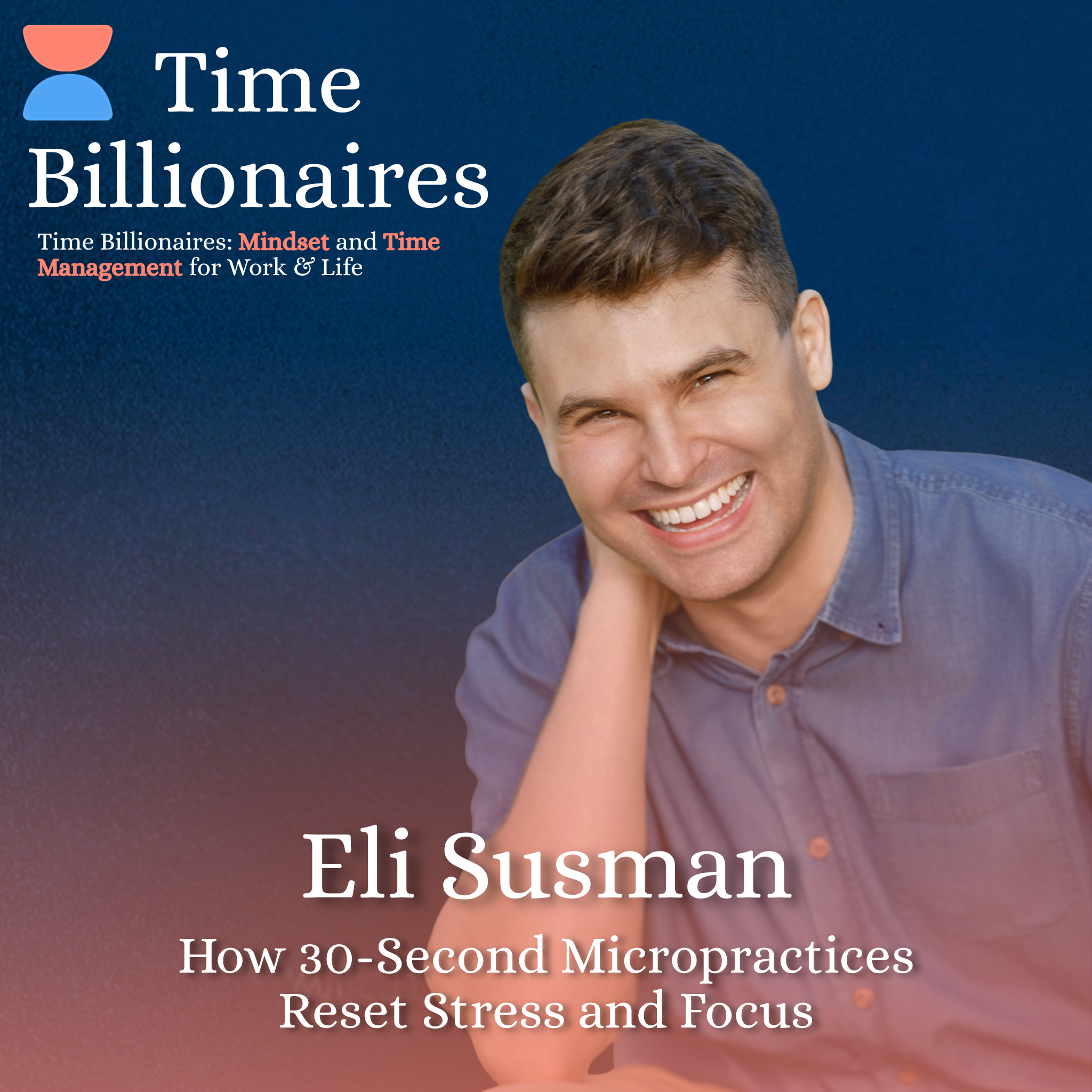
[00:01:02] Speaker C: Thanks for joining today's episode of the Time Billionaires podcast. Our guest is Eli Sussman, PhD, a UC Berkeley trained psychologist, former Harvard researcher, and author of Micro Practice, a science Backed approach for Calm, clarity and joy in 30 seconds or less. His research has been featured in more than 100 outlets across 30 languages, including the New York Times, CNN and BBC.
Drawing on his background as a longtime meditation practitioner and facilitator, certified yoga teacher, and laughter yoga leader, Sussman brings together scientific rigor and lived practice to show how well being can become a way of being. Which is of course very aligned with the premise of this show.
And we were introduced through a mutual connection. Thank you, Adam. Which was wonderful. But realized before we started recording that there's actually more overlap of our interests and our backgrounds than we realized, which includes improv. And so this combination of yoga meditation, your research, gives rise to a pretty unique combination of insights that we don't often see. I'm curious if you could start how did you get into this work and this practice?
[00:02:10] Speaker A: Yeah, so you know when mindfulness really had a huge impact on my life when I was growing up, and it was around that time that I also discovered the work of Thich Nhat Hanh, who is a Buddhist monk nominated by Martin Luther King for the Nobel Peace Prize, and I went out, did a month long meditation retreat at his, you know, kind of main monastery meditation center called Plum Village. When I was at Plum Village, one thing that really struck me when I got there was how the schedule only had about 30 minutes of formal seated meditation, including for the Monks who live there. So you know, one point I decided to see what it'd be like to spend some more time with formal seated meditation practice. And I, you know, later I went up to a monk and proudly said I just meditated for three hours.
Almost like I was expecting some shiny badge for my efforts. And his eyes widen, he said, three hours.
And then he smiled and he said something I'll never forget.
How about three breaths? That's all you need to tune into the present moment.
And I remember thinking, oh, here I was having walked over like I just skilled spiritual Everest. And with one gentle question, he helped me see I've been measuring the wrong thing entirely.
It was humbling, but, but also incredibly freeing because most of us aren't short on good intentions, we're short on time.
And it had me wonder, what if something as quick as three breaths, something that takes just 30 seconds or less, could actually make a difference in people's lives?
That became the through line of my research at Harvard and UC Berkeley. And I found that just 20 seconds a day of this practice I developed called Self Compassionate Touch, basically involves things like placing your hand over your heart and belly or whatever helps you feel compassion towards yourself pair with a kind inner voice. 20 seconds a day was associated with improvements in self compassion, stress and emotional well being, with effects comparable to much more time intensive interventions.
And that's really what led me to coin the term micro practice, which I define as, you know, wellbeing practices that take no longer than three deep breaths, 30 seconds or less.
[00:04:49] Speaker C: It's brilliant. Yeah, we really do live in a more is more society. Our workplaces aren't designed to treat efficiency as a sign of better productivity. We would see somebody who can finish a three hour project in three breaths as needing more work or, or more challenge or doing something easier. And really your research has shown that's not the case. Which I think sounds almost too good to be true or too simple to be true for a lot of people listening. So for anyone who does have that misconception or the skepticism, what would you say about how to get started or what to do?
[00:05:27] Speaker A: So I'll give you some examples.
You know, 30 seconds of slow deep breathing is know breathing in for four seconds, breathing out for six seconds has been shown to increase alpha and theta waves in the brain which are associated with calm and relaxation.
10, 5 to 8, 10 second bursts of vigorous physical activity, things like jogging, the catch the bus or uh, you know, hauling groceries up to the stairs. There's 5 to 810 second bursts of that every day and non exercising adults was shown to reduce mortality risk by 44 to 54%. That's the risk of dying from any cause over the course of seven years.
Life isn't lived in 30 minute meditation sessions. It's lived in the other 23 hours and 30 minutes of your day. I wrote micro practice for those other 23 hours and 30 minutes because that's where mindfulness and all these practices truly shine, you know, not by pulling us out of life, but by calling us more fully into it.
[00:06:39] Speaker C: Yeah, it's so great. I love a lot of what you just said for a lot of reasons. A couple of them are you can do these anywhere, right when you just reminded me. Now I do this research every day, but you reminded me to start while I was listening to you. Taking, breathing. Four deep breaths in and six deep breaths out. Anyone can do that in person or on a virtual meeting and it doesn't look any different. You can be in a doctor's office waiting room, doom scrolling, or you can look around at the surroundings, notice something new, which really is the core of mindfulness, noticing where you are in your surroundings. And if you give yourself that task, there is no change to your day. There's no schedule disruption. It's the exact same minutes you're already wasting on things that don't make you happy, that can rewire how you experience what's right in front of you, but then also the rest of your day. And that was really the crux of I sort of had this aha moment, really working hard, hard, hard for years on time management and productivity management because I was convinced that's what I needed to do to advance in my career. Work harder, optimize more, schedule more. And I found so much of the advice really requiring a audit or a schedule log and then a shift and even the advice of how to audit. What did you do for the last 30 minutes? Well, if there's only one option, I checked my email, brushed my daughter's teeth, did some dishes, prepped for this podcast. So how am I going to code 30 minutes? Most of us don't have 30 uninterrupted minutes. So the crux of a lot of the traditional time management advice I find to be just at odds with modern lives, especially for people who have kids or any kind of neurodivergence, anything, it just doesn't work for us. And with this, wherever you are, whatever you're doing, it can weave into your day and that consistency doesn't have to look the same every day. Parking farther to carry your groceries, doing 10 push ups between meetings really is an energy boost. And you've just shared some impressive stats of what it changes, but it doesn't require any change to our day. We're not giving anything up to bring more in. So it's really the antithesis of hustle culture or maxing that seems to be all the rage these days. It's just appreciating where you are and what's right there. And I was really touched in your book and then when you were speaking about the impact mindfulness had and the way it didn't work for the teens in the residential treatment facility you worked in. And I found that a lot of you cited one of them as saying, I can't even do nothing right. And I think a lot of this advice does set us up to feel like failures. Doing nothing is hard for a lot of people, especially if there's any kind of trauma. Being still with your thoughts can be where they creep in. And that's where a lot of this addictive adrenaline of being busy and scrolling takes root is we don't want to be alone with our thoughts. But you're saying we don't have to. We can take three deep breaths. We can do, as you talked in your book, some improvisational dance, which I'd love for you to share more on. And however we're showing up that day works. So will you share more about some of these other mindfulness techniques, including that improv dance, and then maybe say a little bit about your work with contact improv too?
[00:09:56] Speaker A: You know, in, in the book, I call it like micro dancing because, you know, they're like, it's basically just doing an improvisational dance for like 30 seconds or less. And you know, tell me you don't feel different after dancing for 30 seconds. Right.
It, but, and, and that really came from my, my practice of contact improvisation and improvisational dance. You know, I never saw myself as a dancer. Like, I was like that, that kid who'd be like standing awkwardly at the, at a school dance, like a collection of elbows, you know, and there's not really a wrong way to do it because it's, you know, we've come to see dance as kind of like a spectator sport rather than something that is about what you're actually experiencing.
The kid was like, I can't even do nothing right. You know, they, this was something that, that they couldn't do wrong. If you're someone who's, you know, practice staying composed no matter what, you know, throughout your your whole life. You know, another practice in non reactivity might not be the relief that you're looking for.
[00:11:10] Speaker C: Yeah, there's a lot of anything improv that I think just. And everything you just said that parallels to life, right? This identity tied up and I'm not a dancer so I won't try. That's not for me. That's a prejudgment before we've tried it. This sense of performing versus experiencing, that's life too. How many jobs do we take because they look good?
Focused on what it looks like, but not how it feels to experience it. And a question I get a lot when I'm talking about micro moments is, well, okay, so if I do it, I don't remember what I was reading or I was thinking about my work email. What's even the point?
[00:11:50] Speaker A: Mindfulness isn't about never thinking about other things. It's not about silencing your mind. You know, if.
If you think you're. You're bad at meditating, what you're actually really good at is. Is noticing that your mind is wandering, which is what the practice is all about.
And so you don't have to make the coming back to the present a walk of shame.
Micro practice isn't about pausing and then just going back to your day as if nothing happened. It's. It's about becoming the kind of person who pauses. The kind of person who takes a moment to care for themselves. Even when things feel overwhelming or busy or unpredictable. If there's something. If there's one thing that I want people to take away from the book, it's this. Well, being doesn't need to be something that you step away from life to do. It could be something that you live.
[00:12:44] Speaker C: That's great. Absolutely. We don't need a month long retreat in Plum Village to see the benefits today. It's great advice.
[00:12:55] Speaker B: Thanks for spending this micro moment with me. If you found it valuable, share it with a fellow time billionaire and give us a rating to help others discover the power of micro moments. For more ways to reclaim your time, check out timebillionaires.org and follow me. Rebecca Shadix on LinkedIn. See you next time.
[00:13:16] Speaker A: Sam.