Episode Transcript
[00:00:00] Speaker A: My clients often will laugh because I'm constantly making this wave motion with my hands, reminding our, reminding myself and reminding them. Being a human being is living on this wave. So to me some of the most important things are effectively restorative moments throughout the day where we can give the nervous system that break. So it just takes being extra intentional about giving ourselves that, that somatic nourish.
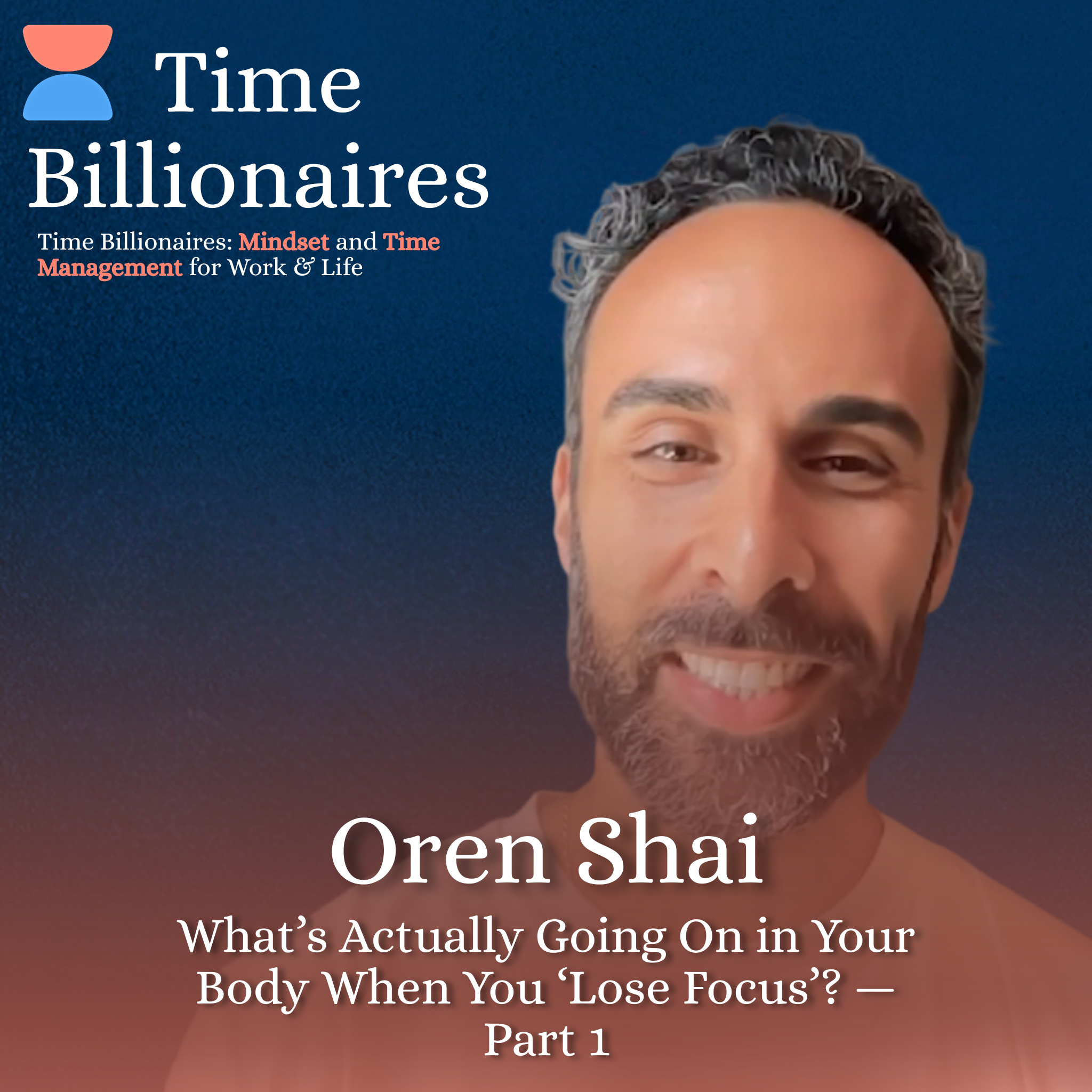
[00:00:41] Speaker B: Joining us on the podcast today is Oren Shy, an organizational psychologist and neuroscience based executive coach.
As the co founder of Feeling School, Oren teaches his signature methodology to high achieving leaders seeking to integrate cutting edge neuroscience with depth and humanity, helping them step into their most connected, alive expression of leadership at work and in life.
[00:01:04] Speaker A: Having a really hard workout or an intense weekend or whatever and we just decide, oh, I shouldn't be in a downswing.
I should be able to do the things that I want to do and that I said I was going to do today and have it be totally fluid.
And sometimes our energy levels are like, no, no, you need actually to take, take a minute.
[00:01:27] Speaker B: Right. And you know, I love about that too is we never actually, I hate this actually. But like, the funny thing is instead of asking why am I so tired From a place of genuine curiosity of like what does my body need right now? Why does my body need so much rest? It's why am I so tired? I shouldn't be. Come on, hustle harder. Have the same consistent energy level throughout the day because this only takes an hour. Why can't you do it at 8pm? And so I think that's something so missing from so many of the time management books. I just read one that I thought was overall great, but it's like, well, if you work for 50 hours and you sleep for 50 hours, that leaves tons of time for other stuff, but not the which hours are they of. If you have been wrangling kids during your peak productivity time, sure, a task that may have taken an hour at 9am could take longer and be less good at 3pm but we don't give ourselves that permission to fluctuate with our energy levels. Which is something you actually think and talk a lot about. About what people misunderstand about how our energy and focus shift throughout the day.
[00:02:30] Speaker A: Yeah, I mean you brought up the example of wrangling kids. There's changing weather and the way your body needs to adapt hormonal changes, other neurochemical shifts that are happening within us all the time.
It's, it's just a natural part of being human. My, my clients often will laugh because I'm constantly making this wave motion with my hands, reminding our, reminding myself and reminding them. Being a human being is living on this wave.
And the more we fight that, the more tension we build and the more this, this kind of shame spiral is perpetuated versus recognizing, oh, I'm a human being, I operate in cycles. Where am I in my cycle? And how can I support myself and have access to what I need and then move through and then I'll be on the upswing in no time.
Yeah.
[00:03:25] Speaker B: The concept of cycles is something women talk a lot about.
Men with cycles. Do you find pushback to the concept that everyone would have cycles?
[00:03:35] Speaker A: Well, I don't think anybody would argue that seasons are a form of cycles.
The daily, the circadian rhythm is a form of a cycle.
There are lots of different cycles that are always happening.
So it's just a matter of opening our field of view as it relates to how nature operates and the fact that we're a part of nature.
We all are subject to natural cycles.
[00:04:05] Speaker B: Yeah, you have some pretty great tools and practices to really ground and get more present and more out of wherever you are. Can you share some of those tools?
[00:04:14] Speaker A: Yeah. And before I share a specific tool, I'll say that just as important as the practice or as the exercise is what's my intention going into it? How am I actually using this thing? Because we can use amazing exercises, kind of like a baseball bat, and be like, I don't want to feel this. Get this out of here. I shouldn't be here. Let me force myself into a different state.
That's going to just build tension, that's going to draw more energy, make us more depleted. So going into a practice, I think it's really important to ask ourselves the question that I'm always bringing it back to is where am I coming from?
Am I coming from a place that's intending to support myself? Am I coming from a place that is meeting my reality right now, which is maybe today I'm feeling a little bit lower energy than I would like to be.
Let me meet myself there actually be in that experience versus try and change that right off the bat.
So I think that's a really important distinction. But one practice that can be really helpful is effectively finding your way of slowing down.
I call this pattern interrupting.
When you know that you have this habit, let's say, of when you're sitting down to work, you're not as focused as you want to be, maybe you're a little bit distracted, maybe you don't feel like you It's. You feel like it's a struggle to engage in the task, to notice that that's happening and be aware of what is my learned tendency when I meet this kind of place. So, for example, for me, oftentimes that looks like I'm not where I want to be. I don't have the focus that I would like in this moment. And it looks like, okay, what do I need to. Did I, Did I have my supplement this morning? Did I? You know, I start looking for all these external things that might be giving me a reason, an explanation.
And so I want to pattern interrupt that and start with, okay, let me just get even more of a complete sense of what's going on in my body.
And that might look like standing up from the computer and taking a moment to walk around, let my eyes wander, give my. Myself an opportunity to just be present, to come back to present, as opposed to trying to force myself into a.
[00:06:52] Speaker B: Different state before we get into more of these tools, which I think are so great and relevant wherever you live. There's something there to working in an office setting where the appearance of productivity is so important. The idea of just standing up, looking around, maybe stretching, I worry would look like I wasn't engaged, focused, productive, committed. And so I often find that found when I was working in an office that I needed to find an excuse. I'm going to get coffee. I am walking to the bathroom. I find myself walking to the bathroom, even if I didn't need to use it because it was a justifiable location to pace up and down a hallway as opposed to just walking back and forth.
When I worked at a company where there was a culture of 3pm every day was playing some pushups for 10 minutes. It was energizing. It was great. But I couldn't just drop and do pushups next to my desk by myself. That looks weird.
So the culture around it of making this look and feel like a credible activity, I'm curious if you have thoughts about maybe ways to share it, introduce it, share your intention with the people around you so that it is sort of socially acceptable.
[00:07:57] Speaker A: Yeah, I have a lot of thoughts about this and I've had similar experiences.
And when I was working in a corporate environment, my area, my desk area was typically known as the stretch zone.
[00:08:11] Speaker B: Nice.
[00:08:11] Speaker A: And I had like a foam roller and I had some different, you know, myofascial release balls and stretchy bands.
And there are a couple of things around. This one is, look, if we want to, if we want things to shift and we Want culture to change, Somebody's got to start it, somebody's got to get that train going and why not be that person? But if that's. If you're not in that place yet or you feel like it's a little too risky in the environment you're in, there are ways that we can get space just like you were describing and have the room to come back to our body, get into our body, do the stretches, do the breathing that don't really look very weird.
And one of the simplest ways is just going for a walk.
And if you're out of sight, you're out of mind for people.
And if you can have that space and just.
It's so simple but also so profound in terms of the impact of giving your eyes a chance to reset, giving your blood a chance to get flowing again, as opposed to sitting for extended periods of time. And if that means leaving the building, it's worth leaving the building or the office, whatever that may be.
But I think we don't give ourselves that permission because most of the time of our story of what that means if we're stepping out to just get some air for five minutes and what people might think, people are paying way less attention to us than we think.
[00:09:51] Speaker B: It's true. And claiming that with pride. Right. If you're acting weird and awkward about something, people think it's weird and awkward. If you're just, yep. Taking a step outside to get some air and claiming that as an intentional practice, it's fine. No one to your point will think about it. We're all moving between meetings anyway. Let's say you have three minutes, a three minute break. Are there certain somatic tools and practices that you recommend? And we define somatic for people?
[00:10:19] Speaker A: Sure. When we're talking about somatic work or somatic practices. Soma is the body.
So we're effectively speaking about being inclusive of the full body in whatever moment you're in. So that means incorporating the sensations that are present in the body, supporting the body's natural need to move and to breathe.
And so that connects back to what are some of the most helpful things we can practice if we just have a few minutes. One is a visual system reset.
This is why I mentioned giving your eyes a chance to move around. There's something really challenging that happens when we're staring directly ahead of ourselves at a screen, our vision when, when it's narrow, it communicates to the body there's threat. It is not natural for human beings to have their vision fixed ahead without lots of Free movement.
And so that can induce stress. So just by giving ourselves an opportunity to let the eyes move around, which happens naturally on a walk, or we could even go to a window, give our eyes an opportunity to look out far, maybe scan the horizon a bit, that can have this outsized impact in supporting the nervous system to downregulate the access to maybe personal space, quiet place where you can just kind of sit and close your eyes and rest safely.
And that's what makes it so important to have some practice. I'll give some examples of how this can look to support your body, your nervous system and accessing a sense of safety.
Because one of the things that is so stressful in living and working in an urban environment is that you have to constantly be pretty alert when you're moving around.
And you have to be very aware of where other people are.
And going back to this notion of cycles, our nervous system needs a break.
And so to me, some of the most important things are effectively restorative moments throughout the day where we can give the nervous system that break.
So it just takes being extra intentional about giving ourselves that, that somatic nourishment so that that vigilance, that hyper alertness can come down. And so that can look a number of different ways. One of the best ways that we can do this is through the breath and through deep belly breathing and recognizing moments when we're in higher chest breathing that tends to perpetuate the cycle of stress.
So by learning and practicing how to soften the belly, counter to everything we learn in Western civilization, where you want your belly to be as flat as possible and sucked in, we need to practice releasing the belly breathing into the lower part of the torso and in so doing, supporting the body and activating its parasympathetic response.
[00:13:40] Speaker B: Part two of this two part episode is coming to you next week.