Episode Transcript
[00:00:00] Speaker A: I was in a class the other day. I was having a little bit of a hard time, just kind of resting in our final posture instead of struggling through it. I decided to start changing the way I was talking to myself in that moment, just in my mind. And I started telling myself, it's safe to let go, it's safe to rest, it's safe to deepen your breath.
[00:00:23] Speaker B: Hey there, billionaire. Yep, I'm talking to you. If you expect to live another 31 years, you're already a billionaire. Not in money, but in the real measure of wealth, time. That's because 31 years is roughly a billion seconds. But most of us waste time in ways we'd never waste money. The currency of time billionaires is micro moments. The 90 second to 15 minute gaps hidden between the structured parts of your day. This podcast is about reclaiming them with quick, research backed ideas to help you feel more creative, productive and alive. Welcome to Time Billionaires. Let's make your next micro moment count.
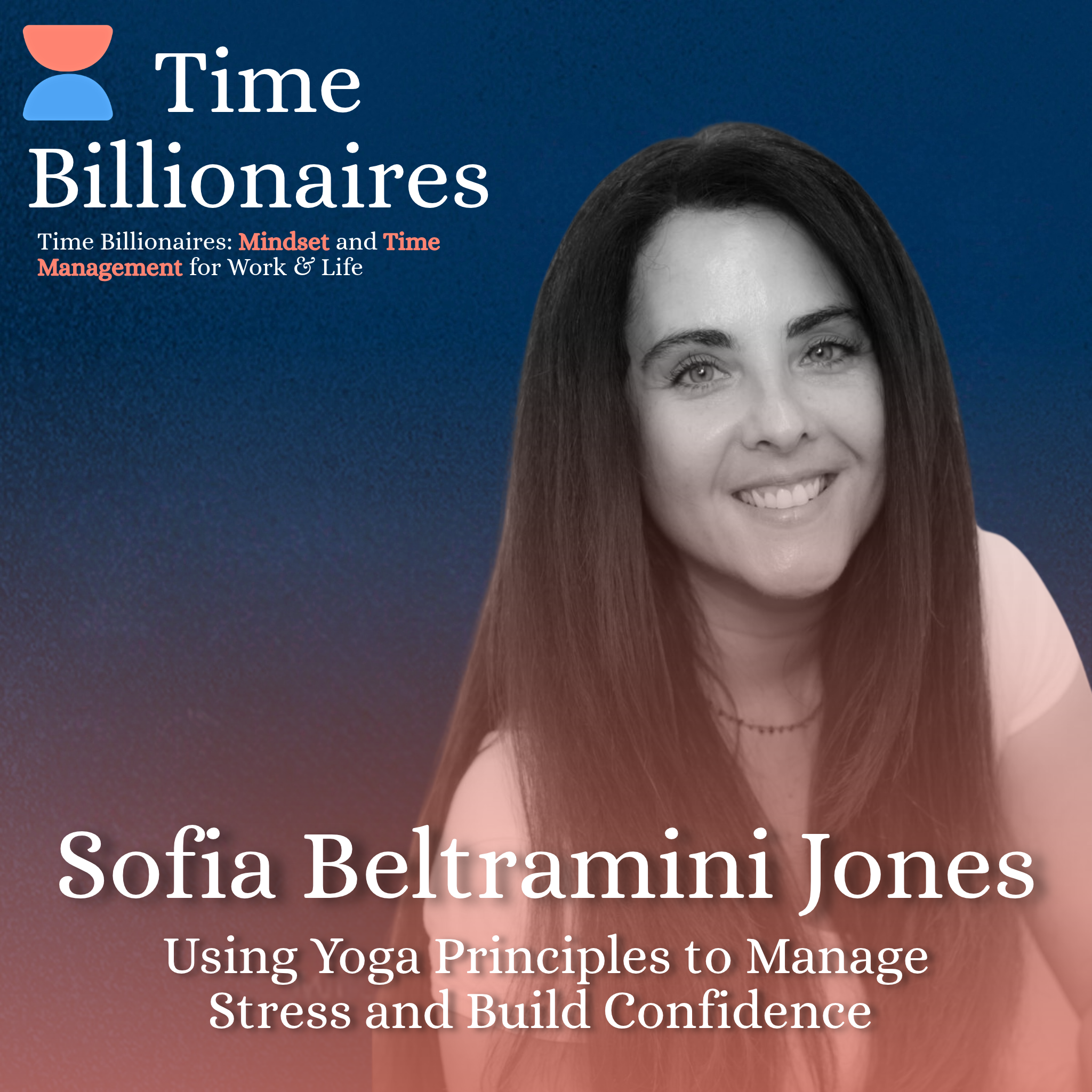
Welcome to today's episode of the Time Billionaires podcast. Our guest today is Sophia Beltramini Jones, the owner of yoga studio Flux Power yoga and a 10 year yoga teacher. She's actually my yoga teacher and I have learned so much from her classes and practice that I thought were applicable to life in general that I was excited that she was willing to share them here. And as I've said before and before we started recording, I think there's a lot of misconception around yoga practices. And what it is, is, especially in the west, we tend to think of it as strictly movement, typically Vinyasa style movement. But there's a lot that applies to everyday life and I'm hoping we could start with that. What's something you learn from yoga that you now apply to your everyday life?
[00:01:51] Speaker A: Probably one of the biggest things I learned from my yoga practice is there's been a lot of things, but the main thing is, you know, a lot of times we go into a class, they're very physical, they're a little bit challenging. And I think that when you can train to do hard things in a safe environment, you become more resilient and your capacity to do hard things off the mat increases. And so I've, that's like the biggest thing that I've learned.
Another really big thing that I've learned personally is a lot of times it's in the small little details that big things happen.
And it's a lot of times in yoga practice we're focusing on those small little alignment cues and, and you're kind of wondering, like, why are we doing this? What's the, you know, what happens after this?
Those little details can lead to big things. And just. Just an example of, like, in life, what would that look like? So if you focus on the small things and just kind of forget about the big things, focus on small things like making your bed, cleaning up after yourself, putting your socks away, your dishes away, those little itty bitty things are training you for bigger things. So, like, if you can't manage those little small things, how can you manage other things? And so on the mat, you're managing those little small things well, that in turn teaches you that you can manage bigger things later on.
And so I'd say those two are big, big ones for me.
[00:03:25] Speaker B: Yeah, I'd agree. And they don't have to look impressive externally. I think about these little moments with my daughter, who's 13 months old, and it doesn't look like much from the outside, but I see her growing and learning and our connection building and her trust in me building and her curiosity building. And that doesn't look like a whole lot of productivity externally. And it's not really about that. Right. You. You've told me that the difference between performing yoga and practicing yoga often comes down to your breath, which really isn't something that anyone watching would see the difference between. And that transformed my practice, as did, really the revelation that the reason we focus on our breath as opposed to anything else, our hands, is because our breath can only be in the present. It can't be in the past, it can't be in the future. So we can't or be stuck in anxiety.
So if we do that, if we just focus on our breath between meetings, we'll find ourselves more regulated.
[00:04:24] Speaker A: Yeah, totally. That's another really big one, actually. I. Breath has changed my life completely. Like you said, it can change a moment. It can change a moment from, like, you just performing, going through the motions. If you actually focus on your breath, it really does bring that moment into more of an experience. You're not performing that moment, you're experiencing that moment.
[00:04:46] Speaker B: There's no limit to where you can do this. Right. I find myself, I was with my daughter in the pediatrician's office, finding myself frustrated by how late we were and thinking, oh, man, nap time's gonna get messed up. If we were this late, they'd make us reschedule and just spiraling. And then when I just focused on my breath, it was fine.
[00:05:05] Speaker A: Yeah,
[00:05:06] Speaker B: this moment is okay. She's not upset. She's not sick. Everything is fine. And that did transform it from rushing through what's next, what's coming, what it took for us to make it there on time and just, oh, this moment is okay. And this is really a tool to unlock something that I didn't have access to before, which was the calm. And you've talked about yoga poses in that way that it's not about performing them to look a certain way, comparing yourself to your neighbor, even comparing yourself to what you could do or wanted to do last week, but it's a tool to unlock something you didn't have access to before. And that intentionality in life, I think, is so important, even in something that feels, quote, easy. Like Shavasana pose is corpse pose. And for those who are unaffiliated with yoga, it basically just means laying there. You're basically just laying there is what it looks like. But there's tools in it, right? There's power in it. I'm curious, like, even something that's simple and easy, what you found in it or what it's unlocked for you?
[00:06:02] Speaker A: Yeah, for me personally, the poses, I guess, for me, they're kind of two different things. For me, shavasana is like just a moment of. Of integration, of a moment to, like, let the residual effects of your practice soak in, to integrate, to come to fruition. And it's that pause. It's that sacred pause that you take when you've done so much. You don't just go about your day and just go quickly. You really let it soak in the poses itself, themselves as well. It's. It's something completely different. For me, like, we're doing. We're in class, we're doing poses, but it's a moment to be present, a moment to just kind of focus on our bodies. Like, if you were to just lay there for a moment and just kind of scan head to toe as you're scanning head to toe. Same thing as we're in our class, we're in our poses, we're kind of scanning our bodies.
You cannot be in the past, you can't be in the future. Like you were saying earlier, you have to be in that present moment. And that's really, really powerful.
The presence, all you've got.
That's when you're most calm. That's when you're most at peace, when you're in the present and not thinking and spiraling in all these other directions. And so for me, that's what the do. They're kind of vehicles to be right here. Right now?
[00:07:18] Speaker B: Yeah. And there's power in the transitions, too. It's not about getting quickly and moving through them to look a certain way. There's power in the transition of appreciating that this is now the time for this practice. And it's not productive to be thinking about your grocery list or anything else while it's happening. So for someone listening, whether or not they've ever taken a class, is there something from yoga they think you think that they can do today that will help unlock something? Lymphatic hops or something I learned from you that come to mind? But anything else? Do you want to explain what lymphatic hops are?
[00:07:51] Speaker A: Yeah, absolutely. That is my favorite.
That's one of my favorite techniques that I use in yoga class. Some people think, oh, this isn't yoga. It's all yoga. It's movement. It's. It's just being present. Moving lymphatic hops in particular. Sometimes I'll start a class that way. It's a super simple technique to just release anything you've been carrying and to really help you come into the present moment and be there for your practice.
But all it is is stand. You know, feet about hip, shoulder width apart, knees soft, and you just sit there and shake, bounce, hop on your heels.
It can look different from body to body, but basically it's just a little bit of a bounce, a little bit of a shake. Something as simple as doing that for a minute or two can completely change your state. It's so powerful.
I do it almost daily.
And one of the things I love, and it's not just with the lymphatic cops, it's not just with shaking and bouncing, it's really with any kind of movement. With yoga, any kind of movement.
There's a big saying that, like, depression hates movement. Sadness cannot touch a moving target. And so it's just the idea of get somewhere and move. I don't care if it's a minute, two minutes, five minutes, whole hour, it's going to be amazing. You're going to feel a million times better. It's going to completely change your state.
[00:09:20] Speaker B: Yeah. And I like focusing on different parts of my body during it. Maybe first my ankles and my shoulders and my fingers and just find that it lets me be even softer. And that's another way to just anchor in the present and get all those benefits.
[00:09:33] Speaker A: Yeah, no, I totally agree. I do the same thing. When I'm doing a little balance or a little shake. I'll focus on one body part at A time. And it's that same concept of like, kind of scanning your body parts, being in tune with how you feel, how, how. How a certain part feels as you're moving it. And it's just really anchoring you into that present moment.
[00:09:51] Speaker B: Yeah, body scans are powerful.
Anything else from yoga that you think people, whether or not they've taken a class, can do today and will get benefit from
[00:09:59] Speaker A: breathing? Breathing is so simple. It's. You can take that anywhere with you.
It just. Same thing, same as movement. It can completely change the state you're in.
There's a few powerful techniques that I really like to include.
I'm sure you've probably done this in class with me, but I really, really like Ujjayi breathing. It's a breath where it's been studied even, and it's been shown to slow your heart rate down. So all you do is breathe through the nose. Super simple. Breathe through the nose, slow down your breathing, and constrict the back of your throat so you can actually hear an audible aspect of your throat. Some people kind of call it Darth Vader breathing.
So literally, if you try right now, just taking a deep breath in, constricting the throat totally brings you into this present moment. I mean, it's so powerful. Do that a few times. See how that feels. It's amazing.
Another thing I really like to do with breath is intentional breathing. So say you kind of wake up, you have a little bit of an ache, a pain, and instead of just kind of carrying that pain, that ache around with you all day, pause for a moment and get intentional with your breath. Find where that pain point is. Say it's your shoulder. Direct your breath, direct your inhale into your shoulder, literally. And then as you exhale, imagine that pain, that ache kind of diffusing out of your shoulder. And you would be shocked. A few rounds of that with a really intentional breath, you'd be amazed at how much better your shoulder would feel. It's worked for me. My experience with it has been amazing. It could be part belief, too. Belief is a huge thing, I think.
But it really does work.
[00:11:41] Speaker B: Yeah, it does. It really does. Yeah. I even like.
So the simplicity of it is something. But there's a lot of different ways to do everything that you just mentioned. And I think that's true of all of the poses that can be part of yoga or not. My favorite usually is just a simple plank pose. And there's a lot of ways to do that. Right? If your arms are different length apart, if you're on your forearms versus up on your hands, if your knees are down or not.
Those are all just engaging. Different things, different focus. And I like the saying that Melissa from Flex also says, just because you can doesn't mean you must. The reminder of what's right for you, you bring up a lot of the different variations of how we do. Any pose can look different day to day, and what's right for us is not always more effort.
[00:12:26] Speaker A: Yep, totally agree.
It's a practice that you can change day to day depending on how you feel, depending on your needs.
Everything can look different for everybody.
A pose for me might look completely different for you, and that is okay. I think that we are now learning that our bodies are so unique that we can tailor each pose, each position, each transition we do to fit ourselves. And that really is the highest form of yoga. It's just understanding your needs, your body, what you need in that moment, and kind of tailoring your practice to that.
But totally agree. It's. It's not a one size fits all.
[00:13:13] Speaker B: No, it's really not. And I've been interested in how many guests we've had who are not traditional yoga teachers or even active practitioners who will bring in yoga practices. As an example, the director of product marketing at Calendly, Julia Farina, was on an episode, and she said, just. Just doing nothing, laying on the ground, looking up at the ceiling, doing nothing. What looks like Shavasana pose to us or corpse pose, marking the death or the end of a practice. And the transition is her favorite way to spend 90 seconds. And there's power in just changing your perspective physically to see what that does. Then mentally.
[00:13:50] Speaker A: No, I totally agree. Sometimes, like, the most productive thing you can do is rest.
I was in a class the other day. I was having a little bit of a hard time, just kind of resting in our final posture. And, you know, instead of struggling through it, I decided to start changing the way I was talking to myself in that moment, just in my mind. And I started telling myself, it's safe to let go, it's safe to rest, it's safe to deepen your breath.
And in that moment, I quickly realized that it's in the way that you talk to yourself that really matters.
If you're on your mat, you're practicing yoga, and your. Your mind is like, oh, why can't I do this pose? Or, why can't I do what my neighbor's doing? Or, you know, why am I not able to relax? You know, you really, in that moment, need to kind of switch up and realize that the way you talk to yourself in your mind is going to become, you know, the way we talk to ourselves. The way we think becomes our actions, and our actions become our character. And so that's super important.
Even in a yoga practice. It's. It's as simple as if you're in a pose, you're struggling. Notice how you're talking to yourself and see if you can change that and see if that changes the experience. And it really does.
[00:15:08] Speaker B: Yeah. It changes your intrapersonal relationship and I think your ability to do things that are important, but also your interpersonal relationships. If you're habitually talking to yourself unkindly, the most of the conversations we have are with ourselves.
[00:15:23] Speaker A: Yeah.
[00:15:23] Speaker B: Well, that resets your baseline for how you talk to the people around you and your partner, spouse, kids, neighbors. None of that is really the goal or is productive versus just accepting where we are, the limitations of it, and maybe even trying to answer that, why can't I do crow pose anymore when I could three months ago? Have I not been as consistent? Good to know. Am I feeling tighter? Good to know. Without judgment of, oh, I'm weak and not trying hard enough.
[00:15:51] Speaker A: Yeah, I agree.
I think that's why it's so important to, like, train these things. How you talk to yourself, how you breathe, how you move on a mat, on a safe. In a safe environment, because you can kind of learn about yourself, you can learn your habits, and then you can apply that off your mat. And that's why, for me, yoga has been such a powerful practice.
It's a rehearsal for life, basically. In essence,
[00:16:21] Speaker B: it is. And it's low risk. It's not high stakes. But I think if we attach too much meaning to how we perform yoga or compare, then it's a really good reminder that we can practice being lower stakes, not pushing ourselves to an unattainable limit. That doesn't make sense. And even not comparing ourselves. I was actually, just before we started recording, talking to a friend of mine. We went to the same school, but not at the same time. So we had a lot of overlapping professors and experiences, but we didn't grow, graduate together.
And he was talking about, man, I just look around at all the people I graduated with, and they're all doing this and they're doing that, and we're 35. And none of that was productive because he's at an inflection point for a business he founded, and none of that is their paths. But saying, oh, man, I don't really want to go to this meeting or this event, because I'm going to have to see these people I graduated with and they're going to ask me how this is going. And none of that is high stakes at all. And how he talked to himself about it changed his interpersonal dynamic with people who just wanted to be supportive and show interest.
[00:17:25] Speaker A: Yeah, yeah, that's, there's no, no need for that, honestly.
And that's the cool thing, just about having a practice as you kind of get to, you get to see that stuff before it really happens in real life, you know, and you get to, you just kind of get to explore yourself and see how you are on the mat and how that can change outside of the mat.
But that, that's a really cool.
It's just a really cool way of getting to know yourself.
[00:17:55] Speaker B: Yeah. And all this sounds small and simple, but it doesn't mean it's not transformatively impactful. And I think that's easy to miss. The solutions that seem simple, we often don't even try because they sound too simple. But if they are that effective, it's a good place to start.
[00:18:12] Speaker A: Absolutely. Totally agree.
[00:18:14] Speaker B: Yeah. Thanks for being here and I'll see you in class Thursday.
[00:18:18] Speaker A: Cool. Yay. Thank you for having me. It was an honor to be here and to share this space with you. It was really nice.
[00:18:25] Speaker B: Thanks for being here.
Thanks for spending this micro moment with me. If you found it valuable, share it with a fellow time billionaire and give us a rating to help others discover the power of micro moments.
For more ways to reclaim your time, check out timebillionaires.org and follow me. Rebecca Shadduck on LinkedIn. See you next time.