Episode Transcript
[00:00:00] Speaker A: When it comes to high achievers, the obstacle isn't usually external criticism, it's usually the negative thoughts. Internal psychological safety is really about creating space in your own mind that helps you kind of feel safe when it comes to taking risks and making mistakes and being imperfect.
[00:00:27] Speaker B: Hey there, billionaire. Yep, I'm talking to you. If you expect to live another 31 years, you're already a billionaire. Not in money, but in the real measure of wealth, time. That's because 31 years is roughly a billion seconds. But most of us waste time in ways we'd never waste money. The currency of time billionaires is micro moments. The 90 second to 15 minute gaps hidden between the structured parts of your day. This podcast is about reclaiming them with quick research backed ideas to help you feel more creative, productive and alive.
Welcome to Time Billionaires. Let's make your next micro moment count.
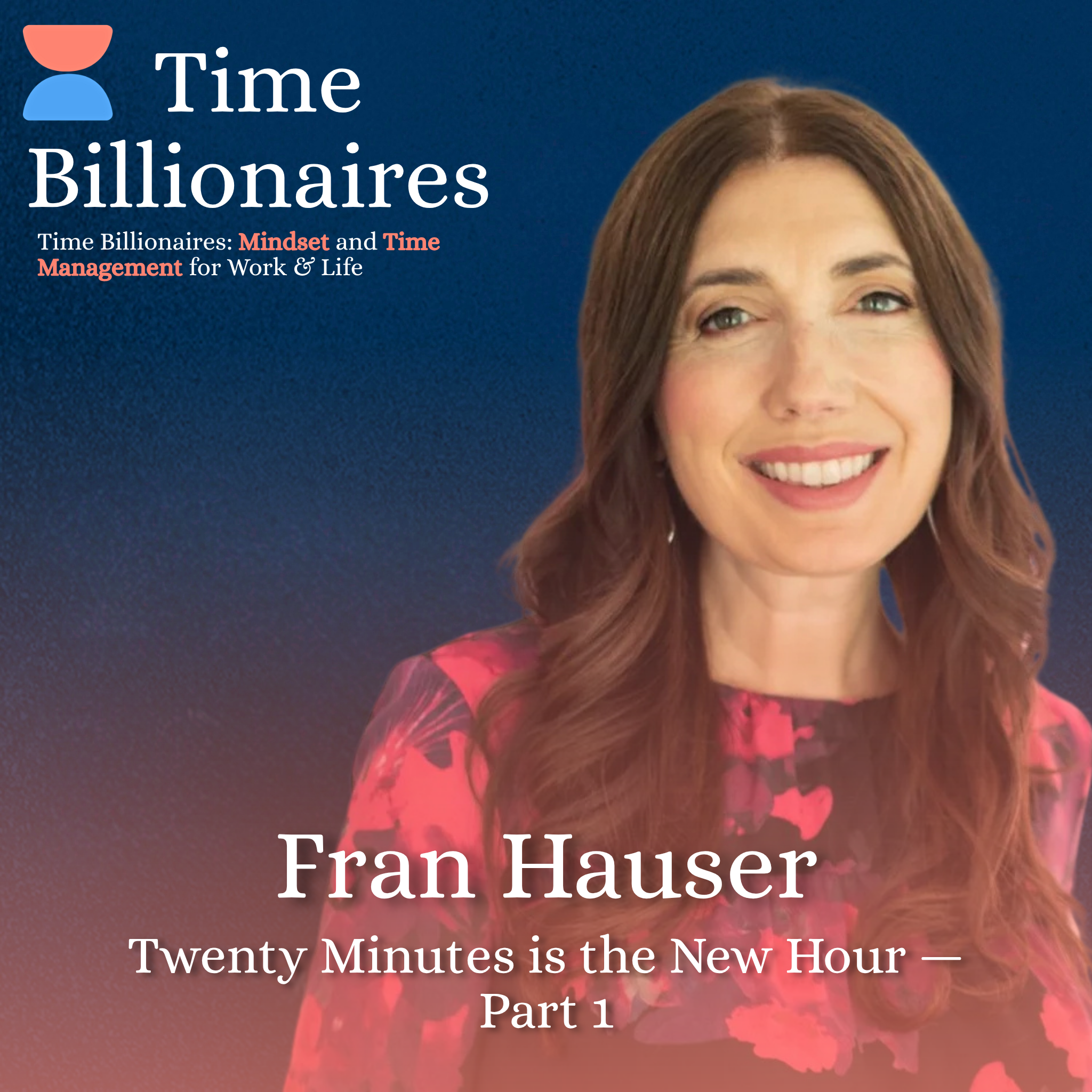
[00:01:05] Speaker C: Thanks for joining today's episode of the Time Billionaires podcast. Our guest today is Fran Hauser, best selling author and career expert who spent her career helping people build work they love without losing themselves in the process. She's a former Fortune 500 executive and now a startup advisor, an investor and independent bookstore owner. Her work focuses on navigating ambition, authenticity, and the small decisions that shape a career over time. Thanks for being here, Fran.
[00:01:32] Speaker B: Hi Rebecca.
[00:01:33] Speaker A: It's so nice to be here. Thank you for having me.
[00:01:35] Speaker C: Thanks for joining us especially to focus on talking about your new book, which I've loved, called 20 Minutes is the new Hour. Obviously it's an amazing title, super relevant to the topic of this show. And you talk about these time thieves, the four Ps that you call time thieves, which are padding, perfectionism, people pleasing, and procrastination.
Let's talk about which one you think is the most misunderstood.
[00:01:59] Speaker A: Yeah, so in the book, obviously I talk about how each one of these, you know, can be harmful when it comes to our relationship with time.
But I also talk about how there is a bright side to each one. And I think the one that's the most misunderstood probably is procrastination. You know, procrastination is not all bad. I think sometimes the best ideas come to us when we're away from our work. You know, when you're in the shower or you're going for a walk and all of a sudden you have that like light bulb moment or that unlock if you're, if you're feeling stuck.
So sometimes when we like marinate on a decision or, you know, we just really sit with it for a little bit, it could Be a good thing.
[00:02:46] Speaker C: Oftentimes my procrastination is I'm afraid of doing a bad job or afraid of failing. So I try to make the situation perfect.
[00:02:53] Speaker B: Right.
[00:02:53] Speaker C: I'm like, I have to have all the parameters. I have to be well rested. I need enough time to think. And that isn't the motion that actually leads to productivity or moving forward. But it's easy to feel like it's in control because if I'm worried about this big macro outcome I can't control. It's easy to feel like I'm controlling more by increasing the odds of doing more by. By perfecting the minutiae that doesn't really matter of how caffeinated I am.
[00:03:19] Speaker A: Yeah, well, and there's. There's a huge connection between perfectionism and procrastination.
Huge. Right. Because if you are in that perfecting mode. Right. And that feeling of like, I need to be in total control, it. It definitely makes it harder to just start. And I talk about messy action a lot. I really love this concept of like, you know, like I said, just like just starting could just be literally like jotting down a few bullet points. And it can be really messy. And then you can turn it into something that's more polished. But better to do that than to be stuck in that inertia where there's like, literally like no momentum.
[00:04:04] Speaker B: Yeah.
[00:04:04] Speaker C: This through line of control for two of the P's I think is powerful and definitely where I get stuck in them. Even probably padding the time you think it takes is a control mechanism. I find my biggest time thief is precrastinating. Doing things before it makes any sense to do them. For the same reason, this sense of control. Oh, ye. Yes. Let's look at all of the school options before my first child's even born. So I feel so in control over this outcome and prepared. And that's not actually productive because so much changes.
[00:04:35] Speaker A: Yeah. I love that you brought up the precrastinating. That's a hard word to say. Doesn't roll off the tongue easily. But.
But, you know, I found when my kids were younger, like, I was always in this prevention disaster mode, you know, like, I was always, like, thinking ahead and trying to solve for all of these problems that didn't even exist yet. And if you think about.
If you think about how much time and energy that sucks up, you know, and that also, like, goes back to like, if you're precrastinating, if you're trying to get ahead of things and you're, you know, trying to Solve for everything even before it happens. That's also fear and it's worry, you know, and when, sometimes when I find myself there, I actually just try to say, like, okay, is there like, one specific thing that I could do right now that has a high chance, like, high likelihood of impacting this future outcome? If there isn't, then I really need to just kind of let it go. Do you know what I'm saying? Like, if there's no, like, action that I could take right now, then I add it to like, a list. I actually keep, like a worry list. You know, it's like my, my list of things that are.
[00:05:49] Speaker C: Your parking lot.
[00:05:50] Speaker A: Yeah. That are, like, worrying me right now. And, you know, I know some people, I actually really love this idea. They actually, like, schedule worry time, like they schedule 15 minutes, 30 minutes on the calendar, like once a week where they go back to that list and they just kind of like, they know it's going to be there waiting for them. So there's something really, like, calming about that, you know, that it's on that list. I can get back to it if I want to.
So that's a practice that could also be helpful.
[00:06:23] Speaker C: Yeah, it really could. And all of this comes to another concept you introduced me to, which is this idea of internal psychological safety, which I had never heard or thought about. Like being safe from your own inner critic. I thought of psychological safety as usually being a team dynamic or even interpersonal. If it's just two people, what is this internal psychological safety look like in practice?
[00:06:46] Speaker A: Yeah, I mean, internal psychological safety is really about creating space in your own mind that helps you kind of feel safe when it comes to taking risks and making mistakes and being imperfect. Right. It's creating this safety in your own mind. And what I think is interesting is that when it comes to high achievers, the obstacle isn't usually external criticism. It's usually the negative thoughts in our own heads. Right.
And the, the practice that I really like when it comes to, like those moments where you're having these negative thoughts is to think about how you show up for your best friend when they're struggling with something. Like if your best friend were to say to you that they were scared about something or they didn't think that they were going to be able to do xyz, you would show up with kindness, compassion, grace, patience, encouragement. So it's directing that same approach to yourself. It's showing up for that voice in your head the way that you would show up for your best friend. And, and then when you can create that internal psychological safety.
I mean, it's, it's really just, just magical in terms of like, just from a time and energy and space perspective, how much more internally aligned you will feel.
[00:08:26] Speaker C: Yeah, no, I think you're right. Being kind to it, I think is so key because of trying to be kind to ourselves.
The first step is being kind to appreciating that that internal self critic is trying to do something helpful for us. Right. It thinks it's protective. Whatever we've trained and practiced, we're continuing to train and practice on how we respond to it. And I found that everything feels high stakes when I feel like I fail. You run at the example of like small failures that really don't matter. Dropping a water bottle, spilling something, These really don't matter. I still was amplifying with the same intensity of big mistakes with big consequences, thinking that was helping me make fewer mistakes, but it was actually just taking up more energy into things that didn't matter and not having the psychological safety to just say this doesn't matter. And I think that one of the most often cited but potentially misapplied or misunderstood is how you do anything is how you do everything.
But so if how you do everything has to be perfect on, well, what if how we do everything is kind and in proportion to what matters? There are certain things that we shouldn't invest a ton of time into that we should be okay with doing mediocrely because they don't matter. But if we have this intensity, if I have to do everything perfectly, A, by what standard? We're probably not defining that very clearly. And B, that comes back to the control and the fear of if we are so focused on these perfect outcomes, just like containing and controlling the input that probably don't matter is amplifying this energy away from the things that actually really do.
[00:10:02] Speaker A: Yeah, I love, I love that. And you know, I love like. And maybe we. It may make sense to talk about the 20 minute mindset, you know, in relation to this. Right. Because we were going there next.
[00:10:17] Speaker C: Oh my gosh, Perfect.
[00:10:18] Speaker A: So the 20 minute mindset is, is really all about acknowledging that you can make meaningful progress in a short amount of time.
You know, it's like acknowledging that I don't really need an hour for that meeting. We could probably get it done in 20 minutes. Right. Or I don't need six months for that project. It's questioning those time defaults, you know, like, just because we've always done it that way, um, we're going to continue to do it that way. And so it's questioning, it's questioning assumptions, it's questioning defaults. And what's really nice is when you give yourself less time, then you're naturally creating these boundaries so that the four P's can't get in. Right. Because you're not going to have time to be a perfectionist. You're not going to have the time to, to people, please or to procrastinate because you're giving yourself a shorter container to begin with.
So. Right. So I think this 20 minute mindset is, you know, it came to me because when I was writing the book proposal, I was working on the chapter on meetings and I was talking about how I shifted from one hour meetings to 20 minute meetings. Not for everything. Right. There's some meetings that require more time, but for office hours, I was actually doing office hours.
I shifted that from an hour to 20 minutes. And as I was writing that, that's when the book title came to me. It's like 20 minutes is the new hour.
And yes, I was speaking in that moment specifically about meetings, but it's really a metaphor for everything.
[00:12:02] Speaker C: It is, yeah. And I'm hearing you say we're basically shifting what we're optimizing for having an hour for something that may take 20 minutes or 30 minutes. We're optimizing for making sure we don't run over.
But that means we're accepting that there will be perpetual waste in that day. And so if we're more afraid of wasting that time and not optimizing it, I think we can say, sure, if we run over that 20 minutes, we can make good use of another 20 minutes.
[00:12:31] Speaker A: Absolutely.
[00:12:32] Speaker C: But we don't necessarily need to perpetually waste half an hour or 40 minutes, which is twice as long as it really would have taken to get done.
I call this in go to market strategy, defining an acceptable miss. Basically the thing that's not a risk to our goals, the opposite of a risk. Something that we all agree if we don't do this, nothing changes. And that's been important for cross functional alignment because I found a lot of the pushback to oh, we can't launch this product this quarter is really because there was this assumption built into sales or to customer success or to marketing that every launch was going to require some big tier one effort and if it didn't have it, that was a miss on them. And so it was less psychologically risky for people to say I can't do it than to say, okay, what would it take? And if you're, if your acceptable miss is we're not being quite as thorough because moving more quickly is the goal, then we're all on the same page. And so what I hear with this 20 minute mindset is the acceptable miss is needing more time in running over the unacceptableness is perpetually padding our days. So they're just inefficient and ineffective.
[00:13:34] Speaker A: Yeah.
Yes. I love that. And you know, padding was really the, the one that kind of surprised me. Like when I was working on the book proposal, I. Padding was not in the book proposal. The original book idea was around three Ps. It was perfectionism, people pleasing and procrastination. And then what happened was after I got the book deal, this bookstore opportunity came to me where the space opened up the perfect space in town. And, and I decided to open the store. I signed the lease in October of 2024 and I decided that I wanted to be open for the holidays. And you know, because it would be such. Talk about a miss. It would be such a miss to not be open during the busiest retail time of the year. That gave me eight weeks to open the bookstore. And typically it takes six months, nine months.
And so that's when this idea of padding came to me because I'm like, huh, like there was huge benefits from me not padding the timeline. Like just giving myself eight weeks forced so much clarity. Like, because it's like, okay, I've got eight weeks. What am I not going to launch with? I'm not going to launch with E Commerce. I'm not going to launch with an event strategy.
I'm not going to enter into vendor relationships with all of the major publishers. I'm just going to work with a distributor at the beginning because it's one contract. Like so it just forced so much clarity. And it also, there was no time or room for perfectionism.
And so even like with the logo, like if I had had six months, I know that I would have asked for like so many more iterations of the logo. Right. But I knew I had eight weeks and the logo was good enough.
And so as I was going through
[00:15:22] Speaker C: that, it wouldn't have made a difference.
[00:15:23] Speaker A: It made a difference.
Yes, it did. And that's when I was like, okay, wait a second, there's actually a fourth P here. And it's padding.
And padding is, is. Is actually so relevant to the 20 minute mindset. Right? I mean, it's like everything that we just talked about, so it's constantly questioning yourself when you give yourself a certain amount of time to get something done when whether it's a task, a a meeting, a project, whatever it is, is, you know, just question yourself. Like, do I really need all this time?
[00:15:58] Speaker C: Yeah, I think that's so fantastic because amazingly, serendipitously from the title, you're reminding me of the Pareto principle, the 8020 rule. With your 20 minute mindset, you're essentially saying, what are the activities that actually make a difference in the success of launching, opening this bookstore? Well, having it open by the holidays is more important than e commerce, for your example, but it's easy to say we need all of it, I need to do all of it and then have 80% of these activities delivering 20 if that percent of the returns. Oftentimes my understanding is it's more like 90 10. Is that so? All of this energy and effort going into activities that don't actually move the needle, but you're basically saying no. Really? Can I force this?
[00:16:44] Speaker B: Part two of this two part episode is coming to you next week.
Thanks for spending this micro moment with me. If you found it valuable, share it with a fellow time billionaire and give us a rating to help others discover the power of micro moments. For more ways to reclaim your time, check out timebillionaires.org and follow me. Rebecca Shattucks on LinkedIn.
See you next time.