Episode Transcript
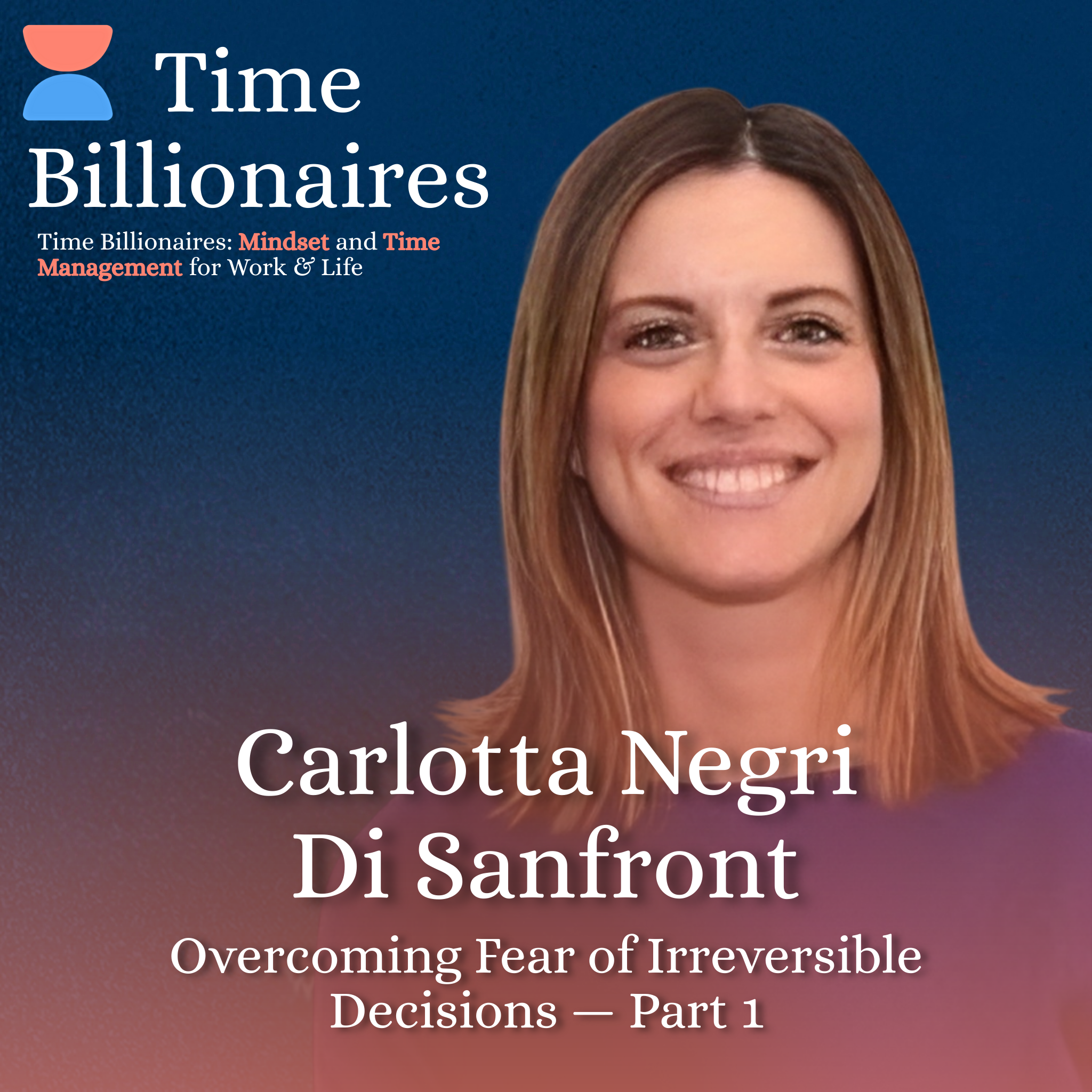
[00:00:16] Speaker A: Hello and thank you for joining today's episode of Time Billionaires. Our guest today is Carlota Nigri, D San Front and she is a career coach and former chief product officer with 15 years of experience in the tech and telecoms industry.
As a senior leader, board member, and working mom, she now helps professionals and organizations navigate the challenges of modern careers with a focus on working parents. Her grounded and strategic approach empowers individuals to thrive while enabling organizations to build more equitable workplaces. Thanks for joining us, Carlota.
[00:00:50] Speaker B: Thank you for having me, Rebecca. I'm very excited to be here.
[00:00:55] Speaker A: I've loved a lot of what you've said and really resonated with me. So one of the things I was hoping you could talk about is that you've led product teams at scale and also coached individuals one on one.
I'm curious if there's a belief about ambition, leadership or success that you wish more people would unlearn and a small shift that they can try this week to replace it?
[00:01:18] Speaker B: Yeah, well, sure.
You know, Rebecca, now that I speak with so many people with, you know, know such a great variety of experiences and belief and values and I have deep and meaningful conversations with them, I'm such in a lucky position where I can actually spot patterns across the human nature.
And what I notice the most is that most of the time a glamorous job title or the team size you're managing or how fast you've climbed up the corporate ladder actually do not matter in terms of success to most people unless those are really aligned with one's values.
And so I think that something to unlearn really is for us to associate success with those big, bold achievements that capture the headlines.
And I would suggest to your audience to then replace it with their own definition of success. But does it really matter to you and why? And it doesn't need to be something particularly grand as long as you own it, as long as that really matters to you, as if it's your own definition of success.
And so you were asking me about a shift and, and I think one thing that I would like to offer is to just take a piece of paper and jot down what you think are your own values, what really matters to you, what comes to your mind, and then have a quick glance at your diary and see whether you are living up to those values, whether you are investing your time to nurture your purpose, your fulfillment. And some people might find out that, yes, there is a strong alignment between the two things.
And some others might realize there's a Big friction or there is a, you know, there's a gap essentially between what matters to them and how they're actually investing their time on.
And if you are in the second camp, then a second field.
I suggest you to think about one thing that you could do differently to then start bringing your own values much closer to the way you are investing your own time.
[00:03:46] Speaker A: Yeah, it's good advice. One of the things that I struggle with with advice like this is that I have my values and core principles outlined. Compassion, contribution and family are my core values. But there's a lot of ways to apply those. And one of the things that I get anxious about is the idea that things that feel like a good, fulfilling, engaging, happy way to apply them in the moment could be irreversible. Right. I have a four month old and if I decide to take a bigger gap to focus on her, there's a lot of ways to apply that. Right. Like going back to work is not necessarily not embodying compassion, contribution and family. And so the decisions that I make now, I worry could be irreversible five years from now or I'll regret an application because I didn't foresee consequences of it.
[00:04:33] Speaker B: Yeah. And, and I think a good way of looking at this is the choices that you made 10 years ago. Did they end up being irreversible or not? Did you have to adapt whether they were good or bad in your life? Were they really irreversible?
[00:04:49] Speaker A: Good question. I would say they were not irreversible. But if I had made different choices, some of the opportunities I have now may not have been the case. So I was a pedal to the metal grind really hard through college, know what you want to do, career person 10 years ago. And I definitely gave up a lot, a lot of things that my peers enjoyed. I didn't really travel much, I didn't socialize much. I worked and that was mostly it.
And I certainly don't regret it.
And a lot of the opportunities I've had since have been because of that. And so it's. It's sort of an interesting balance to your question.
[00:05:24] Speaker B: Yeah. And, and I. It sounds like you are fairly grounded in what's important to you. And it doesn't mean that it's always easy to, you know, stick up to those values and stay on top of those.
But I think over time it gets a bit easier, especially when you have to face a really difficult decision or a compromise or a trade off between those two things.
But it's definitely true. It's the modern Challenge of knowing what you really want and then needing to be financially independent and wanting a successful career but also a great family.
So, yeah, we're not alone on this challenge. I think though, the difference is the mindset that you apply to it.
We will always be making mistakes. I think good mindset to bring into this.
You know, navigating these challenges is really knowing that we are.
We can adapt, we can learn, we can adjust, we will be making mistakes. And from my point of view, those choices are not necessarily irreversible, but also because I made quite bold decisions in my life, so I'm quite used to that ambiguity. But I do appreciate and understand that others might not be that comfortable with ambiguity, with navigating change. Well, and that's why I really love my job. I think that it's always a bit easier when you have a bit of support and having someone that helps you think it through with you, what really matters to you and gives you that kick in the bum to go and do it and will cheer you up and will support you.
[00:07:17] Speaker A: That's interesting.
[00:07:18] Speaker B: It's also very important to have a support network to your point, Rebecca, people that will keep you accountable for your own choices and that will.
Yeah, we'll support you along the way.
[00:07:32] Speaker A: So when you say you've made bold choices, would some people call those risky that you, what do you mean by bold?
[00:07:40] Speaker B: I suppose they were bold in my own definition of what bold means. So other people might be bolder than me. Others might find that absolutely, incredibly bold.
I lived in many different countries.
I've lived more abroad than in my home country.
I know some people that never left their own hometown. So in that way, those were risky decisions.
I switched jobs, careers.
A year ago. I left a secure job, a great job, full time job, because I was searching for greater flexibility, variety, and maybe more purpose as well.
And I don't think that many people might be able to tolerate the ambiguity that comes with it, what that does to your own identity.
I see those shifts as things that add on to my own personality and my own intellect and my own identity.
But some others might just see it as too risky.
[00:08:54] Speaker A: Yes.
[00:08:54] Speaker B: And it's unknown. It's completely unknown what that's going to do for you.
By my own definition of success, I know that I need to do big, chunky, significant things according again, to my own definition of success.
[00:09:14] Speaker A: Yeah, I resonate with a lot of that. And I think one of the things that stands out to me is that it's internal, your measures. I've heard lots of people say, define your own values and definition of success. And I think there's a lot of ways to interpret that. But really you internally are happy with the choices. I think for a lot of people, myself included, and I was just talking to a friend a couple of days ago, the bull swing comes with trade offs we don't foresee. So if you were in this job with a team, with momentum, with et cetera, there's downsides to going out on your own, not having that same team structure. It's hard to predict how you'll feel in the moment. And so what those trade offs are isn't always clear. When you take that swing of. It's easy to take for granted. Oh, I like this structure of having a team and then missing it and not realizing how important it was to your own motivation until you're there.
[00:10:05] Speaker B: Yeah, absolutely. And it, it's so unclear, actually. It's, it's maybe for some people. Why, you know, we take some bold, risky choices because in the end, some people do thrive on that ambiguity and unclear waters.
By all means, I'm not suggesting or recommending that people need to have those big shifts in their lives.
If they don't feel that calling, if there's something that isn't quite working 100% but works 80%, by all means stay there and can work on the 20%. That maybe doesn't bring you all the happiness.
But I think individuals usually tend to know when it's time to take a leap of faith into the unknown and to do something new.
But I don't think it's something that should be pushed or necessarily encouraged per se.
I think there's so much beauty as well in the definition. In the definition of success, which is very personal, which is not always big achievements from a professional point of view or a career perspective.
I think there's a lot that we need to learn around also being satisfied and happy with what we have. And I don't know whether that is a skill set that we are very much taught since we're kids. I think we all, well or, you know, successful. What we associate with leadership or successful people is that sense of overachievement and keep achieving more.
And therefore I think that again, there's. It's important to take a good look at ourselves and knowing when we are pretty much in a good place, even if we're not, you know, taking on big shifts, big moves, big and bold decisions.
[00:12:17] Speaker A: Yeah. What you're reminding me of, actually two books I've read recently. One I'm in the middle of. There's a lot of chemical wiring in this, right? So I'm reading a book right now called the Molecule of More. And it's about how dopamine shapes human evolution, et cetera. And certain brains just tend to be more what the authors call dopaminergic, that there's just higher levels of dopamine than what they call, quote, here and now chemicals. So the chemicals that prioritize and emphasize the here and now. And there's clear patterns of people who are likely to immigrant to immigrate. Immigrants are more likely to be dopaminergic. It's how we expanded on Continent. So they're more likely to start businesses because they think of the potential upside. They're also more likely to be progressive as they vote. And people whose brains just tend to emphasize the here and now, there's chemical wiring to being more conservative, more risk averse, less likely to immigrate. And so it's not even just cultural teachings of what's rewarded. It's just some of our brains are wired to prioritize things differently. And to your point of defining your own version values, definition of success, you can't change how your brain is wired. And so even more than just parents teaching their children certain political ideologies, for example, your brains could be wired similarly to your parents and therefore more likely to follow in the same political values that the brain support. Part two of this two part episode is coming to you next week.