Episode Transcript
[00:00:00] Speaker A: You can hate your job and you can make the best of it. At the same time, do you tend to see a lot of people who come because they are extremely unhappy in their job and they don't know what to do?
[00:00:13] Speaker B: Hey there, billionaire.
[00:00:15] Speaker C: Yep, I'm talking to you. If you expect to live another 31 years, you're already a billionaire. Not in money, but in the real.
[00:00:22] Speaker B: Measure of wealth, time.
[00:00:25] Speaker C: That's because 31 years is roughly a billion seconds. But most of us waste time in ways we'd never waste money. The currency of time billionaires is micro moments. The 90 second to 15 minute gaps hidden between the structured parts of your day. This podcast is about reclaiming them with quick research backed ideas to help you feel more creative, productive and alive. Welcome to Time Billionaires. Let's make your next micro moment count.
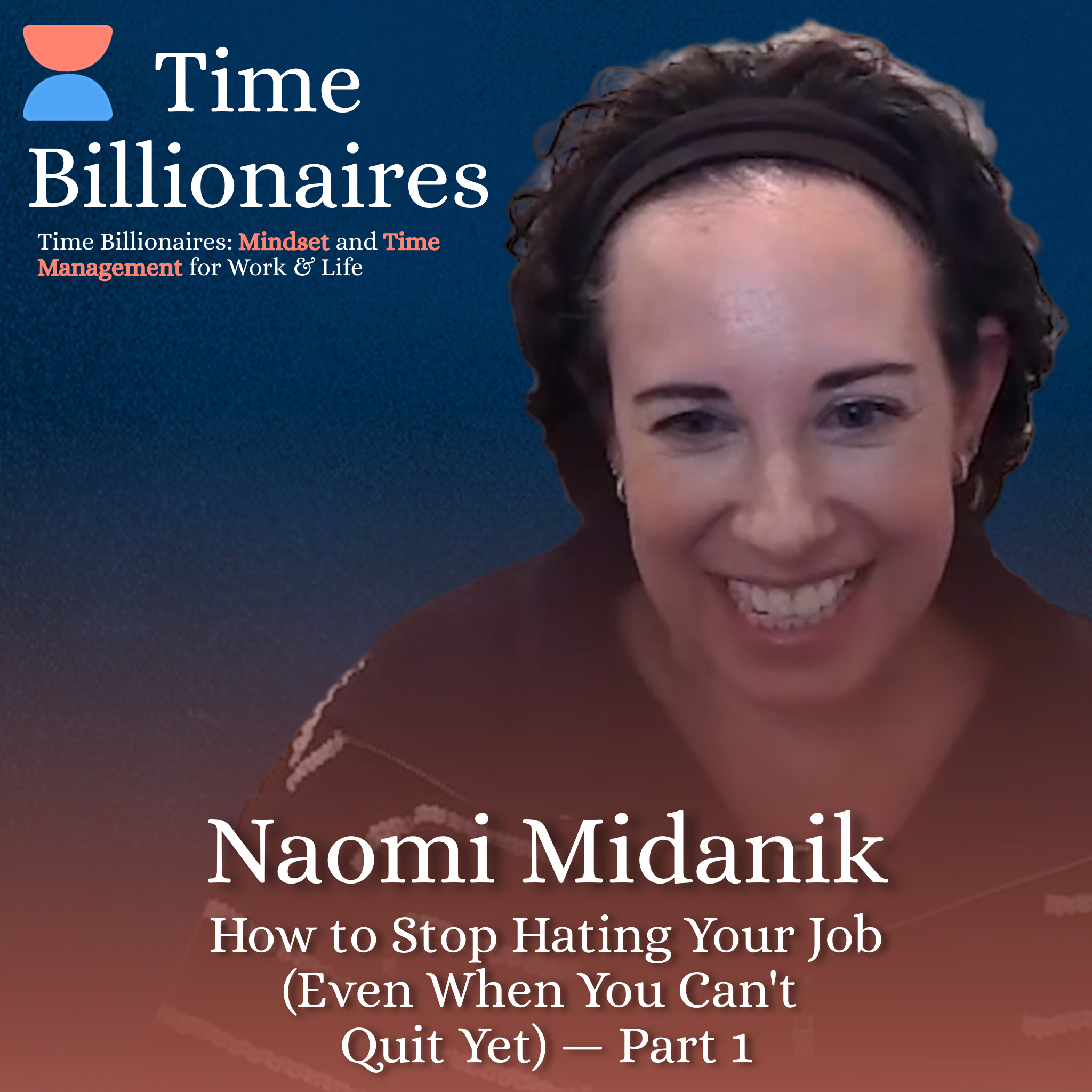
[00:00:58] Speaker B: Thanks for joining this episode of Time Billionaires. Our guest today is Naomi Medanic. And Naomi, please introduce yourself.
[00:01:06] Speaker A: Hi, I'm Naomi. I am a registered psychotherapist practicing out of Ontario, Canada.
And before I became a psychotherapist, I was in the corporate world for 17 years working in marketing.
[00:01:18] Speaker B: You've talked about how to approach a situation or a job that you hate, but you either can't quit or can't really change.
I'd love to start with that.
Yeah.
[00:01:29] Speaker A: So my specialty in my therapy practice is professionals, entrepreneurs and working moms.
And I do tend to see a lot of people who come because they are extremely unhappy in their job and they don't know what to do.
And a lot of the time they believe that the only thing to do is to quit without a job lined up or to get another job.
And on the flip side, there's also lots of people who believe this, but also just aren't in that reality where they have the financial freedom to quit without another job lined up. Or the job market is such that we can't just dream of having a new job and then get it at the snap of the snap of our fingers.
And so it becomes, okay, well, there's actually a way to feel better about the crappy job that you're in so that you can manage better on a.
[00:02:31] Speaker B: Day to day basis.
[00:02:32] Speaker A: And it's not about invalidating our experience of a crappy job. It's not about convincing ourselves that our crappy job that we hate or the boss that we really don't get along with is good.
But it is about practicing the art of radical acceptance.
[00:02:49] Speaker B: And what does that look like? How do you actually do that?
[00:02:54] Speaker A: Yeah, so radical acceptance is a skill that comes out of dialectical behavior therapy. So a woman named Marcia Linehan had developed dialectical behavior therapy.
And radical acceptance is basically the skill of taking a look at our reality, accepting what we can't change, and then reshifting our energy to the things that we can.
So in the case of a bad job, it looks like this waking up and going, okay, I'm in a job I don't like. Here are the things I don't like about it. I don't like my commute.
I don't like my boss.
That's completely valid. It's actually okay for me to think that I'm not going to invalidate that I'm going to validate it.
And here are the things that are within my influence and control to make my day better. So. So I can't change my commute, but I can think about how to make that commute better by whatever that is by listening to podcasts, whatever.
I can't change my boss, but I can figure out a way to promote a healthy relationship with them so that it is more enjoyable for me to be there.
I can't change my day to day work life, but. But I can make sure that I'm focusing my energy on a positive home life.
And the idea here is that we are accepting the things that we can't change and we are focusing on the things that we can.
[00:04:28] Speaker B: Yeah. This is something I personally have a really hard time with.
Possibly as a control freak, possibly as someone who just sort of brute forces my way to effort to try to change things.
[00:04:40] Speaker C: I am.
[00:04:41] Speaker B: You're reminding me of the Navy SEAL mentality of saying good when something bad happens. Which for whatever reason is a form of radical acceptance that focuses on what we can control but just connects better from my brain. I don't like my commute. Or I have a long commute. Good. That means I can call my parents, listen to podcasts. I don't like my boss. Good. It shows me what not to do when I'm in a leadership position for whatever reason. That reframe of just saying good this happened.
[00:05:11] Speaker A: I don't know.
[00:05:12] Speaker B: It validates to me that you can't change it, but also focuses on something good that will come out of it.
[00:05:16] Speaker C: In a way that I just find.
[00:05:18] Speaker B: Personally easier than saying I can focus on what I can control.
[00:05:23] Speaker A: Yeah. And that exercise of going good. And I'm not familiar with the Navy SEALs being, you know, my Canadian self, but that kind of reframe if, if you find it helpful is a great thing to do. And what happens often is that I see people who come to me and they say, I'm trying to reframe. I'm trying to put a positive spin on it. And I can't.
And so for them, that's where I would practice this radical acceptance. Because sometimes that good reframe can be invalidating. I'll give an example.
So I was diagnosed with breast cancer in early 2024. I'm. I'm now cancer free.
But at the time, if someone had said to me, when I said, hey, I have cancer, and I'm really upset about that. If someone had said to me, well, good, because now you can think about how precious life is, I think I would have wanted to punch them in the face. I think. I think I would have found that very invalidating because there are certain things that are just on their face inherently not good. So something like cancer, not good. If somebody got into a car accident and became paralyzed, not good. And so there's something about ensuring that we, if we need it, right, if we need it, that we validate the things that really might not be good and go, you know what? Yeah, that sucks. And, and now I'm going to look at what good can come from it versus going, oh, I'm paralyzed now. Like, good. Now I can. I can learn how to crochet. Like, it. It's there. There's a nuance there.
[00:07:14] Speaker B: There is. And there's a gradient of the types of situations that, that the good exercise works for.
[00:07:21] Speaker A: Yes.
[00:07:22] Speaker B: And not for radical acceptance. Right. So with the same Navy SEAL example, if it would have been our commander just got killed, good is the wrong response to that radical acceptance. What do we do now? How do we shift into respecting their legacy? Doing what we need to would be an appropriate response. Oh, interesting. Yeah.
[00:07:42] Speaker A: Yes, yes. So in that context, the context you just gave or the example you just gave, that would be okay.
That is a tragedy. We're going to grieve that, and we can't change it.
And so where are we going to focus our energy around the things we can change? It doesn't mean that we don't put energy into the grieving process.
With someone who despises their job, it doesn't mean that they're not allowed to talk about how they don't like their job or feel the feelings around not liking their job.
But it's a balance. It's a both things can be true type of thing.
[00:08:29] Speaker B: It is.
[00:08:30] Speaker A: You can hate your job and you can make the best of it at the Same time.
[00:08:36] Speaker B: You're so right. Yeah. You're reminding me of a job I was in that I hated. And I felt such pressure to have this toxic positivity of look at all the good things about it. It's remote, it's prestigious, it pays well, the company's doing well. And I just found myself feeling like there was something wrong with me. Like I wasn't grateful for an opportunity that did check those boxes of being a great opportunity. And I, I found myself one day in the shower just thinking, oh, okay, it's this, it's this. It's that so many people would be happy with this job and then finally following it up with, fine, then one of them can have it because it doesn't make me happy. And that was the shift to what do I actually want to do about this? Which I mean, to the initial question of radical acceptance acknowledges the privilege of being in a position where I could make a pivot and shift from there.
But you've talked specifically about how this emotional numbness can be a quiet signal that something's off long before anything drastic like official burnout hits. And I'm hoping you could talk about how people can connect those dots or figure out this disconnect between where they are and how they want to be living.
[00:09:45] Speaker A: Yeah, and emotional numbness is a tricky one because shows up as the absence of emotions versus emotional intensity. And so when we feel emotions intentionally intensely, we're going to notice it and go, oh my God, I'm feeling so sad, I'm feeling so angry. What should I do about it?
Numbness is the absence of emotions.
And so it's easy for us to miss. And it's why oftentimes people wait until they've hit rock bottom in order to seek help. It's because they didn't notice the time before the rock bottom. And that was likely emotional numbness. And particularly if we're high functioning people. So if we're the kind of people who are high achieving, who always make sure to get their responsibilities done, who continue to show up to work and do a good job and be good parents and all the things but they're not really feeling, it can really go unnoticed because we're still going through all the motions and showing up in our lives.
And so some of the signs to look for with emotional numbness, pay attention. If you are just going through the motions instead of really experiencing what's happening on a day to day.
If you're feeling flat during moments where normally you would be having a reaction. So that could be feeling flat when doing a favorite hobby, or seeing a friend, or even feeling flat when getting reprimanded about something at work if there's some sort of mistake.
Another sign is avoiding reflection time. So doing anything you can to stay distracted so that you don't so that you're not alone with your thoughts can be a sign.
Feeling detached or just irritable could be another sign.
[00:11:30] Speaker C: Part two of this two part episode is coming to you next week.
Thanks for spending this micro moment with me.
[00:11:40] Speaker B: If you found it valuable, share it.
[00:11:42] Speaker C: With a fellow time billionaire and give us a rating to help others discover the power of micro moments. For more ways to reclaim your time, check out timebillionaires.org to and follow me. Rebecca Shadix on LinkedIn. See you next time.