Episode Transcript
[00:00:00] Speaker A: When you're young, you think that every event is a pattern that's going to last the rest of your life.
That's not the case. We think these are patterns, when in fact they're just blips. You are telling your brain something so that your brain starts being aware of what it is that you are becoming or that you are.
[00:00:24] Speaker B: Hey there, billionaire. Yep, I'm talking to you. If you expect to live another 31 years, you're already a billionaire. Not not in money, but in the real measure of wealth, time. That's because 31 years is roughly a billion seconds. But most of us waste time in ways we'd never waste money. The currency of time billionaires is micro moments. The 90 second to 15 minute gaps hidden between the structured parts of your day. This podcast is about reclaiming them with quick, research backed ideas to help you feel more creative, productive and alive. Welcome to Time Billionaires. Let's make your next micro moment count.
Foreign.
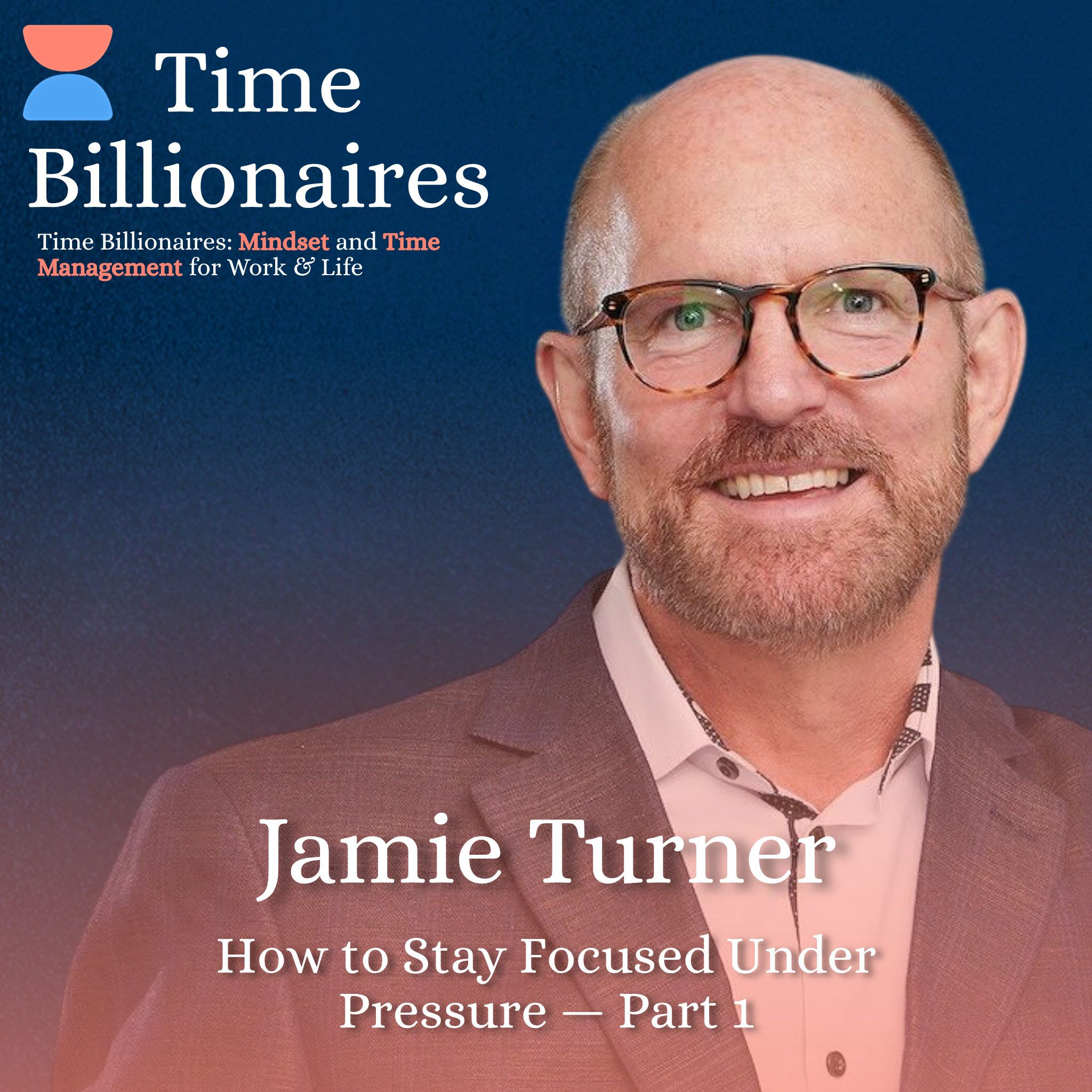
Turner, an author and CNN contributor who teaches at Emory University.
His work on performance and leadership has been featured in the Wall Street Journal, Forbes, and Business Insider. He now helps people move beyond achievement on paper to build a legacy rooted in presence and intention.
And that's where we'll start today. So Jamie, if you could give yourself at 31 and 31 years, is a billion seconds. So when you were a billion seconds old, if you could give that version of Jamie one piece of advice, what would that be?
[00:01:44] Speaker A: It goes back to quit regretting the past and being worried about the future. My father, who I got to work with, he had retired, I started a business and he came out of retirement to work with me. And it was great.
We had a blast. And at age 31, a billion seconds in I was, was in the mix of it. I was trying to run a little company and I would have high highs and low lows because we would win a piece of business and I'd be like, ah, this is going to be great. Then we'd lose a piece of business. And I was like, oh, it's the end of the world. And my dad told me, when you're young, you think that every event is a pattern that's going to last the rest of your life.
That's not the case. The pattern is you have ups, you have downs, you have ups, you have downs. It's like a roller coaster. And a roller coaster is exc because it has the ups and the downs. And so his point was it's not going to always be a down. It's not always Going to be an up. It's going to be a mixture of those things. Very quick, great story out of, I think, the Taoist tradition, which is a ancient Chinese spiritual tradition. And there's a story that goes, a king is thrown out of his kingdom. He's leaving the kingdom because he's been overthrown. He gets to the border of the kingdom, and old man comes up to him, and the king says, I can't believe I lost my kingdom. And the old man hands him a little locket, and he opens the locket, and in the locket it says, this too shall pass. Which is the point I'm trying to make. This too shall pass. The king goes away. He feels a little bit better. This too shall pass. Years later, he comes back into the kingdom to rewin his kingdom. He wins the kingdom back. He's having a big, huge celebration. And he's sitting around having this big celebration, and he sees the same old man man in the corner of the room. And he goes over, he says, sir, you're here again. Why are you here? He handled hands on the locket, and it says, this too shall pass.
The point being the ups, the downs will pass.
It is life is messy. We started this podcast out talking about how messy life is. You just got to go through them and push through them and know that there's a lesson in there somewhere for you to learn how to be a better human being and a more richer, more fulfilled, more better version of yourself as you come out the other side of the challenges that you're facing.
[00:04:10] Speaker B: Yeah, it's so true. Ups and downs are inevitable. They'll pass. But I think it's easy when you're in a down to feel like it's some kind of character flaw or indictment of your abilities that you face this rather than accepting everyone has ups and downs. I have a close group of friends, and we travel together every year. And this past weekend, we were together in Seattle and talking about how differently we feel now than we did earlier in our careers, 10, 15 years ago.
And a friend of mine, one of my closest friends, we grew up together. She sort of embarrassedly talked about how when she was in this job, early on, she had sent an email. She was working for Teach for America. She had sent an email to a donor with a blank attachment. It was supposed to be a thank you letter, and the attachment she sent was just a blank PDF, which all of us now can say is a very minor problem. Not a big deal. It happens. And she said she took the rest of the day off and thought she had to quit her job because it, it was such a terrible representation of Teach for America to this donor. And now we're all laughing about it like, oh, ha ha, how ridiculous.
Then I realized that I have a seven month old and we have a couple of really wonderful part time nannies that we're piecing together their schedules. And I accidentally, once, one time in her seven and a half months of life, had two of them overlap by an hour, where one of them was scheduled till 5, another one got here till 4. And literally as this was happening, I was not home. And I was just thinking, well, I can't do this anymore. Tyler has to do the scheduling. Clearly I'm so inept that I didn't even know. And here I am picking up dinner and the other one could have picked up dinner and it's just spiraling. And I think it's easy to say in the grand scheme of things, whatever mistake you're facing is probably not that big of a deal. If it feels like a massive deal, it's probably a sign that you're attaching meaning beyond it. Right? I was attaching meaning that I do not function effectively and have too much XYZ and just don't do these detailed things well. So when this happened, if I had not told myself these stories that I was bad at executive functioning, it wouldn't have been a big deal. I would have laughed it off, shrugged it off. Someone goes home an hour early and everybody's fine. But because I had attached so much meaning to I am bad at this became a proof of I am a fundamentally flawed person who can't do something as simple as schedule nannies. And it didn't have to be. It was a small mistake that did not matter. My husband didn't care, the nannies didn't care. But I deeply cared because I was saying, look at me as a flawed person and it doesn't have to be. And like, whatever problem it is from an outside perspective probably seems smaller. And so that's why I like this of if you were the protagonist in a movie facing this challenge, what would you want the protagonist to do? Can separate you out. For me, it's a little better than the give your best friend a piece of advice that, like, if the protagonist in a movie, what had scheduled two nannies to overlap by an hour, what would they do? They would send one home and everybody would be fine. And that's what we did. And I just think it's easy to attach so much personal blame to small Problems. To your point.
[00:07:19] Speaker A: I love what you said there about it's attaching larger meaning to a small thing.
Goes back to that idea of we think these are patterns, when in fact they're just bliss lips.
And, and, yeah, and I think we all do that. And one of the things you just did for your listeners is say we're. We're all flawed. It's all messy. It's all. And we all take things way too seriously. There's a great idea called positive ambivalence, which is just going. It's going to be what it's going to be and just have a positive attitude about things. And that is infectious. And then people pick up on it and they lean in on it and things like that. So. So I love your idea of trying to. Trying to give yourself grace. My oldest daughter's going through a lot of challenges right now for a variety of reasons. Things that are just outside of her control. She loses her job, she has a breakup in her life, her dog is sick, all these things.
And I've told her a number of times, give yourself some grace. Life is messy. It's not easy. We're all clunking through it. None of us have it figured out. We're doing the best we can. And as long as you're trying your best and leading with ethics and decency and kindness, you're going to, you're going to be fine. It's all going to sort itself out. So your essential message there was about giving grace to yourself for screwing up the, the, the, the, the, the schedule. I'm not going to give you grace. I'm going to, I'm going to hold you accountable. I think it's just horrible that you screwed that up. It's just terrible. That's a joke. If anybody's listening to this, I'm just kidding. I got a smile on my face when I say that.
[00:08:54] Speaker B: Right. But it's all temporary. Right. And I think the through line of this is the labels we assign. Your daughter going through this hard time can assign labels to herself. Of I can't blank. I always blank. I am blank. But there's no labeling. Right. Saying I'm disorganized and unreliable is not true and not helpful in that situation.
And I think the more we do that, and ironically, the more we cling to outcomes, the less likely we are to get the ones that we want. And this is such a random example, but your story was reminding me of the first time I played pinball. I was like 34 years old with a Coworker. I'd never played pinball, wasn't part of my life.
And that was just like, I didn't care.
And he considered himself a very good pinball player. And like, et cetera, I demolished him. I think I won seven games, but I didn't care. I wasn't that attached to the outcome.
And I just played. I was like, oh, whatever, okay, it goes this way, it goes this way, it goes this way. And he was trying to get the level ups or whatever they are. I didn't care. And it was such a lesson to me that if I had considered myself a good pinball player, I would have really cared about the outcome because it would have attacked my identity to say I lost pinball to somebody who'd never played before. But because I went in there being like, eh, I go this way, oh, I go that way. Okay, that's all it took. And I think for a lot of us is clinging to the outcome. I am somebody who writes good books, is an excellent marketer, is any number of things can really make us cling to the outcomes in ways that are not productive. And honestly, probably focus on the minutia at the expense of the bigger picture.
[00:10:32] Speaker A: Yeah. What you're talking about, and I love it, is this getting into a state of flow. And there are studies that show that when you are relaxed, you will always do better.
The best example of that is they were studying one of the world's fastest sprinters and they watched him and they said, what's he doing differently that everybody else is doing? And they said, oh, he's smiling when he's running. Why he's in a state of flow. This is his natural state, is to run fast. And so he feels that. And the same thing holds true with all the examples you just gave of just getting into that state of flow with pinball. Makes you kind of, you know, sort of relax.
I do play golf occasionally. The best golf game I ever played was when I inadvertently experienced that. I go up to Chicago to play some people up there. We go out on a golf course and I'm like, guys, I'm no good. Like, I took it up, up three years ago. I'm horrible. You know, I'm going to hold you back. They're like, no, no, no, no, you're fine, you're fine, you're fine. I ended up playing better than they did that day. Why? Because I let go of any identity of I'm supposed to be a good golfer. I'm around people who are good golfers. So I'M just going to go along for the ride. And that smoothness and that ease helped me hit the ball more efficiently better. All that sort of good stuff. Same thing with you with a pinball. Same thing with a runner who is just to sprinting and relaxing. And it goes back to that kind of positive ambivalence that it's all going to work itself out. It's all fine. You know, let's not get wrapped up in identities or have to's or must haves or anything like that. Let's just go along for the ride and enjoy it while.
While it's happening. Easier said than done. I will say that. But. But it's definitely a mantra to stay focused on.
[00:12:15] Speaker B: Yeah. And for the sake of the activity itself, Right. Not playing a tennis game or a golf game for the sake of looking like a good golfer, impressing any number of people, winning money for charity. Just the sake of this is fine. Yeah, I know. It's the same thing when I took up tennis of I was so focused on, well, no one's going to want to play with me if I'm not good, so I have to really level up, et cetera. And those were my worst games. And when I said, yeah, let's just go hit the ball around, let's have a good time. Those are my basketball.
[00:12:44] Speaker A: That is good. I got a question for you, Rebecca, if you don't mind my flipping the tables here. But you've got so much wisdom for somebody at, you know, at your stage of life. I'm very impressed with it and I've told you that before. What, what are the things that you do where you get into that zone? Cook, cutting vegetables. I got it. Are there other things that you do where you feel like I'm in that zone? That state of flow, that state of ease?
[00:13:12] Speaker B: That's such an interesting question.
Biking is definitely one. It feels repetitive. And I also feel like I'm not holding anyone else. No one else is held back, et cetera, which, like you said, easier said than done. I think just focusing on the environment, biking, especially outside.
I want to say kayaking, but it's not true. Um, even though it has the same repetitive motions, I often double kayak. And I'm so focused on being a good partner or keeping up that it's not kayaking. I enjoy kayaking, but it is decidedly not kayaking.
Reading is one, I think, where I just love.
I don't know, connecting with someone. Looking at art is another one. Just figuring, wondering what somebody was thinking behind it. I just Bought a Van Gogh book on a whim last week because I didn't realize how prolific he was and how much intention there was behind things like empty chairs for Van Gogh symbolized the person being there.
But I bought it for myself as a reminder as I'm writing this book and working on this podcast, that this is somebody who sold, what, three paintings in his life? But he kept going, he kept painting. And it wasn't about who else would see it or the external validation or ascribing the label of painter to himself. We would call him a painter, but he might call himself a seminarian or pastor at one point. So just those things, I think that really let me, I don't know, feel connected to something.
[00:14:42] Speaker A: Have you ever thought about taking up painting?
[00:14:46] Speaker B: I absolutely never. Not once.
[00:14:49] Speaker A: Well, the reason I bring it up is a positive flaw in me is that I see things people are doing. I'm like, that doesn't look that hard. And then of course you do it and you're like, oh, it's way harder than I thought.
And I would look at Van Gogh paintings and go, that doesn't look that hard. And so I bought a bunch of paints. Very first painting I mimicked was Starry Ignite, which is a famous Van Gogh painting it'd be familiar with. And, and, and I was like, oh, okay, well, maybe there's something to this. And it's a very wonderful passion and you can really get into it and all that sort of stuff. I have a sneaking suspicion you'd be an amazing artist. So cycling, sort of kayaking, looking at art and, and reading again. I know I'm flipping the tables here. What are, what are the favorite kind of books that you love to read?
[00:15:43] Speaker B: I'm really a non fiction person. I love connecting with people's thought process. I mean, there's a lot of fiction that I like too, but there's two things that you've already hit on that I want to.
To pull out. One is use the word wisdom. And I heard recently that you can share knowledge, but you can't share wisdom. That wisdom has to be applied.
And I loved that idea that we all sort of have to go on our own journey and see how we apply things that we've heard or learned because there's nuance for all of us. And this painting example is fascinating to me because I would say I have the diametric opposite. I look at anything and I think I will never be able to blank. I'm like, wow, even I remember. How do the cars stay so straight? In the lines. I don't know if I'm going to be able to keep my car before I learned how to drive when I was maybe nine.
Everything. I ascribe such to a full of, like, overwhelming admiration of. I will never be able to blank. I am never going to be able to get even the name time billionaires. I was like, well, I'm never going to be able to make that a big enough standalone thing, so maybe I should pick a term that already has.
I don't know. So, yeah, like, it's funny how our predispositions totally change how we look at the exact same situation. I'll look at art and think, I will never, ever be able to make anything.
[00:16:56] Speaker A: Like, yeah, it's funny because what we're effectively talking about here is the imposter syndrome, which I thought I didn't have.
And I'm talking to a guy and we're doing. We're accountability partners. And I said, oh, I don't think this, you know, imposter syndrome, I don't have. And he's like, are you kidding me?
And that's what an accountability partner is supposed to do, is like, go, dude, are you seriously saying that? And I. I said, well, yeah, I don't think I have it. He says, you don't charge enough for your services. What do you mean? You don't have imposter syndrome. You're, like, backing into deals that nobody would ever take. And that's imposter syndrome in essence, because you're not saying, hey, I'm good enough to do this. So, again, life is messy. It's nuanced. It's like, how do I take this, that doesn't look so hard idea that I have a natural tendency towards, and then apply it to myself and say, okay, I am bringing value to the table. So I.
I admire you for everything that you've done. And calling it time billionaires, I think, is a great idea. And I'm. If you don't mind, I'm going to ask you another question. Is that okay? Because I know your listeners. Please do as well.
The. Where. What did you study in school? I think I asked you that before, but what was it again?
[00:18:17] Speaker B: Political science and education policy. And was 100% certain between the ages of 12 and 23 that I wanted to work in education policy at the federal level. And I got my dream job working for the Senate, working for the chair of the Health, Education, labor and Pensions Committee and realized, oh, no.
My whole life, I wrote my college admissions essays on the fact that I'd known exactly what I wanted to do.
I didn't like it. It, long story short. So, yeah, here we are.
[00:18:46] Speaker A: Well, it's interesting. No surprise. Effectively, this gets into core essence. And so for all of your listeners, if you, you listening to this, think about who you are at your core essence. And I would suggest, Rebecca, you have a helping tendency. So do I. And it's why, effectively, we were both teachers. So I'm a teacher in the books I write, you're a teacher in the podcast. And you went down a path which was let me into policy work around that. And then of course got into it and went, this is not at all. My late wife Dana, studied, was great with math. She had an uncle who was an accountant. She goes through four years of accounting as a college career, gets out, says, I'll get a master's in it. I'll go ahead and do this. Goes and gets her first job as an accountant with a master's degree, the whole thing. And within a month, she was like, like, boy, did I pick the wrong career. Just because I'm good at math doesn't mean I want to be an accountant. And ended up jumping ship and becoming a real estate agent, which she loved and did. So you're in a similar boat where, you know, again, I'm not trying to tell you about you, but what I'm observing about you is that you have a giving personality and you have a helping personality, and that's part of why you're doing a podcast and the book that you're going to do, because I know you're going to do that book. It's a great idea. And then you went into teaching, effectively teaching policy, and realized that's not my greatest and highest usage. My greatest and highest usage is to share my wisdom and thoughts and ideas with people in a number of different ways. And I apologize up front. I feel like I'm, like, telling you about you.
[00:20:34] Speaker B: What stood out to me about that is that there's infinite ways to interpret the exact same thing. Right? I'm good at math. Could mean I should be an accountant.
I. I told you I didn't enjoy that job. I actually love the people I work with and the work itself, but one of the things I just can't do, I'm kind of a bullish. Why? Why not? Well, why can't I do blank? And so the, the pace that we were held back, the people I work with, I respect tremendously, many of whom are still doing incredible work in ed policy. And I have such Admiration for the work they do. If everyone were like them, it would be fantastic. But I was frustrated by a lot of politics, for lack of a better word, of things that held back just having the impact. And my plan was then to go become a seventh grade teacher. And then life had other plans, but we interpreted the exact same thing differently. And I think the labeling that you just said of you said I didn't have imposter syndrome. Somebody reflected back, you do.
This past weekend I said something about, we're talking about a frustrating situation and I was perhaps giving too much grace to somebody who may not have deserved it, which was frustrating my friends. And I said, well, I have some executive dysfunction, so I get it. And my friend was like, what do you mean? And she was like. I was like, well, I leave my water bottle, the yoga studio, and sometimes I forget where I put my keys. And she goes, that's just human. I do all of that and. But my husband doesn't. He's a very organized person. This doesn't happen to him. And so just labeling.
I don't have good executive functioning for them to say, yes you do, or you're comparing yourself to a bar that isn't realistic is helpful. And then attaching criticism to yourself that you don't deserve all of this is helpful. To label out loud things that we tell ourselves about ourselves.
[00:22:17] Speaker A: I love that idea. And it can work in the positive too.
I'm a big believer in visualization exercises.
There's power in the statement I am and then filling the blank. And we're talking about labeling ourselves in negative ways. I am, you know, not good with numbers, which is something I have told myself all my life. And you know, I, I had people say, stop telling yourself that you're going to be even worse with numbers than you already are. But the point being, 25, 30 years ago, I came across the idea of writing down I am and then filling in the blank blank with what you wanted to become. And at the time that this started happening or I came across this idea, I was a mid level employee at a, you know, companies and didn't amount to much. I was doing fine, you know, but nothing rock star status. And I sat down, I started writing. I am an author who travels the globe helping others improve their lives. I am an author, travels globe helping others improve their lives. I wrote it down 15 times a day. Yes, my hand would get, get achy. Yes, there is something to be said for handwriting. It. I don't know why. I think it's the neural processing that happens. But what happens, and this is scientifically proven, is you are telling your brain something so that your brain starts being aware of what it is that you are becoming or that you are. And for me, having written down I'm an author, yada yada yada, I'm sitting around with a friend of mine and she says, oh, I know somebody who's a acquisition editor or a publisher. And my antenna went up. Why? Because I'd been telling myself I'm an author. So I went, oh wait, wait, wait wait, wait. Who do you know who's an acquisition editor? That's the editor who acquires new, new, new books. And she said, this person? I said, well let's go to lunch, let's write a book together. And so we did, and that was our first book and then it was off to the races. Point being, saying what you are can have both positive and negative. And if we take the down patterns in our life and say I am never going to be any good at xyz, yeah, that's a self fulfilling prophecy. So you got to flip it on its head and say well let's turn that around and say what am I? I'm an author travels go of helping others improve their lives. Okay, cool, well how are you going to prove that? Oh well here's I'll go write a book and then things happen. So anyway, that's the power of I am statements, which I'm a big huge fan of and it sounds like you are too.
[00:24:55] Speaker B: I am. Yeah. Haha. I am. But well you're also reminding me that language is powerful and the value we ascribe to it is powerful. In English we only have one way to say I am. And whether that's a permanent fixed personality trait or a temporary state, I am cold or I am kind. We only have one way to say it. But other languages have multiple temporary and permanent states. In Spanish have two different verbs and they don't mix them up. And so the idea that they could change and be fluid is clear in some languages in how we tell ourselves the stories. So it both shapes our reality and reflects what we're actually hearing back. And so being intentional about what we say I am and how we ascribe it.
Part two of this two part episode is coming to you next week.
Thanks for spending this micro moment with me. If you found it valuable, share it with a fellow time billionaire and give us a rating to help others discover the power of micro moments. For more ways to reclaim your time, check out timebillionaires.org and follow me. Rebecca Shattucks on LinkedIn. See you next time.