Episode Transcript
[00:00:00] Speaker A: If you talk to people who are experiencing imposter syndrome, there are often three beliefs underlying that, and this is what cognitive behavioral therapy calls negative automatic thoughts. One is, I'm not up to this challenge that that I'm facing right now. Another is, I'm not as good as everyone else around me.
[00:00:20] Speaker B: Hey there, billionaire. Yep, I'm talking to you. If you expect to live another 31 years, you're already a billionaire. Not in money, but in the real measure of wealth, time. That's because 31 years is roughly a billion seconds. But most of us waste time in ways we'd never waste money. The currency of time billionaires is micro moments, the 90 second to 15 minute gaps hidden between the structured parts of your day. This podcast is about reclaiming them with quick research backed ideas to help you feel more creative, productive and alive. Welcome to Time Billionaires. Let's make your next micro moment count.
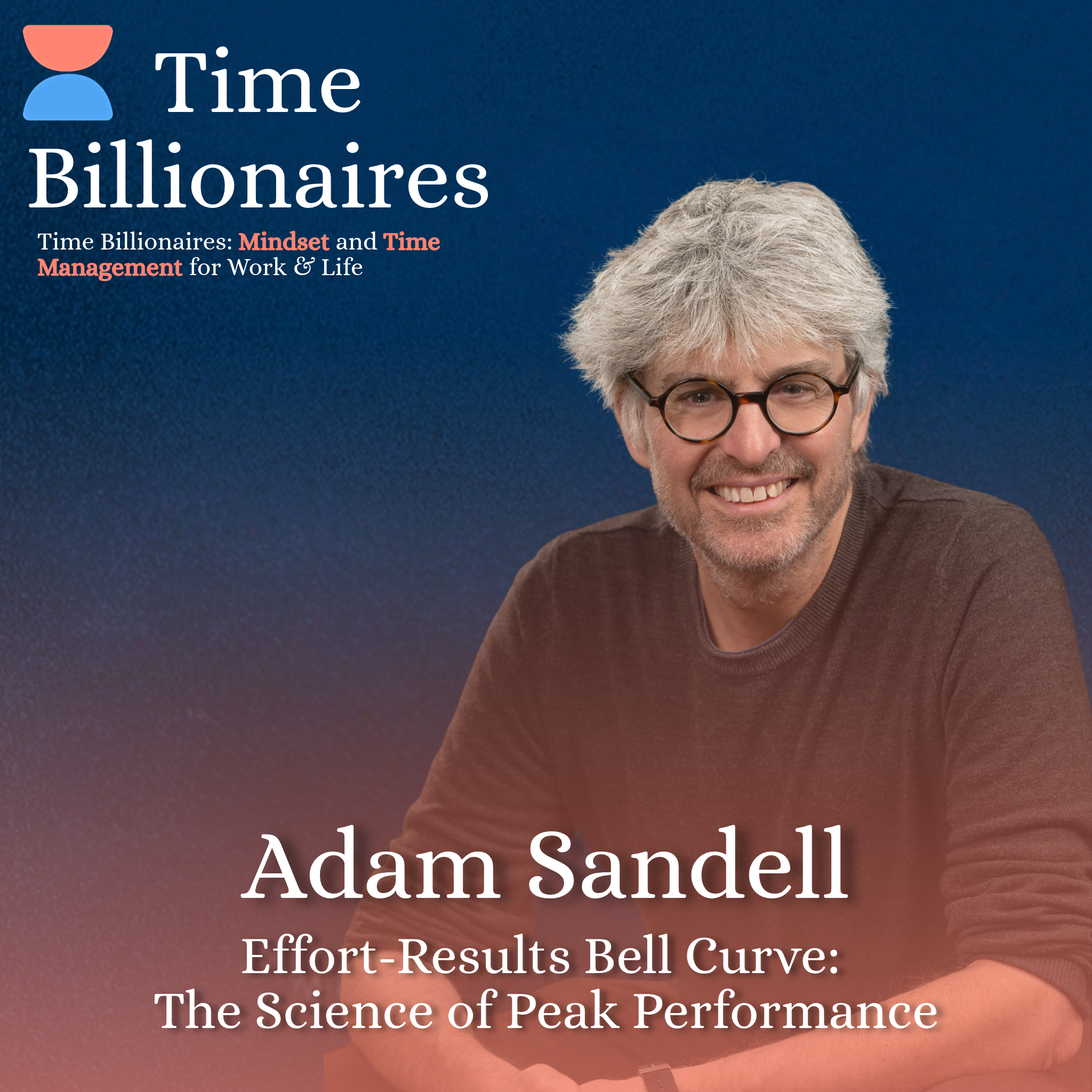
Thanks for joining today's episode of the Time Billionaires Podcast. I'm your host, Rebecca Shadix, joined by Adam Sandel, a medical doctor, clinical assistant professor at the University of British Columbia, and lawyer, writer and speaker. He has worked across medicine and law, including serving vulnerable and marginalized communities. Today, Adam writes and speaks about how people doing work they deeply care about can build better working lives and do more good.
Your background, Adam, is fascinating. A lawyer and a writer and a medical doctor, which is a rare combination that we don't often see. And I found it in your writing to lend itself to very interesting perspective, not limited to introducing me to concepts that I wasn't familiar with, either the concept or the application of, including the effort results. Bell curve, which I found fascinating. Will you explain what that is and then how that shows up for high achievers?
[00:02:01] Speaker A: Sure, absolutely. So talking about a bell curve without being able to illustrate it is probably a dumb thing to do, but let me try and do that. So imagine a graph which has a horizontal axis, which is how much effort you're making, so how hard you're working, how many hours a day or a week you're working, how much effort you're making overall. And then on the vertical axis of that graph, you've got the results of all the effort that you're making. So the short term outcomes, the long term outcomes, not just the quantity of work that you're getting through, but also the quality of work that you're doing.
What does that graph look like? It's a bell curve. And if you think about it, it has to be a bell curve. The harder you work, the more you achieve up to a point and then it's going to start decaying again.
And we all think that we're somewhere on the left side of that curve. And we know that, we think that because we believe that if we push ourselves a little bit harder, we will achieve a bit more.
And in the short term today that might be true. But in fact, a large amount of evidence from a bunch of different perspectives, taking different approaches and in all sorts of different settings consistently tells us that most of us, most of the time are sitting somewhere on the right side of that curve.
And that's not a great place to be.
The interesting thing about being on that right side of your, of the curve is not just that if you decide to push yourself a little bit harder today or this week, you're actually going to achieve less than you would have done if you hadn't done that, but also that if you want to achieve more, if you want to do better, the way you have to do that is going a little bit easier on yourself.
And what everyone says when I explain that, we all know, on some level, we all know that this is true.
But when, when, when we talk about this, everyone's response is, yeah, that's a nice idea. But actually in my busy working life, my busy life outside of work, with all of my responsibilities, there is simply no way of doing that.
And I think that's a mistake. The curve is real.
There are ways in which you can go a little bit easier on your achieve more. And that in fact may be the only way that you can achieve more.
And the answer to this lies in breaks, in being much more disciplined about rest and breaks.
And that means often micro breaks. And there is good evidence that breaks that last for just a few minutes, maybe five or 10 or 15 minutes a day, have a huge impact and a long term impact on both how we perform, but also simply how we feel.
And then the one other, the one other thing I'll say about that is that if you're going to take a break, you actually need to break.
Scrolling Instagram isn't a break, nor is anxiously checking your email to make sure there's nothing in there that you need to worry about.
And you'll know what your breaks are. But for me, it's something like stepping outside and just for five minutes, going for a five minute walk outdoors or reading a few pages of my novel, or finding somewhere to hide, or I can close my eyes and just allow myself to daydream for a few minutes, or having a chat with someone at work. Who makes me feel good, or all kinds of other things, but things that genuinely allow us to switch off and unwind and switch on a part of our brains called the default mode network, which is this vital neural network that allows us to perform optimally and to feel better.
[00:06:02] Speaker B: Yeah, it's brilliant.
So much of what you've said rang true with my experience, my research, and also some prior podcast guests. But it struck me as you were talking that really the definition of productive and the definition of discipline are where this can fall apart or why it feels so challenging.
High achievers don't have any problem being disciplined around working harder, but the discipline around taking structured, intentional breaks isn't one we often think of applying. And you've also talked about truth. The burnout mechanisms sometimes don't come from the workload itself, but our judgment about the workload. And I'm hoping you could say more about that and the beliefs that we carry into our work.
[00:06:47] Speaker A: Yeah, happily.
And this was a, you know, this was a big perspective shift for me as someone who spent especially a lot of the early years of my career teetering near burnout and often very stressed by my work, which at the same time felt really important to me.
You know, you can go back to the Buddha or to Marcus Aurelius and ancient, ancient philosophers who pointed out that when something is troubling us, it's often our reaction to that thing rather than the thing itself that is the biggest problem on a day to day basis. Often the sorts of things that are stressing us are much smaller things when we focus on how we are reacting to it rather than what it is that we are reacting too.
And I have found this really useful in a bunch of different ways.
One of the things, I've always been, for some reason quite confident as a doctor, but when I was working as a lawyer, as a litigator, having come there via a very unusual route, I suffered from a bit of imposter syndrome. And that's a very common thing for a lot of people.
There's a, there's a line of therapy, there's a branch of therapy called cognitive behavioral therapy, which is by far the most evidence based, the most research supported form of therapy for disorders like anxiety and depression. And that is very useful for those sorts of worries and stresses, for feeling like you're not up to whatever this challenge is that's facing you.
If you, if you look at, if you talk to people who are experiencing imposter syndrome, there are often three beliefs underlying that, three beliefs. And this is what cognitive Behavioral therapy calls negative automatic thoughts. One is, I'm not up to this challenge that, that I'm facing right now. Another is, I'm not as good as everyone else around me.
And a third one is, and something awful is going to happen as a result to this project I'm working on to my patients or my clients or to my career.
And in fact, if you are willing to do the work of identifying those negative automatic thoughts that are driving these awful feelings that you're having, and then to ask yourself, or better still, ask someone else, because it seems to be a universal truth of human experience that we're much better at doing this for other people than we are for ourselves.
Ask yourself or ask someone else whether those thoughts that you are having that you won't notice unless you pay attention to them, are really accurate, because they almost certainly aren't. They almost never are.
Someone's put you in the role that you are in because they think you are up to it. And they've made that decision based on objective evidence. And whatever this stress is that you're dealing with right now, that feels overwhelming, that feels as though something terrible is going to happen and you're not up to dealing with it, almost certainly you've dealt with things at least as challenging and maybe more challenging in the past, and they've worked out okay more or less most of the time. And also, if it all does go terribly wrong, blessedly, especially with the passage of time, that rarely is anything like, as serious as it feels like it's going to be in the moment. And in fact, sometimes good things come out of things going wrong.
If you're willing to do that work of identifying what the negative thoughts are that are driving those feelings, and then really evaluate them for accuracy, find more accurate thoughts, and then commit those thoughts. It's a beauty of human psychology that if you fix the thought, you fix the feeling. And if you keep on doing that, if you make this into a habit, if you are willing for this to become just an automatic activity that you do in your head, and it takes only a minute when you are feeling stressed or overwhelmed, you will find yourself becoming a new person. You will start to dissolve those feelings. And you can even get to the point where situations that once stressed you out now are exhilarating because you think, hey, I'm up to this. Bring it on. This is fun.
So I've found that that perspective shift, I'm not going to focus on the thing it is that I'm stressing about until I've finished focusing on how I am reacting to it and trying to optimize the way that I am reacting to it. That's changed my life. That has been utterly transformative in terms of my own work stress, sometimes my own burnout, my own feelings of imposter syndrome in some circumstances.
[00:12:02] Speaker B: Yeah. The weight we put on it I think is important. The significance of any single task, very unlikely.
How good or bad no single task, project moment will make or break our careers. But similarly, the weight that we put on other people's opinions, I think is interesting because to your example, a core tenant of imposter syndrome has to be that we're actually capable. Otherwise we're just self aware. Right. If we think that we're bad at something and we are, that's self awareness. You do a really good job of a nuanced assessment of stress being potentially additive, but not in every situation.
How do you think about telling the difference between stress that helps us grow and stress that is actually damaging and is something we should try to minimize?
[00:12:53] Speaker A: This has been a big perspective shift for me in the last few years, and I want to come back to that. But can I just pick up on something you said a moment ago? Please do, because I think it's such an important point.
At the beginning of what you were just saying, you were talking about how you know the difference between imposter syndrome and self knowledge if you really aren't up to something.
And I just, I think it's important to acknowledge that there is a sense in which we are all amateurs, we're all making it up all the time.
And the more you dip your toes into different areas of life and I've been able to tip my dip my toes into a bunch in various different parts of the world, the more you realize that all of these industries or walks of life that you thought were super skilled and highly trained and very professional are in fact filled with people who are figuring up as they go along. We're all. We're all doing this by the seat of our pants and at the same time projecting confidence and authority. That may not fool us, but it does seem to fool everyone around us.
And I think that. And I think there's also a little bit of a gender dimension here because of cultural expectations about how men and women project confidence.
Which, you know, is. Is why was part of the explanation, it seems to me, for why there is at least some evidence that women experience imposter syndrome at higher levels than men than men do.
When you are thinking, gosh, I really am not up to This, I think it is right for you to evaluate that very carefully and recognize if you may not really be up to it, but also to recognize that actually maybe no one's up to it. Maybe we're all figuring this out and that's okay, you know, that we are none of us quite as expert as we're trying to project to everyone around us.
[00:14:50] Speaker B: Qualifications versus capabilities.
So being qualified for something is often an arbitrary set of credentials that somebody has decided translates to capabilities, but it often doesn't.
[00:15:03] Speaker A: Chronic stress is almost always bad for us.
But acute stress, the sorts of short term stresses that we experience in our lives and our work, can in fact, even if they feel unpleasant at the time, be opportunities for growth and learning. And they can be positive. So that's a simple answer, but there's a subtler answer that is derived from a line of research into what's called mindset psychology, a lot of which comes out of Stanford University in California, which suggests that, and there is a growing body of evidence to back this up, that what stress does to us and what it does for us is in fact going to be a product of what we expect stress will do to us and for us, that our beliefs about stress are what determine the outcome. Let's just think about the sorts of stress that you or I may experience in our work sometime. The kind of acute stress that last forever. But is those situations where we feel, gosh, this is a challenging situation, this is going to be difficult.
Stress mindset researchers distinguish between two sorts of stress mindset.
There is what is called the stress is debilitating mindset. And that's the idea. That's the mindset that we've all encountered. That's the culturally normal belief about stress that we encounter if we read an article about it, or read a book about it, or watch a video about it. And the stress is debilitating mindset tells us that stress is something that is bad for us, that we should avoid, that it will deplete our performance, it'll worsen our performance, and it will hinder our ability to grow and develop.
Stress is debilitating mindset.
But there is another mindset which involves recognizing that acute short term stress is a sophisticated, adaptive, physiological and psychological response to challenging situations that supports us in rising to them.
And this is called a stresses enhancing mindset. And if you have a stresses enhancing mindset, then your belief about stress is, is that it is something that you can use, that it may even make you feel energized and better, that feeling stressed is going to help you to rise to the situation and is going to allow you, enable you to perform better.
And that stressful situations are those from which you grow and develop and learn.
And the research about this tells us that which mind, the mindset you have will determine the effects that stress has upon you. And fascinatingly, the research that has been done into this has used interventions as short as three minute videos, essentially explaining what I've just been talking about to try and switch people from a stress is debilitating mindset to a stresses enhancing mindset.
And the results of those research studies, when people are put into challenging or stressful situations is that they perform better, they have measurably improved stress hormone responses, and they feel better.
And as I say, these are tiny little interventions.
So all you need to do, maybe just to think about what we've just been talking about and recognize that in acutely stressful situations, this might be something to embrace. For example, when I do a speaking engagement in front of a large audience that I don't know, I have gone from, as I prepare to walk onto the stage feeling stressed and thinking, oh God, I'm not quite up to this, I'm still getting nervous about this, to thinking, oh great, this is my body doing what it's meant to do. And my mind, I feel my heart beating, I feel a little bit stressed, I feel hyper alert, I feel a little bit sweaty. This is, this is this response that I want because it energizes me, it invigorates me and it allows me to perform better on the stage. And when I take that mindset, that's exactly what happens. And this is so easy. All you need to do is think about it.
[00:19:55] Speaker B: The choice in that I think is so important and something I don't know if really stood out to you, but stood out to me from your answer is the interpretation of that stress. You went from thinking, oh, I'm not quite up to it, which is almost assuming that stress is a sign of a personal weakness or a failure or an aptitude signal. As if you're thinking, there are some speakers who in this situation never get nervous and that makes them better, versus this is a inappropriate response to the situation.
That is a sign that I'm interested. It isn't a sign, right, that you're not capable. It happens to everyone. Difficulty learning certain subjects isn't a sign that you're incapable. It's part of the process itself. But I think that mentality, that thinking that something is difficult for you, so it's a sign you're not up to it is much more common than we tend to talk about and really an impediment to applying what you just said.
[00:20:49] Speaker A: And I think, you know, and I. When I talk about this stuff with teachers or with parents, people are always responding by saying, gosh, yes. And I find myself having these conversations a lot with kids or with learners who are saying, well, I'm not. I don't feel completely comfortable with doing this. Well, no, you're not going to. If you're going to grow from it. The point is to challenge yourself a bit.
That is, that is how we learn to push, push through that anxiety that maybe you're not up to this and discover, in fact, that you are and that you can develop the skills to deal with it.
And the one other, I mean, the one thing I. The one thing I want to be really clear about here is that there are jobs that are awful and there are situations that are terrible.
You know, stressful stuff happens.
And the big answer, the big correct answer to these crazy lives that we lead is that society and the economy and workplaces ought to be, for most people in the world, a lot better than they are. And I don't want to detract from that at all.
My. My interest here is in, given that that is not the case, is in equipping myself and other people who have busy, stressful lives and may do work that they're emotionally invested in with the skills that allow us to navigate this as best we possibly can in this highly imperfect world in which we're trying to do that.
[00:22:25] Speaker B: Right. Can we actually get into your example, your willingness to pivot that, your willingness to go from an expert who's credentialed, who's graduated, who has work experience into an entirely different field that requires new education, new degrees, new beginner, new beginnings, is not one that many people are willing to do. And so the confidence that goes from that total pivot, knowing, let's say, more about your track and how you knew that you wanted to go from lawyer to doctor, if I have that order correctly. And the willingness to. Then to jump into confidence, I think is very aspirational and can probably teach us a lot.
[00:23:05] Speaker A: Yeah, and there's a few things it could teach you about what not to do, because I've done some pretty bizarre things that haven't always been wise. I mean, just to tell you a tiny bit about myself, I like new adventures. So I'm not someone, I think, who could ever have found one job and stayed in that job for my. For My entire career, I need new challenges and new stimulation. And I think.
And I'm very grateful for having recognized that fairly early in my life and allowed myself to do that.
And I'm also very grateful for having had those opportunities. And I also enjoy studying. So I think one of the reasons I actually went doctor, lawyer, doctor was the sequence. And I think, you know, what happened to me a few years into my early medical career was itching to learn about something new and starting to study law, and that one thing led to another and I ended up working as a lawyer.
I think, you know, if there are messages here, very few people on their deathbeds say, I wish I had taken fewer risks in my life.
So, you know, you're more likely to regret the thing you didn't do than the thing that you did. But I would say, you know, keep doors open if you possibly can.
Don't be afraid to reinvent yourself.
And then we were talking a few minutes ago about stress mindset. Another branch of mindset psychology is growth mindset, which is very familiar to teachers. No. Well, I've got a few. I mean, there's a few points to make about that.
I think you're exactly right.
I think some of this, you know, again, I need to acknowledge for much of my life, I've kind of had a safety net like the consequences for me, if you are poor and have people who are dependent on you and are living in a part of the world where personal security and the economy are precarious, then you may have very, very few choices. So we're talking about what I recognize is a fairly luxurious position.
But I think there are risks that it is worth worrying about, and there are risks that are. Is not worth worrying about. You know, risks of financial devastation or worse clearly are worth worrying about.
Risks of doing something that other people don't do. And what will people think of me for doing that?
You know, I just.
First of all, actually, people will probably not think of whatever it is that you're worrying they will think of you. But the fact that this isn't common to do or that this is unusual, you know, we have only one life. It is not long, but we have a bunch of years in the prime of our life where we can do all kinds of different things. And if you have a hankering to move around the world or do something completely different or stretch some part of you that hasn't previously been stretched, or explore something that you really want to explore, it seems to me it's worth taking some risks to try and make. Make that happen. Because the worst that will happen is you will realize. Likely the worst that will happen is you will realize that that wasn't for you after all. And that's fine. You've now scratched that itch and you can go back to whatever it was that you were doing. But perhaps you will be really grateful for having done that. And it will transform your life. And you won't, when you're old, look back and say, I really wish that I had tried to get better at this or just experimented with that or taken a bit of a risk there.
[00:26:50] Speaker B: Right? And even that learning the skills that we develop could be relevant to something we do want to do. One of my favorite micro moment activities is to think about something I'm frustrated by and just come up with three other ways of doing them. It doesn't have to be a good idea, it's just the reminder that it's not stuck. It can be as simple as I'm frustrated by getting the groceries, the mental load, the time it takes. What are three better other ways to do? It may not implement any of them, but just that reminder that we're not stuck. The scaffolding of that discomfort, I think is all important.
[00:27:22] Speaker A: I love that. I love that idea that. Let's just. Let me just think of three ideas and maybe two of them will be crazy, but maybe one of them actually will.
Maybe I don't need to do this. The grocery shopping today and then just to return back to where we were taking about that willingness to take risks and to reshape things. I think it's so important in working life to remember, remember that the time that we will spend working will be a very substantial chunk of our life.
And so to aim for work life balance seems to me to be a dismal and pessimistic goal because that is to say, well, my life is good and my work is bad, but it's a necessary evil. It's something I have to do. So let me try and achieve a balance. No, we should.
We should aim higher than that and see work as part of our life and for it to be something that we find rewarding and just like the rest of our life. There's plenty we have to do in our life that is a little bit of a grind, but there should also be great bits to that. And the same should apply to our work. There'll be bits that are grinding and there will be bits that are stressful, but this also ought to be something that you feel at least a bit emotionally invested in that you are a little bit proud of that. That is one of the answers that you would give. If someone were to say to you, what is good in your life? One of the things that you should come back with should be, well, my work is one of the things that's good in my life.
So I, I think I, I, I really believe in being ambitious about our work.
And, and if, if it is a grind, if it is entirely negative, if it is entirely unnecessary, evil, a thing that you have to do because of the paycheck, then if you have the luxury of doing this, step back, breathe, give yourself a little bit of perspective, and have a long, hard think about whether there are things that you can do about that. And if that means taking a risk, then maybe that's a risk that it's worth taking.
[00:29:37] Speaker B: Yeah. Brilliantly said. Absolutely. And there are boring, stressful parts of any job.
The idea that we'll quit one and find one that doesn't have any boring or stressful parts is a fallacy that will leave us perpetually unhappy.
My debate team coach in high school always used to say, you can't quit on a bad day. Yep, I know. You just lost. You can quit. You can't quit today, you quit next week. Can't quit on a bad day.
[00:30:05] Speaker A: And you know, even on the best of vacations, you still have to go to the bathroom.
You know, there is, there is. You know, there's always downsides to everything.
The aim is not a life of swinging from one blissful activity to another.
But, but it seems to me that an awful lot of what we do can be meaningful if we, if we choose to construct it that way.
[00:30:28] Speaker B: That's beautiful. Even on the best vacation, you have to go to the bathroom. And as you're saying it, this metaphor for life is coming to mind. The best vacations I've ever had have had the worst or no bathrooms. And the nicest bathrooms are pretty mundane memories now. And that is life.
[00:30:47] Speaker A: Couldn't agree with you more.
[00:30:49] Speaker B: Did you come up with that even on the best vacation you have to
[00:30:51] Speaker A: go to Dr. Come up with it just there? Yeah, it's just. But I think these metaphors, I find metaphors really helpful for thinking about the world.
You know, that those sorts of ideas just kind of remind us that there is. Is always a balance to be struck.
[00:31:09] Speaker B: Thanks for spending this micro moment with me. If you found it valuable, share it with a fellow time billionaire and give us a rating to help others discover the power of micro moments. For more ways to reclaim your time check out timebillionaires.org and follow me. Rebecca Shattucks on LinkedIn. See you next time,
[00:31:30] Speaker A: Sam.